What actually happens when a dog visits
Quick note before the studies: you will see terms like "animal-assisted therapy" and "animal-assisted activity" in this field. The difference matters. Therapy is planned and tied to a specific goal, like reducing a person's agitation. An activity is more like a friendly, informal visit. Research on one does not automatically tell you what will happen with the other.
The largest review in this area looked at 32 studies, most of them involving dogs. Social interaction went up in almost every study that measured it. Agitation and aggressive behaviour improved in a little over half the studies that looked at it. Mood was a mixed bag - up in some studies, unchanged in others. A smaller, more recent review of six studies came to a similar broad conclusion: dogs seem to help as an add-on to regular dementia care, especially when the visit is tailored to what that particular person actually likes.
Then there is the more rigorous end of the research. A review that only counted the strongest study designs, randomised controlled trials, found no clear benefit for daily living skills, depression, agitation, quality of life or thinking ability. One small study did find an improvement in apathy, but with only 37 people in it, that finding needs to be treated carefully rather than as settled. A bigger 2022 review pooling 11 such trials with over 800 people found a real reduction in overall behavioural symptoms, and depression specifically, but again no clear improvement in thinking ability, daily living skills, agitation or quality of life.
Put simply: dogs seem to help people with dementia feel more socially engaged and, for some, a bit better in mood. The evidence for calming agitation or lifting quality of life is far shakier. And there is no real evidence, so far, that a dog visit improves memory or a person's ability to manage daily tasks. That is a fair and current picture of the science, not a disappointing one. Helping someone feel a little more connected and a little less low is still worth a great deal.
Yakimicki et al., 2019 · Zafra-Tanaka et al., 2019 · Chen et al., 2022
Structured visits, not just a friendly dog in the room
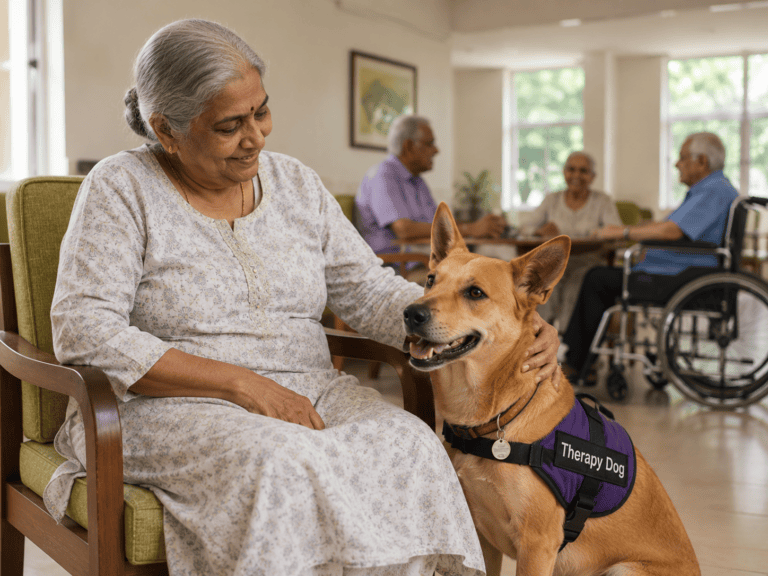
Studies that show a benefit usually describe something more structured than a dog wandering into a room. A trained dog and handler visit on a set schedule, and the person is encouraged to pet, brush or talk to the dog, sometimes as part of a small group session. One well-designed 2021 German study on a psychiatric ward for older adults is a good example. Twenty-six patients were each observed on a day when a therapy dog and handler visited, and on a separate day when only the handler came, without the dog. The person rating each patient's agitation did not know in advance which kind of day it was, which helps keep the comparison fair. Agitation was noticeably lower on the days the dog was there. Two physical measures the researchers also checked, heart rate patterns and a stress-related blood marker, did not show a difference either way.
This detail matters for how you read the research. Where a benefit shows up, it is usually tied to this kind of planned, repeated visit with a trained dog and handler, not to a dog simply being present somewhere in the building. A casual visit is a different thing altogether from a dog trained and handled specifically for this work, and it would be a mistake to expect the same result from both. It is also worth knowing that even in the better studies, almost none of them checked for possible downsides, like a patient becoming frightened, having an allergic reaction, or the risk of a fall around the dog. That is a good reason for any such visit to be introduced carefully and watched closely, not assumed to be risk-free.
What the research does not yet tell us
It would be easy to write this as a feel-good success story. That would not be honest. Many of the studies above are rated as low or very low certainty by the researchers themselves, mostly because the trials are small, use different ways of measuring things, and are hard to run blind - both the patient and the caregiver usually know whether a dog is in the room. None of this means the benefits are made up. It means they should be treated as promising and worth pursuing, not as proven the way a new medicine would need to be before doctors prescribe it widely.
Dementia also looks very different from person to person, from mild memory changes to advanced disease with serious behavioural symptoms. A dog visit that calms one person could overwhelm another, especially someone who is afraid of animals or in a more agitated state. That is why we believe a dog visit should be introduced carefully and watched closely, not offered as something that will automatically help everyone the same way.
Why we are building this slowly, not skipping to it
Elder and dementia care is a setting our therapy dog track hopes to reach eventually, as some of our Cohort 1 dogs mature into facility and therapy roles. But everything above is exactly why we are not rushing there. A dog that sits calmly in a school reading corner is not automatically ready for a psychiatric ward for older adults. The kind of structured, closely watched, individually suited visits the better studies describe is a higher bar than just having a friendly, well-trained dog.
As our dogs and Heroes progress, any future work in elder or dementia care will be built with doctors and clinicians, structured and supervised, and introduced step by step while watching how each person actually responds. We will not present it as a guaranteed source of comfort, because the research does not support that yet. It is a slower way to build this part of the programme. Given what we now know, it is the right one.