Animal-assisted therapy
AAT is a goal-oriented, planned and structured therapy intervention delivered or directed by an appropriately qualified health or human service professional, such as a doctor, nurse, social worker or therapist, as part of their profession. The professional should have relevant preparation for animal-assisted work and stay within their area of expertise. The aim is to support a person's physical, thinking, behavioural or emotional functioning, and progress is measured and recorded in professional documentation.
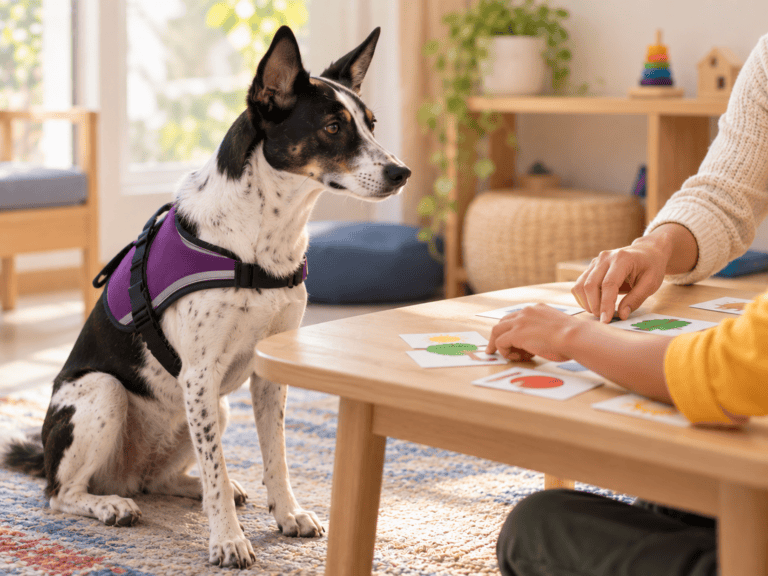
Example: an occupational therapist uses a dog during a session to work on a child's grip and coordination, and notes the result in the child's record. Our post on therapy dogs in speech therapy looks at what the evidence says for one such setting.
Animal-assisted education
AAE is also goal-oriented, planned and structured, but it is led by a qualified teacher or other education professional, and the goals are educational. These may include academic skills, social skills and focus. Student progress is meant to be measured and documented.
Example: a teacher plans reading sessions where a child reads aloud to a calm dog, with a reading goal for each child. We explain how this could work in our post on reading assistance dogs, and look at schools more broadly in how therapy dogs help in schools.
Animal-assisted activities
AAA is generally the more informal form of animal-assisted work. A trained and assessed dog-and-handler team, often volunteers, visits to offer comfort, motivation, educational or recreational benefits. Visits are informal in delivery, but they are not aimless. What they do not usually involve is an individual treatment plan or a requirement to document each person's progress as in AAT. A health or education professional does not need to lead the visit.
Example: a volunteer team visits a hospital ward or a care home for an hour and spends time with whoever wants to say hello. This is also what many people picture when they hear "therapy dog", although "therapy dog" is a loose everyday term and not one of these three formal categories. Our post on why a pet visit is not a therapy dog programme covers where that line sits.
The same dog can be part of all three
Here is an illustration, not a real case. Picture one calm dog and handler at a children's hospital. On Saturday they walk the corridors and say hello to families who want a visit. That is AAA. On Tuesday the same dog sits in a physiotherapy room, where a therapist has set a goal of reaching and gripping and writes down how the child did. That is AAT. Later, in the hospital's school room, a teacher uses the dog as a reading buddy with a literacy goal for each child. That is AAE.
Nothing about the dog changed. The leader, the goal and the record keeping did. It is also why one dog may not suit all three: a dog that enjoys corridor visits may find a busy therapy room tiring, and each setting needs its own assessment of the dog's comfort and welfare.
The quick comparison
| AAT | AAE | AAA | |
|---|---|---|---|
| Who leads it | A qualified health or human service professional | A teacher or education professional | A trained team, often volunteers |
| Goals | Therapeutic goals | Educational goals | Comfort, motivation, education or recreation |
| Records | Progress measured and documented | Progress measured and documented | Documenting individual progress is not a defining requirement |
| Where you see it | Clinics, hospitals, rehabilitation | Classrooms and schools | Wards, care homes, libraries, campuses |
The dog does not decide the category. The structure around the dog does: who leads, what the goal is, and whether progress is recorded.
Sources: IAHAIO, Definitions for Animal Assisted Intervention and Guidelines for Wellness of Animals Involved (2014, updated 2018) | HABRI, AAI definitions summary of the IAHAIO white paper | IAHAIO, Terminology update: Animal-Assisted Services (November 2024) | Pet Partners, terminology
Where the terms get blurry
- Definitions differ. IAHAIO treats AAA as an informal activity and counts it as an intervention only under certain conditions, while Pet Partners lists it as a form of AAI. Always check how a programme defines its own terms.
- The dog's role differs too. A therapy dog visits with a handler and goes home with them. A facility dog works inside one institution through a professional's role. An assistance dog (service dog) supports one person with a disability. See our post on facility dog vs therapy dog.
- Naming is loose. Many programmes say "therapy" for what is really an activity visit. That is not wrong, but it can set the wrong expectations about what a visit can achieve.
- The wider term is not the same as a dog type. For the difference between a therapy dog and a therapeutic dog, see this post.
Five questions to ask any programme
Labels are used loosely, so a few plain questions tell you more than the name does. These are our own suggestions, based on the IAHAIO distinctions, not an official checklist.
- Who leads the session? A qualified professional, or a volunteer handler?
- Is there a goal? For a therapy or education claim, what is it, and for whom?
- Is progress recorded? If a programme calls itself therapy, where is it written down?
- How was the dog assessed? And how often is the dog's comfort and health checked?
- Who is responsible if something goes wrong? Hygiene, bites, allergies and consent should have a named owner.
What this means in India
We have not identified a nationally standardised framework for AAT, AAA or AAE in India, and programmes may not yet be widely available. Terms are often used loosely, so the questions above are a practical way to see what a programme really is.
In practice, the terms matter most to the people who would run such work. A hospital or school considering a dog visit needs to know whether it is planning an activity, which a trained volunteer team can offer, or a therapy or education session, which needs a qualified professional with goals and records. Our post on why a pet visit is not a therapy dog programme makes the same point from the institution's side.
What HeartDogs is doing
HeartDogs is working towards training therapy and facility dogs for structured programmes in India, with the dog, handler and professional roles clearly defined from the start. Part of that is describing each programme by what it actually is, whether an activity, a therapy session or an education programme, and not by whichever label sounds strongest.