Built around one household's actual daily risks
A small but growing body of work has looked at trained dogs living with people who have dementia, most notably a 2023 Australian study that followed 14 people with younger onset dementia matched with trained assistance dogs over two years, interviewing their family carers about the experience. That study documented trained behaviours including responding to a cue to rest its head on the person's lap, fetching the carer, following the person through the house unless told otherwise, finding specific objects such as a phone or glasses, and stopping at kerbs. Potential roles discussed in this area of work more broadly may include:
- Alerting a caregiver. Some programmes may explore training a dog to respond to individually identified cues, such as a person getting up at night or approaching an exit, and alert a caregiver. This should be treated as programme-specific work, not a universally established task.
- Grounding during agitation or confusion. Some families may explore trained contact or interruption behaviours during distress or confusion, similar in principle to the deep pressure and calming tasks used in psychiatric assistance work. The evidence does not yet establish that a particular grounding or deep-pressure task is effective specifically for people with Alzheimer's disease.
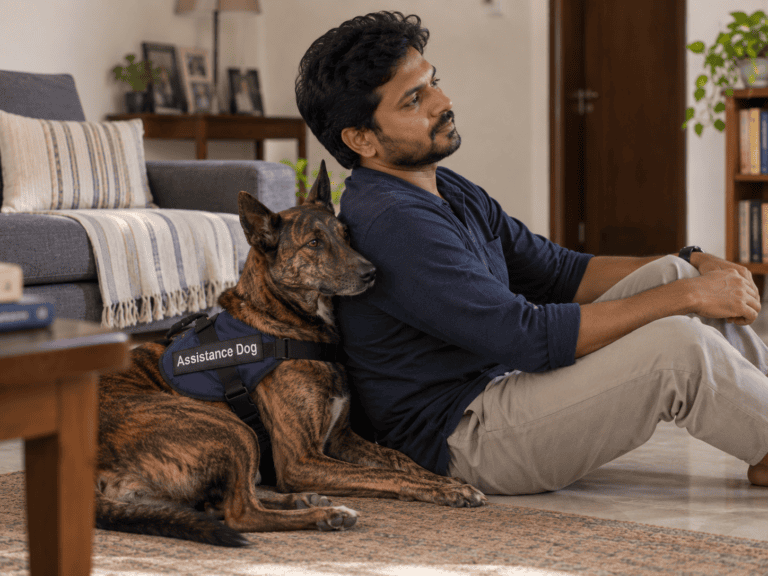
- Providing routine and companionship. In the Australian study, family carers described the dog as part of the household's relationships and daily rhythm, rather than simply as a task-performing tool.
It is worth being precise about wandering specifically. Formal, reliable task training for a dog to physically prevent or reliably stop a person from leaving a home unsupervised is not an established, standardised practice the way guide dog work is. Some individual programmes and families have explored dogs alerting a caregiver when a person approaches an exit, which is meaningfully different from a dog being relied upon to physically stop someone from leaving. Anyone considering this specific task should treat it as an emerging, individually developed approach, not a proven, off-the-shelf solution. A dog should not be treated as a substitute for supervision, environmental safeguards, identification, door alarms, GPS tools or an individualised dementia safety plan.
Marks & McVilly, Animals, 2023 · Exploratory Case Study, Neuro Service Dogs and Dementia Caregivers
This is genuinely early stage work, not a settled field
Unlike guide-dog and hearing-dog work, which have much longer-established programme models and professional practices, dementia-specific assistance dog work does not yet have the same depth of evidence or standardisation. The research that exists is mostly small, qualitative and exploratory, built from interviews with a handful of families rather than large controlled trials. The 2023 Australian study is genuinely valuable, but it studied ten family carers, not hundreds, and it deliberately used qualitative interviews rather than trying to measure a specific clinical outcome. A separate Canadian exploratory case study used three comparative case types, one involving a neuro service dog, one a companion dog, and one no dog at all, alongside interviews with caregivers from those groups. It was exploratory and qualitative, rather than a controlled trial. A 2020 systematic review on this broader topic found no specific studies available for younger onset dementia at that time, which gives a sense of just how recent the 2023 Australian study is as a contribution to the field.
Both studies acknowledge their own limitations and describe perceived or reported benefits alongside practical challenges. That makes the findings worth exploring, but it is not proof that assistance dogs produce clinical improvements for people with dementia. The Australian study specifically found that carers described genuine strain too, including the resources and responsibility involved in caring for a dog on top of caring for a person with dementia, and it noted that support needs to stay in place as the person's condition changes and the dog's role in the family shifts over time.
Alzheimer's changes over time, and so must the dog's role
Dementia is a progressive condition, and a task or routine that works well early on may need to change, or may no longer be appropriate, as the disease advances. This is different from most other assistance dog roles, where the handler's needs are relatively stable over the dog's working life. A family considering this kind of support should think of it as something that needs ongoing reassessment, involving the person's doctor and care team, rather than a fixed arrangement set up once and left unchanged.
Where this fits, and why we are moving carefully
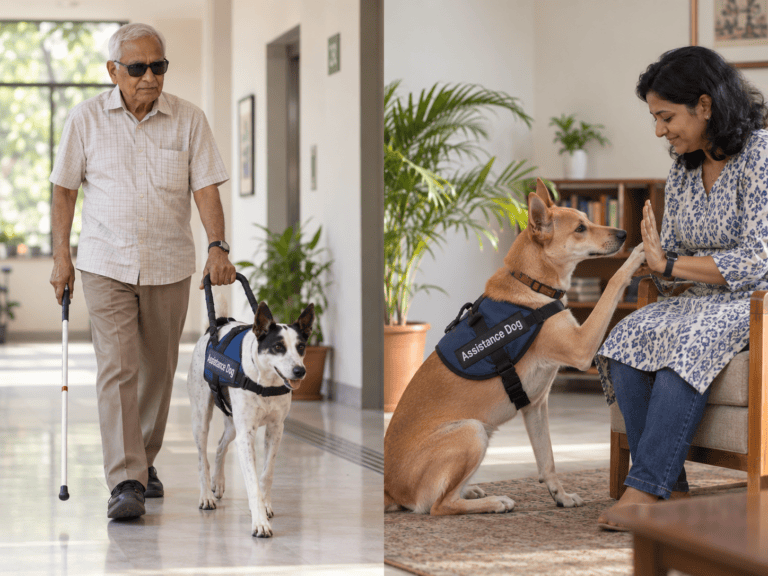
Some of our Cohort 1 dogs are training toward mobility and companionship support for older adults, which may overlap with some needs in families affected by Alzheimer's disease. But we want to be honest: task specific work for dementia and Alzheimer's specifically, particularly anything related to wandering safety, is one of the least established areas in this entire field, and we are not going to claim more certainty than the evidence currently supports.
What we can say is that we take this progression issue seriously in how we think about any older adult support work, since a fixed, one-time training plan does not fit a condition that changes over months and years. As with everything else on this blog, we would rather describe this as a promising, still developing area than present it as a solved problem it is not yet close to being.