What actually happens when a dog visits
Quick note before the studies: you will see terms like "animal-assisted therapy" and "animal-assisted activity" in this field. The difference matters. Therapy is planned and tied to a specific goal, like reducing a person's agitation. An activity is more like a friendly, informal visit. Research on one does not automatically tell you what will happen with the other.
One of the most widely cited earlier reviews, from 2019, looked at 32 studies, most of them involving dogs. Social interaction went up in 11 of the 12 studies that measured it. Agitation or aggressive behaviour improved in 9 of 15 studies, while mood results were mixed. These findings were encouraging, but the studies varied a good deal in design and quality.
Reviews that counted only randomised controlled trials have been more cautious. Another 2019 review of 10 studies, six of them randomised trials, found no clear benefit for daily living skills, depression, agitation, quality of life or thinking ability, and rated the certainty of the evidence as very low. One small study of 37 people did find an improvement in apathy, but that finding needs to be treated carefully rather than as settled. A 2022 meta-analysis pooling 11 randomised trials with 825 people found a reduction in overall behavioural and psychological symptoms, and in depression specifically, but no clear improvement in thinking ability, daily living skills, agitation or quality of life.
A larger systematic review and meta-analysis published in 2026 adds to this picture. Across 59 studies, 24 of them controlled studies with 1,881 participants, animal-assisted therapy was associated with fewer overall behavioural and psychological symptoms, less depression and better cognitive performance. The results varied between studies, and the reduction in overall symptoms did not hold up once studies at high risk of bias were left out. There was still no clear benefit for agitation, quality of life or daily living activities. Much of this research covers animal-assisted therapy in general, not one standard therapy dog programme.
Put simply: animal-assisted therapy looks promising, especially for social engagement and, for some people, mood. The evidence for calming agitation or lifting quality of life is far shakier. The evidence does not yet show a reliable improvement in memory or in a person's ability to manage daily tasks, although newer reviews have found possible short-term effects on thinking that need stronger research to confirm. That is a fair and current picture of the science, not a disappointing one. Helping someone feel a little more connected and a little less low is still worth a great deal, but it should not be promised as a guaranteed outcome.
Yakimicki et al., 2019 · Zafra-Tanaka et al., 2019 · Chen et al., 2022
Structured visits, not just a friendly dog in the room
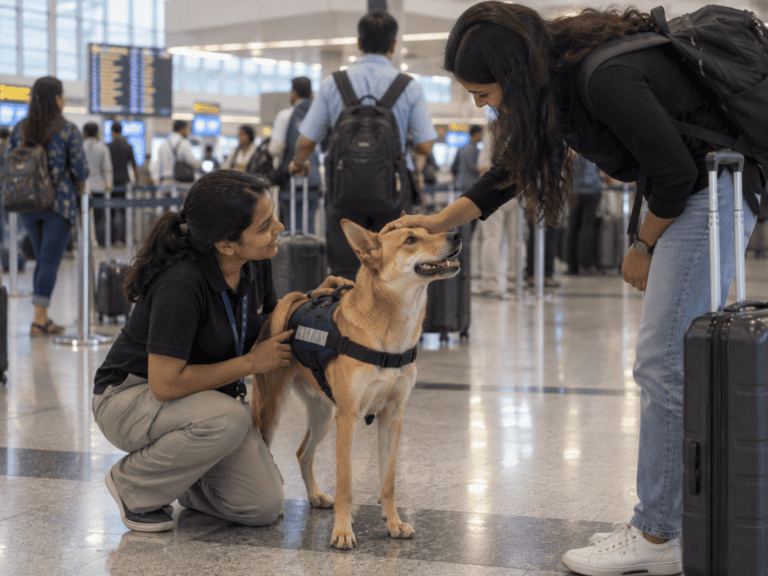
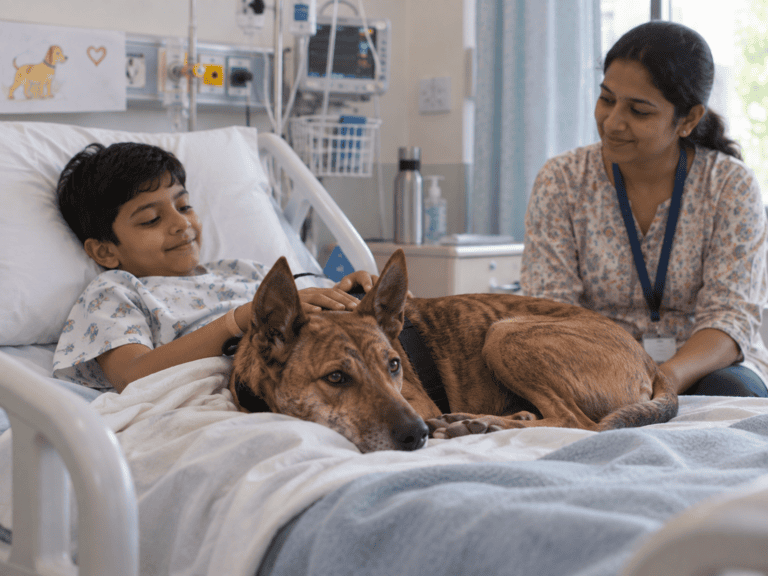
Studies that show a benefit usually describe something more structured than a dog wandering into a room. A trained dog and handler visit on a set schedule, and the person is encouraged to pet, brush or talk to the dog, sometimes as part of a small group session. A small controlled study published in 2021, on a psychiatric ward for older adults in Germany, is a good example. Twenty-six patients were each observed on a day when a therapy dog and handler visited, and on a separate day when only the handler came, without the dog. The person rating each patient's agitation did not know in advance which kind of day it was, which helps keep the comparison fair. Agitation was noticeably lower on the days the dog was there. Two physical measures the researchers also checked, heart rate variability and serum brain-derived neurotrophic factor (BDNF), a protein involved in neuronal function, did not show a difference either way.
This detail matters for how you read the research. Where a benefit shows up, it is usually tied to this kind of planned, repeated visit with a trained dog and handler, not to a dog simply being present somewhere in the building. A casual visit is a different thing altogether from a dog trained and handled specifically for this work, and it would be a mistake to expect the same result from both. It is also worth knowing that even in the better studies, adverse effects were rarely reported or systematically checked, such as a patient becoming frightened, having an allergic reaction, or falling around the dog. That is a good reason for any such visit to be introduced carefully and watched closely, not assumed to be risk-free.
What the research does not yet tell us
It would be easy to write this as a feel-good success story. That would not be honest. Many of the studies above are rated as low or very low certainty by the researchers themselves, mostly because the trials are small, use different ways of measuring things, and are hard to run blind - both the patient and the caregiver usually know whether a dog is in the room. None of this means the benefits are made up. It means they should be treated as promising and worth pursuing, not as proven the way a new medicine would need to be before doctors prescribe it widely.
Dementia also looks very different from person to person, from mild memory changes to advanced disease with serious behavioural symptoms. A dog visit that calms one person could overwhelm another, especially someone who is afraid of animals or in a more agitated state. That is why we believe a dog visit should be introduced carefully and watched closely, not offered as something that will automatically help everyone the same way.
What a careful visit has to handle, and who decides
Most of the studies above say little about harm. Adverse effects were rarely reported or systematically checked, so the research cannot tell a care home how often things go wrong or what prevents it. The main infection-control guidance for animals in healthcare, from the Society for Healthcare Epidemiology of America, was written for acute-care hospitals and ambulatory facilities. It says it is not intended to guide the management of animals in nursing homes or extended-care facilities.
That leaves each care setting to work out its own rules. The lists below are our view of reasonable minimums, drawn from how a visit would have to work in practice. They are not a clinical protocol, and the care home's own doctors and infection-control staff should have the final say.
The dog and the handler
Dementia can bring sudden movements, loud voices, unsteady grabbing or a tight hug. A dog that is fine in a school reading corner may not cope. The handler matters as much as the dog, because they have to watch the dog's stress signals and the resident's mood at the same time.
- The dog stays calm with sudden movements, raised voices and clumsy or tight touch.
- The dog is comfortable around walkers, wheelchairs, drip stands and floor mats.
- The handler can move the dog away or settle it at once, and knows the dog's early signs of stress.
- The dog is healthy, clean, parasite-treated and vaccinated, including against rabies, with records the home can check.
- Visits are short and the dog gets proper rest between sessions.
The person
The better studies describe visits tailored to the person, and that starts with asking whether this person wants a dog near them at all. Fear, past bites, allergies and family views on dogs all count, and in some Indian families dogs carry cultural or religious meaning that has to be respected.
- The person has no known fear of dogs or history of being bitten.
- No allergy, asthma, open wound, skin condition or weakened immunity that makes contact a problem.
- Their own wishes are asked, and where they cannot give consent, a family member or guardian agrees.
- Their family's views on dogs are known and respected.
- Staff know if the person tends to grab, strike or become agitated when touched.
- Fall risk and mobility aids have been thought through before the dog comes close.
The setting
A visit is a small programme with someone responsible for it. Without that, a problem has nobody to go to and nothing to learn from.
- A named person at the home is responsible for the visit.
- Hand washing happens before and after contact with the dog.
- Dogs stay out of food areas and away from clinical procedures.
- The space is clear of clutter and trailing leads.
- Incidents, however small, are written down and reviewed.
- There is an agreed way to pause or stop the visits.
Rabies, and why families in India will ask
In 2016, the World Health Organization cited estimates of 18,000 to 20,000 human rabies deaths a year in India. It also said the true burden is not known, because rabies is not a notifiable disease there. Families and care staff are right to ask about it. A visiting dog should have a current, documented rabies vaccination, and the home should agree with its doctor in advance what happens after a bite or scratch, including first aid and who is called. We are not giving medical advice here. That plan belongs to the clinicians.
SHEA guidance on animals in healthcare facilities · WHO, Eliminating rabies in India, 2016
Dementia care in India, and where dogs fit
The Alzheimer's and Related Disorders Society of India (ARDSI) projected in its Dementia in India 2020 report that about 5.3 million people over 60 in India would be living with dementia in 2020. Estimates vary between studies and methods, so treat any single figure as approximate. A later national study, the Longitudinal Ageing Study in India, estimated dementia prevalence at 7.4% of adults over 60, or about 8.8 million people. The same report describes the physical, emotional and financial strain on caregivers, and estimates what caring for a person with dementia costs a household each year: roughly Rs 29,000 to Rs 96,000 in rural households and Rs 66,000 to Rs 3 lakh in urban ones, based on 2019 figures. It calls for better support for caregivers.
Against that background, we have not identified any national standard or guidance for animal-assisted therapy in care homes or dementia wards in India, and we have not identified published Indian trials of dog-assisted interventions in dementia care. Everything in the research above comes from other countries. That does not mean it cannot apply here, but it cannot be assumed to. Attitudes to dogs in hospitals and care homes, infection control, allergies, fear of dogs and the consent of families would all need to be worked through before a visit programme could be offered safely.
So for India, the useful question is not whether a dog can help someone with dementia. It is what a safe, structured, properly assessed visit would look like in a particular ward or care home, and who would be responsible for it. That is the question we would want to answer first, with clinicians, before offering anything to families.
Why we are building this slowly, not skipping to it
Elder and dementia care is a setting our therapy dog track hopes to reach eventually, as some of our Cohort 1 dogs mature into facility and therapy roles. But everything above is exactly why we are not rushing there. A dog that sits calmly in a school reading corner is not automatically ready for a psychiatric ward for older adults. The kind of structured, closely watched, individually suited visits the better studies describe is a higher bar than just having a friendly, well-trained dog.
As our dogs and Heroes progress, any future work in elder or dementia care will be built with doctors and clinicians, structured and supervised, and introduced step by step while watching how each person actually responds. We will not present it as a guaranteed source of comfort, because the research does not support that yet. It is a slower way to build this part of the programme. Given what we now know, it is the right one.