Built specifically around three conditions, not psychiatric disability broadly
One of the most widely cited psychiatric assistance dog task lists comes from the International Association of Assistance Dog Partners, with an original task list authored by Joan Froling in 1998 and subsequently updated over the years. The list is explicit about its own scope: it was developed specifically for people whose disability comes from panic disorder, PTSD or depression. This makes it an important historical reference point, but it was never intended to be a comprehensive framework covering every psychiatric condition equally, even though the broader idea of a "psychiatric assistance dog" gets applied more widely in everyday conversation.
IAADP, Tasks for Service Dogs for Persons With a Psychiatric Disability
A rare look at actual owners and actual tasks used day to day
A 2019 peer reviewed study, one of the few to actually survey psychiatric assistance dog owners directly rather than describing tasks in the abstract, found that participants reported a range of underlying diagnoses: depression in 84 percent of respondents, generalised anxiety in 60 percent, social anxiety in 61 percent, PTSD in 62 percent, and panic attacks in 57 percent, with many people reporting more than one condition. The tasks these owners reported their dogs performing, in order of how commonly they were reported, included:
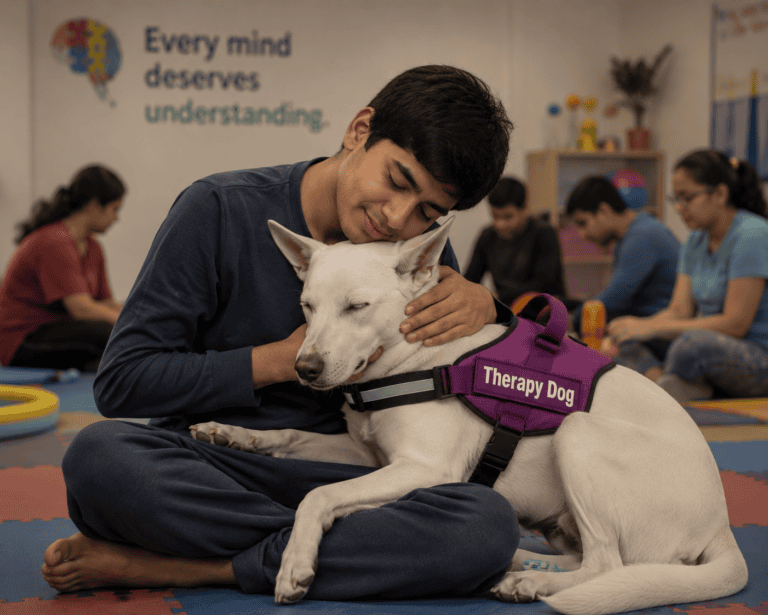
- Reducing anxiety through tactile stimulation, such as the dog leaning against or resting on the person, reported by 94 percent of owners.
- Nudging or pawing to bring the person back to the present moment, reported by 71 percent.
- Interrupting an undesirable behaviour before it escalates, reported by 51 percent.
- Maintaining constant physical body contact, reported by 50 percent.
- Deep pressure stimulation, similar to what we described in an earlier FootNotes piece, reported by 45 percent.
- Blocking contact from other people in a crowded or overwhelming space, reported by 42 percent.
The same study also reported changes in healthcare use: 46 percent of owners said their use of psychiatric or other healthcare services had decreased, 30 percent said it had increased, and 24 percent said it had not changed. Participants who reported decreased use mainly attributed this to fewer suicide attempts, hospitalisations or medication requirements, while those reporting increased use mainly described being better able to attend appointments. These were self-reported associations, however, not evidence that the dog itself caused those changes. Both outcomes are worth taking seriously regardless, since an increase in appropriate healthcare use is not a failure, it can be exactly the kind of support a dog is meant to provide.
Lloyd, Johnston & Lewis, Psychiatric Assistance Dog Use, Frontiers in Veterinary Science, 2019
Conditions named often, but studied much less
Bipolar disorder, obsessive-compulsive disorder, schizophrenia and other conditions are regularly named alongside depression, anxiety and PTSD in general descriptions of psychiatric assistance work. Some structured dog assisted intervention research involving schizophrenia and related disorders has reported potentially beneficial effects, but that research generally concerns broader dog assisted programmes rather than individually trained psychiatric assistance dogs performing specific, disability mitigating tasks for one person. That distinction matters. We would rather say plainly that the evidence base for this whole field is limited overall, and it is especially sparse for condition-specific task effectiveness outside the areas that have received the most research attention. Anyone considering this kind of support for a less studied condition should treat it as a reasonable, individually developed approach worth discussing with a mental health professional, not an established category with the same level of evidence as the better-studied areas described above.
Why we stay close to what the evidence actually supports
Psychiatric assistance work, including tasks relevant to the conditions we have discussed here and in our earlier pieces on PTSD and anxiety, is one of the directions some of our Cohort 1 dogs are training toward. We think it matters to be specific about which conditions this kind of work actually has real evidence behind, rather than treating "psychiatric assistance dog" as one uniform category that works the same way for every diagnosis.
This is also a reminder that a mental health professional, not a dog trainer or an organisation like ours, is the right place to start for anyone wondering whether this kind of support could genuinely help their specific situation. We can train a dog to perform a task well. We cannot, and would not try to, diagnose which conditions that task will actually help.