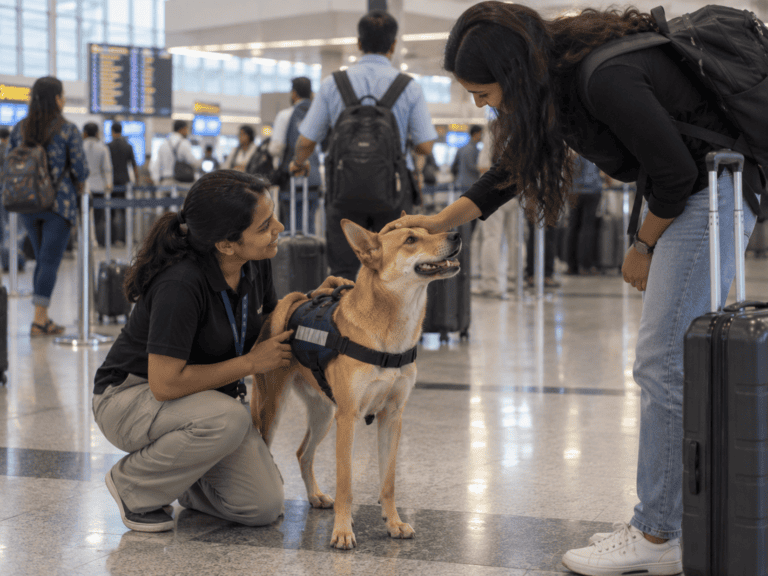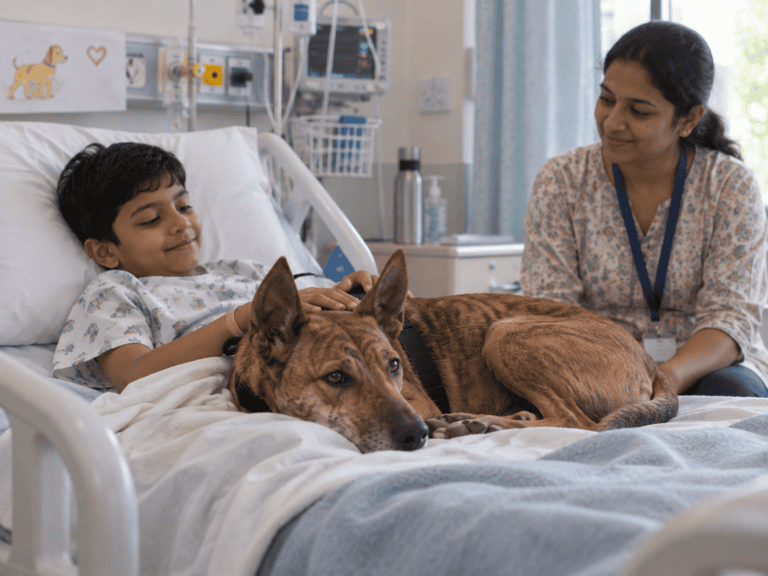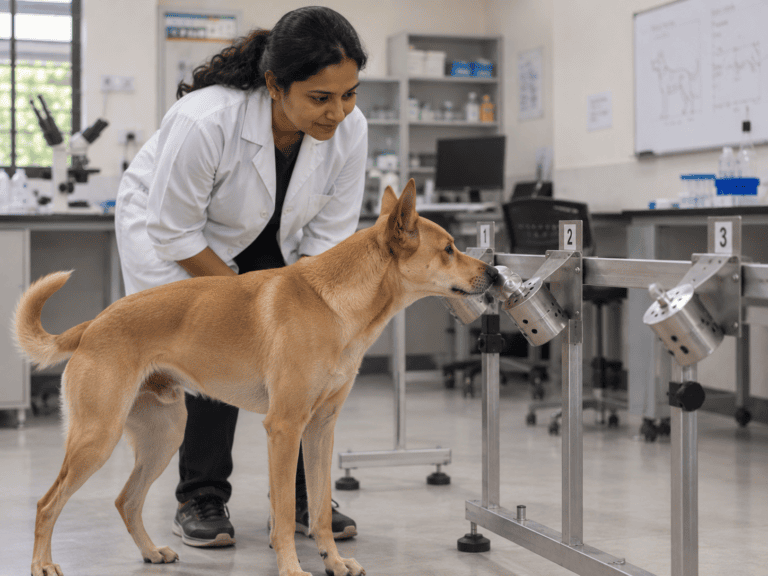
Street dogs are inherently aggressive
This is the most widespread myth - and the one that causes the most harm to dogs. The reality is more specific. Research on free-ranging Indian street dogs has consistently found that aggression is far less common than the public perception suggests. A study cited in Open The Magazine on Indian street dog behaviour noted that researchers observing these dogs "didn't observe much aggression, which might mean that the fear that street dogs arouse in humans is exaggerated."
Where aggression does occur, it is almost always contextual - not a fixed trait. Researchers from the University of Oxford studying India's street dog population describe the territorial behaviour seen in urban dogs as "not irrational aggression" but "territorial protection born of deep association with a specific human community." Dogs that have adapted to urban environments defend familiar territory - this is a learned, contextual response to urbanisation, not an inherent character flaw of the dog or breed.
This matters practically. A dog that has learned territorial behaviour in one context can learn different behaviour in another. Rescue workers consistently report that genuinely unprovoked aggression - aggression with no contextual trigger - is far rarer than the public assumes.
Open The Magazine, 2019 · Oxford research via Phys.org, 2026
None of this means dog bites are not a serious issue
None of this means dog bites are not a serious public health issue in India. They are. India accounts for approximately one-third of global rabies deaths, and millions of bite incidents occur annually. The important distinction is this: preventing bites requires understanding why dogs bite and addressing those causes - overcrowding, lack of vaccination, territorial stress from urbanisation - rather than assuming every street dog is inherently dangerous. One approach leads to solutions. The other leads to policies that don't work.
All street dogs carry rabies
Rabies is a real and serious public health concern in India - the country carries approximately 35% of the global rabies burden, and thousands of deaths occur each year. That context is important and should not be minimised. But the belief that all or most street dogs are rabid misrepresents how the disease actually works.
Rabies is a virus - a dog can only carry it if it has been exposed to and infected by the virus. An unvaccinated dog, whether it lives on the street or in a home, can potentially contract and transmit rabies if bitten by an infected animal. A vaccinated dog - street or pet - cannot. As BusinessToday's fact-check on rabies myths confirms: "Only stray dogs carry rabies" is false - "even pet dogs can transmit rabies if not vaccinated."
The solution to rabies is vaccination, not the removal of dogs. Cities and states that have implemented sustained vaccination programmes have seen dramatic results - Goa eliminated human rabies deaths entirely between 2018 and 2019 after a sustained vaccination drive, according to a peer-reviewed study published in Nature Communications. A 2024 survey by ICMR-NIE, published in The Lancet, estimates approximately 5,700 human rabies deaths occur in India annually - a nearly 75% reduction compared to older estimates of around 20,000, largely attributed to improved vaccination access over the past two decades. The disease is controllable. The myth that street dogs are inherently rabid obscures what actually works.
BusinessToday, 2025 · Srinivasan et al., Humanities and Social Sciences Communications, 2019
Street dogs are all the same - mixed breeds, no particular heritage
This myth flattens what is actually a genetically significant and ancient population. As the INDog Project documents, most street dogs in peninsular India are Indies - dogs descended from the Indian Native Dog (INDog), one of the world's oldest dog populations, with archaeological evidence placing this lineage on the subcontinent at least 4,500 years ago.
The INDog Project is precise about this: calling all Indian street dogs "mongrels" or treating them as a random genetic mix is inaccurate. Many are largely unmixed indigenous dogs. Urban populations in cities with longer European settlement histories carry more admixture, but the underlying Indigenous lineage runs through the majority of India's street dog population.
The genetic significance of this was confirmed by the landmark Shannon & Boyko 2015 study in PNAS, which examined 549 village dogs across 38 countries and identified this population's ancient and distinct lineage.
Street dogs can't adapt to home life
This myth confuses the circumstances a dog has lived in with its capacity to live differently. Indies - the landrace that forms most of India's street dog population - evolved through thousands of years of close association with human households and communities. They are not wild animals that have wandered into cities. They are dogs that have always lived alongside people, in human spaces, reading human behaviour and forming attachments to specific communities.
The INDog Project breed standard is explicit: the Indie "has no inherited traits that make it unsuited to being an urban family pet, provided it gets sufficient outdoor exercise." The adjustment period for a rehomed street dog is real and should be respected - a dog that has lived on the street needs time to decompress, and patience in the early weeks is essential. But the capacity to adapt is entirely there.
Pedigree breeds are healthier and less problematic than street dogs
The opposite case can often be made. Pedigree breeds are products of selective breeding within closed gene pools - a process that concentrates desired traits but also concentrates genetic vulnerabilities. Hip dysplasia, respiratory disorders, cardiac conditions and skin problems are all significantly more prevalent in certain pedigree breeds than in naturally evolved landrace dogs.
The INDog Project breed standard notes that genetic conditions like hip dysplasia are "extremely rare" in Indies, "since in a naturally evolved breed only the fittest breed and the flaws are bred out." Indies also have significantly lower rates of breed-specific health problems, lower veterinary costs over a lifetime and - under good care - an average lifespan of over 15 years.
As for behaviour - every dog, regardless of breed, starts life without knowing what's expected of it. Undesirable behaviour isn't a street dog problem. It's simply behaviour that hasn't been shaped yet. Pedigree dogs without consistent training and socialisation develop exactly the same challenges. The street dog doesn't deserve a lower baseline assumption.
Where these stereotypes come from
The framing of Indian street dogs as diseased, dangerous and fundamentally unsuitable has deep roots. As researchers Srinivasan et al. document in their peer-reviewed study in Humanities and Social Sciences Communications, the idea of free-living dogs as "external threats to human society" was actively constructed by British colonial administrations as part of broader public health management - an approach that framed indigenous animals, like indigenous people, as problems to be controlled rather than communities to be understood.
Free-living dogs have always been a part of Indian society, of the public. What has changed over time is how they feature in public health discourse and practice. - Srinivasan et al., 2019
That framing has persisted long after its origins were forgotten. Challenging these myths isn't sentimentality about dogs. It's about making better decisions - for public health, for animal welfare and for how India manages a relationship with a dog population that has been part of this country for thousands of years.
Srinivasan et al., Humanities and Social Sciences Communications, 2019
What this means for our work
HeartDogs trains Indies - India's native landrace dogs - as assistance and therapy dogs. Every dog we work with is individually assessed, vaccinated, health-monitored and trained using force-free methods from the earliest stages. The dogs in our programme are not abstract "street dogs" - they are specific individuals, known by name, raised in real homes by women in rural Karnataka who care for them daily.
The myths above are part of what HeartDogs is, in a small way, working to change. Not by arguing - but by showing what these dogs are capable of when someone decides to look properly.