What "stray dog" actually means
"Stray" describes a dog's guardianship and supervision status, not its breed or type. A stray dog is one that roams without supervision - it may be lost, abandoned, or simply free-ranging. The word itself comes from British English, implying a dog that has "strayed" from its guardian.
The INDog Project's glossary points out that this term is actually poorly suited to the Indian context. In Indian languages, the word used is closer to "wandering" or "roaming" - which more accurately describes a dog that is attached to a territory and its community, rather than one that has accidentally gone somewhere it shouldn't be. The INDog Project notes that even the World Health Organisation's 1990 guidelines describe "stray" as "imprecise, because a dog found straying may be lost, abandoned or merely roaming."
Crucially: any dog can be a stray. A lost Labrador is a stray. An abandoned German Shepherd is a stray. "Stray" says nothing about what kind of dog it is.
What "street dog" actually means
"Street dog" is a more precise term for urban free-ranging dogs - dogs living on streets in cities and towns. It describes where a dog lives, not what it is. As Wikipedia's entry on free-ranging dogs notes, street dogs may include former pets that have been abandoned, genuinely feral animals that have never been owned, and indigenous landrace dogs like Indies.
The INDog Project suggests that "street dog" is preferable to "stray" in the urban Indian context - it's more descriptive and less loaded with the implication that the dog has done something wrong by being where it is. But like "stray," it still describes a living situation, not a breed.
What "Indie" actually means
"Indie" describes what a dog genetically is, not where it lives or whether it has a guardian. The term was introduced by the INDog Project to describe dogs with INDog ancestry - that is, dogs descended from India's native indigenous village dog, the INDog (Indian Native Dog). Most street dogs in peninsular India are Indies or have significant Indie ancestry. An Indie may be largely pure INDog, or may carry some admixture with other breeds - but what defines it is its connection to India's ancient indigenous dog population.
The INDog itself is one of the world's oldest dog populations, with archaeological evidence placing it on the Indian subcontinent at least 4,500 years ago. It evolved through natural selection, not human breeding for any particular function.
An Indie can live on the street. It can also live in a home as a pet. What makes it an Indie is its genetic heritage, not where you found it.
The INDog Project, which has studied this population since 2002 and collaborated on the landmark Shannon & Boyko 2015 PNAS study on village dog genetics, uses "INDog" for the pure indigenous type and "Indie" for dogs with INDog ancestry, including mixes.
How they actually relate
| Term | What it describes | What it doesn't tell you |
|---|---|---|
| Stray dog | A dog roaming without supervision or a guardian | What breed or type the dog is |
| Street dog | A dog living on urban streets | What breed or type the dog is |
| Indie | A dog of India's native landrace - its genetic heritage | Whether the dog is owned or free-ranging |
As the INDog Project puts it: a purebred dog abandoned by its guardian becomes a stray. A stray adopted into a home becomes a pet. Neither changes what the dog fundamentally is. An Indie that is adopted remains an Indie. A lost Labrador remains a Labrador.
Why the confusion persists
Most street dogs in India are Indies or have significant Indie ancestry. This is simply a matter of population - Indies are the indigenous dog of the subcontinent, and they vastly outnumber other types. So "street dog" and "Indie" have come to feel like the same thing in everyday Indian conversation.
But not all street dogs are Indies. Some are abandoned pedigrees. Some are mixed breeds, often called "mongrels" - dogs with a mix of INDog and other ancestry, particularly in cities historically settled by European colonists where admixture with European breeds occurred. As Wikipedia notes, the names for the Indian Pariah type "are often erroneously used to refer to all urban South Asian stray dogs."
And equally, not all Indies are street dogs. Many live as pets in Indian homes, and their numbers are growing as awareness of the breed's qualities spreads.
Why getting this right matters
The confusion between these terms has practical consequences. When people say "I don't want a street dog" and mean "I don't want an Indie," they're making a judgement about a dog's genetics based on where it currently lives - which is not a reliable basis for any decision. A street dog that is an Indie has the same genetic heritage as an Indie raised in a home from birth.
In the context of assistance dog training, the distinction matters enormously. HeartDogs selects dogs based on temperament and genetics - specifically looking for Indies, not simply any dog that happens to be on the street. "Street dog" is a starting point for finding candidates, not a selection criterion in itself.
What this means for our work
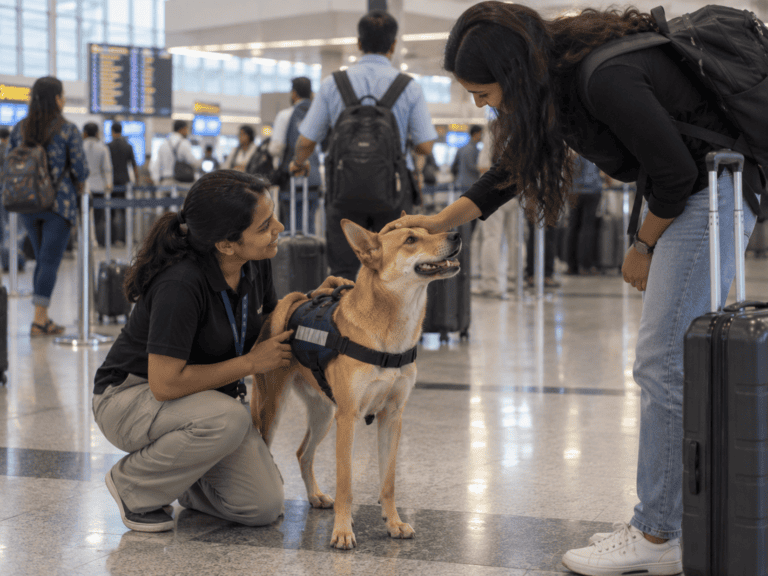
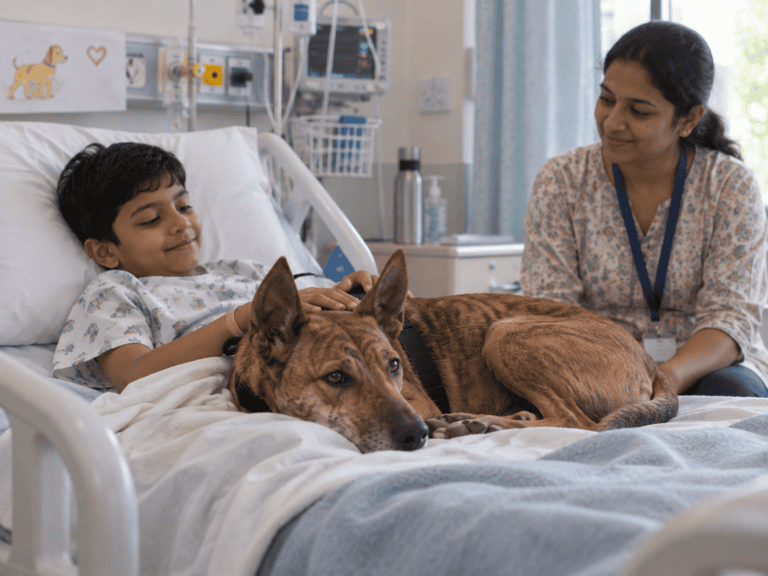
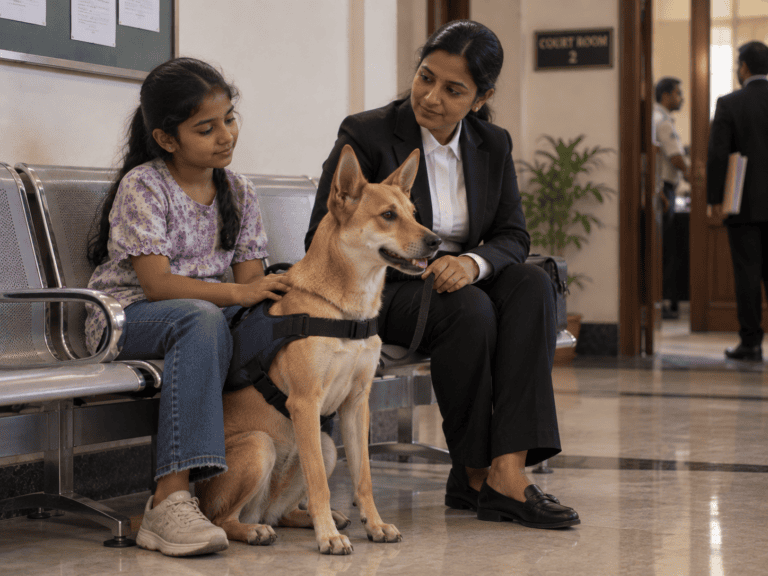
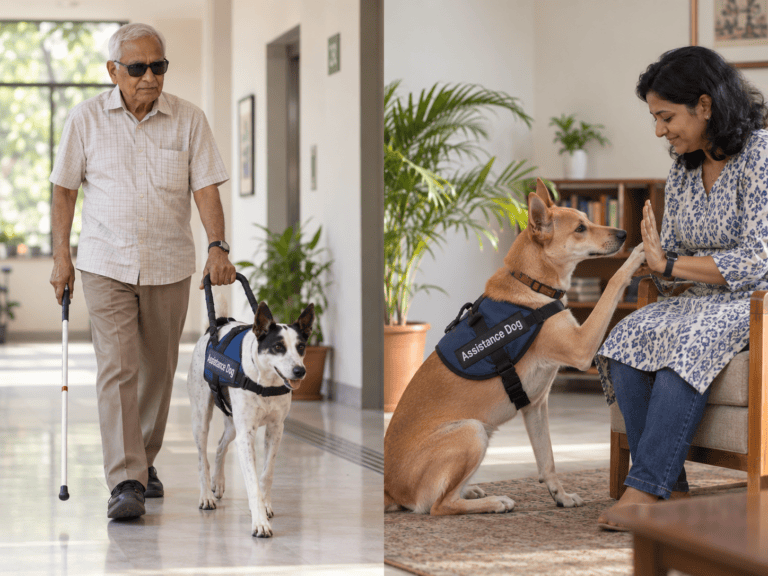
HeartDogs trains Indies - India's native landrace dogs - as assistance and therapy dogs. We use the word "Indie" deliberately and precisely. We're not training "street dogs" as a category. We're working with a specific dog population that happens to include many individuals currently or previously living on streets, assessed individually for the temperament traits that assistance work requires.
The terminology matters because the dogs deserve accurate description. An Indie is not defined by where it was found. It is defined by what it is.