More than difficulty paying attention
ADHD comes in three presentations: predominantly inattentive, predominantly hyperactive-impulsive, and combined. The inattentive type involves distractibility, disorganisation, and difficulty sustaining attention. The hyperactive-impulsive type involves restlessness, difficulty waiting, and acting before thinking. Many people have both.
What gets missed in most descriptions is the executive function dimension. Executive function covers the cognitive systems that govern planning, task initiation, working memory, and self-regulation. For many people with ADHD, the real challenge is not simply "can't pay attention" - it's "can't start the task," "can't transition," "can't regulate emotional reactions," "can't keep track of time." These are the areas where a trained dog can potentially do something useful.
Some people with ADHD also experience prolonged periods of intense, locked-in focus - sometimes described as hyperfocus - where they become so absorbed that they lose track of time, miss obligations, and can't transition out. This is as impairing as inattention, just in the opposite direction, and it is often less discussed.
ADHD is also significantly underdiagnosed in India. A 2026 review published in Frontiers in Psychiatry found that reported prevalence across Indian studies varies widely, reflecting genuine gaps in awareness, access to specialist services, and diagnostic infrastructure. ADHD is still often treated primarily as a childhood condition here, contributing to under-recognition in adults. This matters for any conversation about assistance dogs, because a personal assistance dog for ADHD presupposes a diagnosis and a clinical relationship - both of which are harder to access in India than they need to be.
ADHD in India: Epidemiology, Diagnostic Inequities and Treatment Gaps, Frontiers in Psychiatry 2026
This is about disability, not ordinary difficulty
An ADHD assistance dog would fall within ADI's broader service dog category - a dog trained to perform specific tasks that mitigate the effects of a person's disability. The key is tasks. Comfort, companionship, and the dog's calming presence alone don't make it an assistance dog. The dog has to do specific trained things that directly address the handler's disability.
Under the US ADA, ADHD may constitute a disability when it substantially limits one or more major life activities - activities like concentrating, working, learning, or managing daily routines. The ADA does not require a person to have failed medication or therapy before using a service dog. The relevant question is functional impact: whether the person's ADHD substantially limits one or more major life activities, and whether the dog is individually trained to perform tasks directly related to that disability.
In India, there is no equivalent legal framework that specifically recognises ADHD assistance dogs or establishes their public access rights. India does not currently have a dedicated national framework defining assistance dogs or establishing uniform access rights across sectors. Some sector-specific rules or institutional policies may still address guide dogs or disability assistance - a gap we have covered in detail in our piece on assistance dog certification.
External scaffolding for an internal deficit
Tasks described by assistance-dog programmes and trainers for people with ADHD include the following. These come from practitioner experience and handler reports rather than controlled clinical trials - which matters, and is worth naming upfront.
- Attention redirection. The dog is trained to provide a timed or context-specific nudge - pawing or making contact with the handler after a pre-set interval, or when trained to recognise certain cues. The idea is to interrupt inattention before it becomes a lost hour. How reliably this works in practice across different settings and handlers is not established in controlled research.
- Hyperfocus interruption. A dog trained to interrupt at scheduled intervals - a nudge at a set time, a cue to stand up - is intended to support transitions and reduce missed obligations. Again, this is supported by practitioner experience rather than outcome studies.
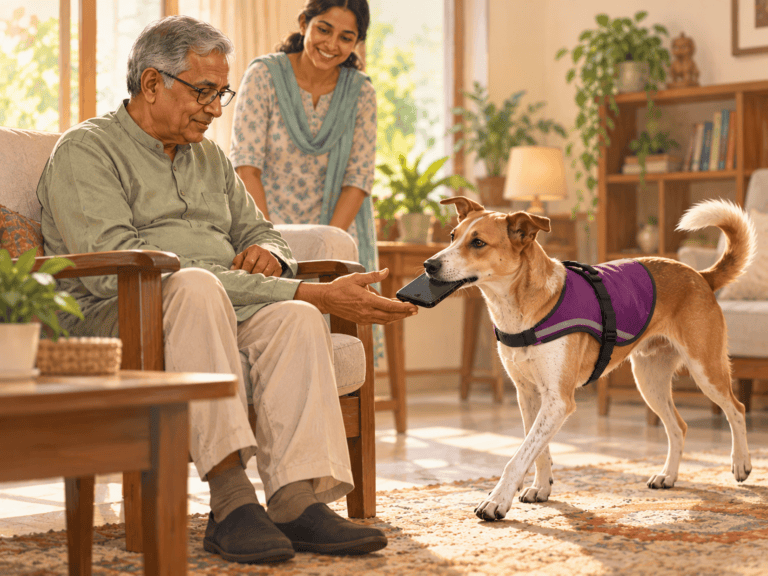
- Medication and routine reminders. A dog may provide a scheduled reminder or retrieve a pre-identified medication container. It cannot decide whether medication should be taken - that remains a medical decision. The ADA itself gives medication reminders as an example of a qualifying service-dog task.
- Grounding during emotional flooding. Some people with ADHD experience rapid, intense emotional reactions that are hard to recover from. A dog trained to make physical contact or perform a grounding behaviour during these episodes may help interrupt the escalation. ADHD-specific evidence for this task is limited, but grounding tasks are used across several psychiatric conditions.
- Deep pressure during overwhelm. In situations of acute dysregulation, a dog trained to apply sustained body contact may help some people regulate. The evidence for deep pressure in ADHD specifically is limited - we covered the general evidence in an earlier piece. It may help some people; it is not established as a general ADHD treatment.
An assistance dog does not treat ADHD or correct its underlying neurology. What it can do is provide external structure, cues, and physical grounding that partially compensate for the internal regulatory difficulties ADHD creates. The dog is scaffolding, not treatment.
The model works differently depending on age
For adults with severe ADHD, the personal assistance dog model may be more practicable because an adult can usually manage the dog's daily care, respond to its cues, and integrate it into personal routines. The tasks - attention redirection, routine reminders, grounding - map clearly onto the functional impairments adults with severe ADHD describe.
For children, the picture is more complicated. Personal assistance dogs for children with ADHD are less common, involve additional safety considerations, and typically require a parent to manage the dog on the child's behalf. School access needs coordination with the institution. And children's ADHD presentations change rapidly as they develop - which affects what tasks are relevant and what the dog's role should be. We'll look at this more closely when we cover therapy dogs and ADHD in a separate piece, where there is actually a stronger evidence base for school-age children.
In both cases, the dog is part of a broader management strategy. Medication, behavioural therapy, environmental accommodations, and psychoeducation remain the primary treatments for ADHD. An assistance dog supplements these - not replaces them.
Two gaps, both large
Getting an ADHD assistance dog in India faces two separate challenges that compound each other: the mental health access gap and the assistance dog gap.
On the mental health side, ADHD remains underdiagnosed and poorly understood here. Reported prevalence estimates vary widely across Indian studies, reflecting differences in study design, diagnostic tools, and access to specialists. A 2025 systematic review published in Social Psychiatry and Psychiatric Epidemiology highlighted the high but poorly quantified prevalence of adult ADHD in India, and called for increased awareness and better identification of affected populations. Access to specialist ADHD assessment, particularly for adults and in non-urban areas, remains limited.
On the assistance dog side, we have not identified a publicly documented programme in India specifically providing personal assistance dogs for people with ADHD. The broader assistance dog infrastructure that would be needed - trained dogs, trained handlers, institutional protocols, legal access frameworks - is itself still being built.
At HeartDogs, psychiatric disability - including ADHD - is one of the areas we are actively thinking about as we consider the directions Cohort 1 will eventually support. Our current focus is building the foundational assistance and therapy dog programme. Supporting people with severe ADHD through personal assistance dogs is a direction we are exploring as that foundation develops.
Real capability, limited evidence
ADHD assistance dogs are a real and plausible application of service dog work. The tasks are specific and potentially trainable, and they are intended to address particular functional difficulties associated with ADHD. Some handlers and providers report improvements in daily structure and self-regulation. But their effectiveness has not been rigorously tested in ADHD-specific controlled studies, and anyone considering this path should do so with that in mind.
But the evidence base is thin. There are no controlled trials of personal ADHD assistance dogs the way there are for, say, PTSD service dogs. What exists is practitioner experience, handler reports, and general research on psychiatric service dogs that includes ADHD among many conditions. The tasks make sense. The evidence for their effectiveness in ADHD specifically has not been rigorously tested.
That honest position is worth holding onto. It does not mean ADHD assistance dogs don't work. It means we don't yet know precisely how well they work, for whom, or under what conditions. And it means anyone considering this path should do so with clear eyes - with a diagnosis, a clinical team, realistic expectations, and an understanding that the dog is one tool in a larger strategy, not a solution on its own.