Who is who: the working and non-working dogs
Alert dog: A service dog trained to alert its handler that a medical event may be imminent, such as a seizure or a dangerous change in blood sugar, so the person can get to safety or take action. ADI calls this an alert service dog. It does not mean a dog can predict every medical event.
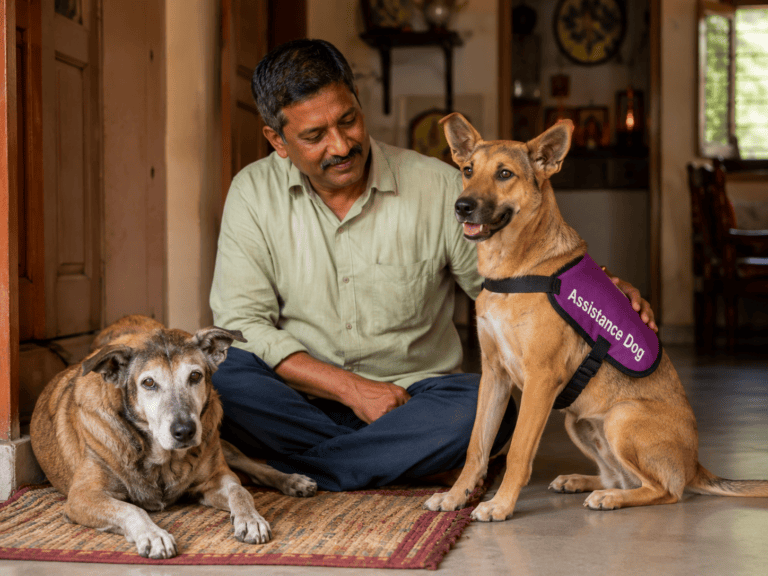
Assistance dog: The umbrella term used by Assistance Dogs International (ADI) for guide, hearing and service dogs. Under ADI's standards, an assistance dog is trained to perform at least three tasks that mitigate the effects of an individual's disability. Other organisations and legal systems may use different definitions or requirements. A dog kept only for protection, personal defence or comfort does not meet ADI's definition.
Companion dog: A pet dog living with a person or family for companionship and wellbeing. Ordinary training may vary, but being a companion dog does not itself involve disability-related task training or confer assistance dog access rights.
Courthouse facility dog: A facility dog that works in legal settings, such as courthouses and child-advocacy interviews, to help witnesses and victims, often children, stay calm while giving evidence. Access is by permission of the court or agency.
Emotional support animal (ESA): An animal that comforts its own guardian through its presence, with no disability-related task training. ESA rules are specific to each country. In the US, emotional support animals may qualify for reasonable accommodation in housing under the Fair Housing Act, even without individual task training. HUD's 2026 guidance changed its enforcement approach, but did not amend the Act to require task training. Housing requests are assessed under the applicable legal requirements. ESAs do not have the general public access rights of trained assistance dogs.
In India: we have not identified any national rule that gives ESAs legal status, so the label does not by itself change what access a venue allows.
Facility dog: A highly trained dog placed with a professional, such as a nurse, teacher or therapist, who handles it at work. It supports many clients in one setting rather than one person with a disability. Access depends on the institution's permission and local law, not an automatic public access right.
Guide dog: An assistance dog trained to guide a person who is blind or has low vision safely through pedestrian environments.
Hearing dog: An assistance dog trained to alert a person who is deaf or hard of hearing to specific sounds, such as a doorbell, a fire alarm or a baby crying.
Owner-trained assistance dog: A dog trained by the person who will use it, sometimes with a professional's help. It is allowed in some countries, including the US, but the dog still has to be individually trained to perform disability-related tasks. Also called a privately trained assistance dog.
Psychiatric service dog: A service dog trained to reduce the effects of a mental health disability, for example by interrupting self-harm, performing grounding or deep-pressure tasks during panic or a flashback, or reminding the handler to take medication.
Response dog: A service dog trained to help keep a person safe during or just after a medical episode, such as by fetching help, retrieving medication or staying in position. ADI calls this a response service dog.
Service dog: In the US and in everyday use, a dog trained to perform tasks for a person with a disability, and the term often covers guide and hearing dogs as well. ADI uses it more narrowly, for dogs working for people with disabilities other than blindness or deafness. In this blog we use assistance dog and service dog together, since one is the international term and the other is the common US one.
Therapy dog: A dog that, with its handler, visits hospitals, schools, care homes, rehabilitation centres and similar places to offer comfort and interaction to many people. It lives with its handler, not with the people it visits, and has no general public access rights. An institution's invitation decides where it can go. A therapy dog is not an assistance dog.
Tasks, access and the people involved
Handler: The person who works the dog. For an assistance dog it is the partner with the disability. For a therapy dog it is the volunteer or professional who takes the dog on visits.
Public access: The right of a person with a disability to be accompanied by an assistance dog in places open to the public, where the law provides it. As ADI frames it, the right belongs to the person, not the dog. Under the US ADA, access depends on meeting the service-animal requirements, including disability-related task training, appropriate control and housebreaking, not on breed, appearance or a certificate.
In India: India has no single national public access framework for assistance dogs. Some sector rules exist, such as India's 2022 civil aviation accessibility guidelines, which define a service animal and include provisions for trained dogs travelling by air, but these are specific provisions in one sector, not a comprehensive national framework.
Public access test: A practical test of whether a dog stays calm, controlled and focused on its handler in public places. ADI has its own Public Access Certification Test.
Reasonable accommodation: A legal idea that a person with a disability may be entitled to reasonable adjustments so they can take part equally.
In India: The Rights of Persons with Disabilities Act, 2016 sets out non-discrimination and reasonable accommodation principles, but it does not specifically address working dogs.
Task: A specific behaviour a dog performs on cue or in response to a trigger, to reduce the effects of its handler's disability: retrieving a dropped item, opening a door, bracing during a transfer, alerting to a sound. Tasks are what separate an assistance dog from a pet, and they are trained, not natural behaviour.
How a dog gets from pup to partner
Accreditation: A process in which an independent body checks that an organisation meets set standards for training, welfare and placement. ADI is one such international body. Accreditation applies to organisations, not to individual dogs.
In India: we have not identified a national accreditation body for assistance dog or therapy dog programmes.
Animal-assisted intervention (AAI): The umbrella term for goal-directed or informal activities that involve animals to benefit people, covering therapy, education and visiting activities. We cover the differences between animal-assisted therapy, activities and education in a separate post.
Assessment: The evaluation of a dog before task training begins, covering temperament, health, focus, and physical suitability for the tasks. Many dogs leave a programme at this stage, not because they are bad dogs, but because the role asks for qualities not every dog has. A pet can sometimes become an assistance dog, but it needs a proper assessment by a professional trainer, not hope based on affection.
Assistance dog trainer: A person who trains dogs to perform tasks and prepares the dog and handler to work as a team. Training commonly takes many months to around two years, depending on the dog, the programme, the tasks and the handler's needs.
Certification: Proof, usually issued by an organisation, that a dog and handler team met a standard. Whether it is legally needed differs by country. In the US, ADA access depends on meeting the service-animal requirements, not on a certificate. Online ESA or service dog certificates and registries do not by themselves make a pet an assistance dog.
In India: there is no national certification system for assistance dogs. Read more in our piece on assistance dog certification and the law.
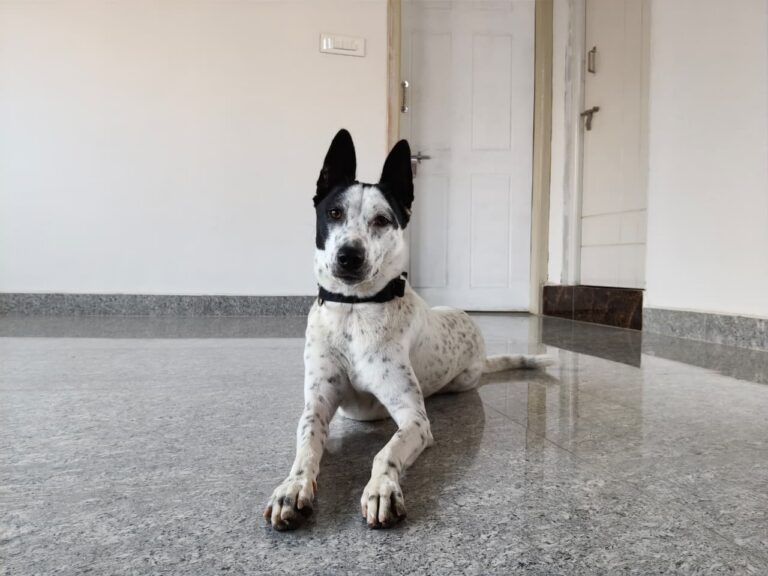
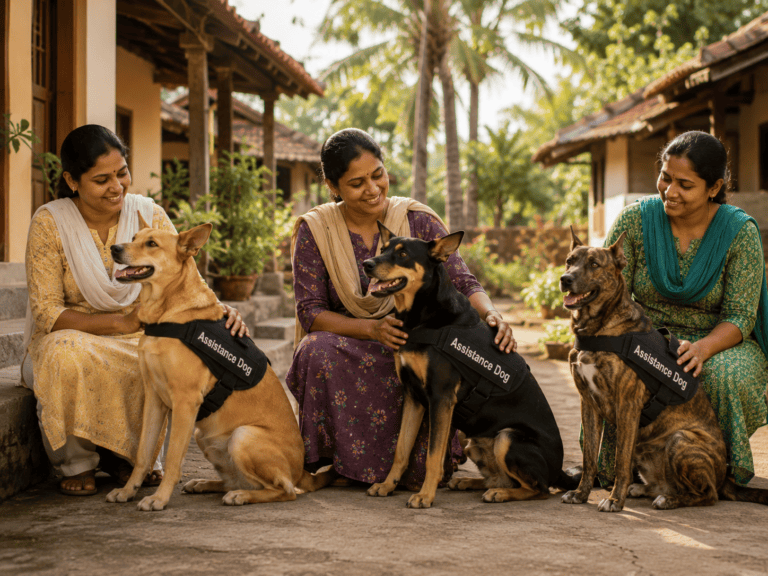
Indie dog: India's native free-ranging dog, also called the Indian pariah dog. HeartDogs trains rescued Indies as assistance and therapy dogs, with women from rural communities in paid skilled employment doing the training.
Puppy raiser: A volunteer who raises and socialises a young dog in a home before it begins formal task training.
The terms side by side
If you only need the short version, ask three questions: who does the dog work for, what has it been trained to do, and where is it allowed to go?
| Factor | Assistance / Service Dog | Therapy Dog | Emotional Support Animal | Companion Dog (pet) |
|---|---|---|---|---|
| Who it works for | One person with a disability | Many people, via a handler | Its own guardian | Its own family |
| Trained to do | Specific tasks tied to a disability | Assessed and prepared for safe, appropriate interactions in its intended setting | No task training required | No disability-related task training required; ordinary training varies |
| Training time | Often many months to about two years | Temperament assessment, socialisation, supervised visits | None required | Varies |
| Public access rights | Broad, where legislation exists | Only where an institution invites it | No general public access | None beyond ordinary pet rules and venue policy |
| Where the benefit comes from | Reliable performance of trained behaviour | Structured visits and interaction | Presence and bond | Presence and bond |
Getting the words right protects the people who need the dogs
A hospital that agrees to a weekly therapy dog visit has made a very different commitment from one asked to let an assistance dog stay with a patient throughout an admission. Someone told they have an emotional support dog may believe they have access rights they do not have. And misrepresenting a pet as a service animal can have legal consequences in countries with access laws, and makes life harder for genuine handlers. Each time an untrained pet in a working-dog space barks or jumps on people, the next legitimate handler faces more scepticism at the door.
In India, where terms are not defined in one national framework, loose language leaves handlers without a clear remedy when a business refuses entry, leaves hospitals without a standard to follow, and leaves families with no reliable way to tell a trained dog from a labelled pet. Defining the terms clearly is a first step. For more, see our piece on assistance dog certification and the law, the types of assistance dogs and what each one does, and who can benefit from an assistance dog in India.
A short guide
If you or someone you care for has a disability and needs a dog that performs specific tasks, the terms to look at are assistance dog or service dog. If you run a hospital, school or care home and want dog support on a programme basis, look at therapy dog and facility dog models. If what you want is a companion whose presence helps with anxiety, low mood or loneliness, that is real and valuable, but it is a pet. Calling it an ESA, therapy dog or service dog does not change what it is.
The best first step is to talk to a clinician about what you actually need, and then find out what kind of trained dog, if any, addresses it. Starting with the dog and working backwards rarely ends well.