The naming is inconsistent - here's how to read it
Before going further, it's worth saying plainly: the terminology in this space is messy. "School facility dog," "school support dog," "school counselling dog," and "school resource dog" are all used - sometimes interchangeably, sometimes to mean genuinely different things depending on the programme and the country.
In the US, "facility dog" is commonly used for a specially trained dog working regularly with a designated professional in an institutional setting, although programme structures and certification standards vary. In Australia and the UK, similar work may be described as school support, wellbeing, counselling, or therapy-dog work. Victoria's government framework, for example, uses the term "wellbeing and engagement dogs" and covers several programme models, not just one.
What we're using "school facility dog" to mean in this piece is the common thread across these models: an intentional programme in which a trained dog is integrated into a school professional's ongoing wellbeing, counselling, educational, or therapeutic work. That's our analytical shorthand, not a universally standardised legal category.
A dog that goes to work, not on a visit
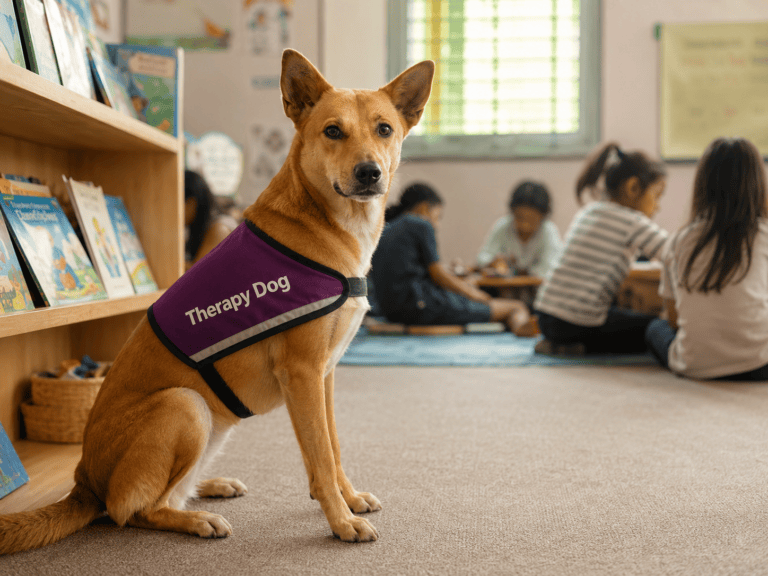
In the embedded professional model, the school facility dog lives with a staff member - often a counsellor, special educator, or school psychologist - and comes to school with them most days. The dog isn't assigned to a classroom. It works out of the counsellor's office, accompanies the professional through the school day, and is available to students as part of the counsellor's practice rather than as a standalone activity.
The schooltherapydogs.org programme, run by a school counsellor in Loveland, Colorado, is one of the better-documented examples of this kind of embedded school-dog model. The counsellor's own dog became part of her counselling practice - present during one-on-one sessions, available to specific students on a scheduled basis, and known by name to children across the school. The dog may become familiar to the students over time, allowing relationships and routines to develop in a way that a visiting therapy dog usually cannot.
In Victoria, Australia, the state government has published specific guidance for "wellbeing and engagement dogs" in schools - a formal policy framework covering handler training, dog welfare, rest requirements, allergy and phobia management, and ongoing oversight. The policy also recommends that two staff members be trained as handlers, recognising that one professional alone cannot carry the full responsibility. The existence of a government policy document for school dogs is itself a signal of how far the model has matured in some parts of the world.
School Therapy Dogs, Loveland Colorado | Wellbeing and Engagement Dogs in Schools, Victoria Department of Education
Specific roles, not general presence
A school facility dog isn't there to be petted during lunch. Its roles are specific to the professional it works with and the students it is assigned to. Across documented programmes, those roles tend to include:
- Counselling support. The dog is present during one-on-one counselling sessions, particularly with students who find direct eye contact or verbal disclosure difficult. Some programmes use the dog's presence to make counselling or supportive conversations feel less intimidating - especially for students who find direct interpersonal interaction demanding. The counsellor's skill and the student's preferences remain central; the dog supports the interaction, not replaces it.
- Attendance and re-engagement. Some school programmes use a familiar dog as part of broader efforts to encourage school participation, particularly for students experiencing anxiety or other barriers. The idea is promising, but evidence specifically showing that facility dogs reduce school refusal or improve attendance remains limited. Attendance changes in small studies cannot by themselves establish that the dog caused the improvement.
- Reading support. Dogs are non-judgemental listeners. A 2023 randomised study of 23 struggling readers aged 8-12 in Dutch special education found that children assigned to a six-week dog-assisted reading programme showed significantly greater pre-to-post gains on two standardised reading tests than children in a comparison group. This is one of the better-controlled studies in the school AAI literature - but it is a study of dog-assisted reading specifically, not of the facility-dog model as a whole. Reading interventions are among the better-studied applications of dogs in educational settings, though the evidence base remains relatively small and findings are not uniform across all populations.
- Social skills and emotional regulation. For students with autism spectrum conditions, social communication difficulties, or emotional regulation challenges, structured interactions with the dog - following cues together, taking turns, reading the dog's body language - can provide opportunities to practise skills such as turn-taking and attention-shifting. Evidence that these skills reliably transfer to peer interactions is still limited.
- Emotional regulation support. In some programmes, a trained dog's presence is used as part of a broader strategy for helping students manage distress. The dog is not a crisis-management tool by itself; the professional remains responsible for assessing the situation and deciding whether the dog should be involved. A calm dog should not be expected to tolerate unpredictable or unsafe behaviour, and the dog's welfare must be actively monitored in any such situation.
What distinguishes facility dog work from a therapy dog visit is that these aren't random or spontaneous. The counsellor sets goals, tracks progress, and adjusts the dog's involvement based on individual student needs. The dog is a tool in a professional's hands, not a mood-lifter dropped into a room.
A growing evidence base, with important caveats
Most of the research on dogs in schools covers therapy dog visits and animal-assisted activities generally, not the embedded facility dog model specifically. This is the same limitation we noted in our piece on hospital facility dogs: the visiting model is older and more common, so it's more studied. Research on the embedded professional model in schools is smaller and newer.
That said, the broader school AAI evidence base is worth understanding. A 2023 qualitative study surveying 118 educators, school mental-health professionals, and researchers found that participants perceived therapy dogs as supporting students' social and learning engagement and emotional and behavioural wellbeing. The authors also highlighted safety and welfare concerns and the need for standardised school protocols. Because this study was qualitative and perception-based, it describes what professionals believe and observe, not what has been causally established.
Across different school-based AAI studies, researchers and participants have reported possible improvements in mood, anxiety, engagement, and social interaction. Attendance effects have also been reported in some studies, though these cannot establish that the dog alone caused the change. Outcomes, intervention formats, and study quality vary considerably across the literature.
Research on dog-assisted interventions in schools reports promising associations with reduced anxiety, improved reading engagement, and stronger social interaction in some student groups. The evidence base is growing but remains methodologically limited - most studies are small, observational, and cannot establish causation.
Therapy Dogs and School Wellbeing: A Qualitative Study, Journal of Veterinary Behavior 2023
Schools are demanding environments for a working dog
Schools are loud, unpredictable, high-sensory places. Bells ring, children run, voices rise. A dog working in a school most days is exposed to environmental demands that a therapy dog visiting once a week may not be.
Responsible school facility dog programmes take this seriously. Victoria's guidance specifies that the handler must monitor the dog continuously for signs of stress and remove the dog from the school environment if needed. The dog must have a quiet, designated rest area with its crate, separate from students, where it can decompress during the day. Water, rest breaks, and daily welfare checks are non-negotiable. The handler must be trained to recognise fear, stress, and discomfort in their specific dog - not just dogs in general. And critically: the dog must remain under handler supervision at all times and must not be left alone with students.
A well-run programme builds rest into the structure of the day. The dog is not "on" for six continuous hours. Some school-based programmes deliberately limit the dog's days or hours on campus to support adequate recovery and welfare. That kind of thinking - putting the dog's wellbeing alongside the student's benefit - is what separates a thoughtful programme from one that treats the dog as a fixture.
Wellbeing and Engagement Dogs in Schools, Victoria Department of Education
Where things actually stand
Animal-assisted interventions exist in India's special education and therapeutic spaces. Indian Mother and Child Care, an NGO working with children with special needs, is publicly described as using dogs in animal-assisted therapy as part of its therapeutic work. Publicly documented providers operate in several Indian cities, including Mumbai and Pune, with services reported in educational, rehabilitation, and clinical settings.
What we have not identified is a publicly documented school facility dog programme in India - one where a trained dog is embedded in a school counsellor's or special educator's daily professional practice, with defined goals, structured sessions, and welfare protocols. We have not found public documentation showing that this particular model is established at scale in India. That is a cautious observation based on publicly available information, not a claim that no such work is happening anywhere.
The barriers are real. Before a school facility dog programme can exist, you need: a dog trained to handle a school environment reliably, a professional handler who understands both the counselling role and the animal-assisted intervention model, a school administration that understands the difference between a classroom pet and a working dog, infection control and allergy management protocols, and a clear policy framework for the dog's welfare and the students' safety. None of these things are trivial, particularly in a country where formal assistance-dog and therapy-dog programmes are still developing.
At HeartDogs, we see school facility dog work as a direction with genuine potential, particularly for special education settings and schools working with students who have social-emotional or learning challenges. It is not something we are pursuing in the current phase - our focus is on completing Cohort 1 and building the foundational assistance-dog and therapy-dog programme. But the school context is one where we think the embedded professional model could work well in India, when the time is right and the right institutional partners are in place.
Animal Assisted and Dog Therapy Providers in India, Mind Voyage
A visit and an embedded programme are not the same ask
When a school principal says "we'd like a dog for our students," the answer to that request depends entirely on what they mean and what they're willing to commit to.
A therapy dog visit is one answer - a trained dog and its volunteer handler come in on a schedule, interact with students in supervised settings, and go home. Valuable, and generally simpler to arrange than a full facility dog programme, though it still requires careful planning, welfare protocols, and trained volunteers.
A school facility dog programme is a different answer entirely - a professional on staff who incorporates a highly trained dog into their practice, with defined goals per student, daily welfare monitoring, and a long-term institutional commitment. It requires a specific kind of professional, a specific kind of dog, and a school culture that understands the difference between a mascot and a working animal.
The research on both models is still developing. But the facility dog model is designed to offer a different kind of continuity: an ongoing relationship between the dog, the professional, and the students, with the ability to set and pursue individual goals over time. For students who most need that - those with persistent anxiety, trauma histories, or significant social-emotional challenges - the difference between a dog they see occasionally and a dog that is simply part of how their school works may be considerable.