Mood and anxiety - yes. Depression scores - more complicated.
The evidence most often points to short-term improvements in mood or anxiety after therapy-dog interactions. Their effect on clinical depression scores specifically is less consistent and varies by population, setting, comparison group, and how depression is measured.
A 2026 umbrella review published in Aging Clinical and Experimental Research - covering multiple systematic reviews and meta-analyses, with data searched through September 2025 - examined animal-assisted interventions specifically for depression in older adults. It found a statistically significant reduction in depressive symptoms among older adults, while also reporting moderate heterogeneity and limitations in the underlying evidence, including substantial risk of bias across studies. A 2024 meta-analysis of randomised controlled trials specifically on dog-assisted therapy in older adults found a modest but statistically significant effect on depressive symptoms (Hedges' g = -0.65), based on a limited and heterogeneous evidence base with substantial risk of bias.
But individual studies tell a more varied story. A 2025 pilot RCT of 44 hospitalised older adults assigned to therapy dog visits, a conversational control, or standard care found significant improvements in anxiety and mood - but no significant change in depression scores, and the improvements in mood and anxiety were not sustained at later follow-ups. A randomised controlled trial conducted in 2019-2020 at a rehabilitation centre in Budapest found significant improvements in quality of life, pain, and anxiety in the dog-therapy group - but not in depression specifically.
The evidence points to a real benefit in some populations and settings, but it is not uniform across all contexts. The signal is clearest for mood and anxiety; depression-score improvements are present in some studies and absent in others.
Therapy dogs appear particularly promising for older adults in institutional and healthcare settings. Their effect on depression scores is variable, while short-term improvements in mood and anxiety are reported in some studies. The evidence supports their use as a complement to depression care, not as a treatment in their own right.
Animal-Assisted Interventions for Depression in Older Adults: An Umbrella Review, Aging Clinical and Experimental Research 2026 | Effectiveness of Animal-Assisted Therapy in Reducing Depressive Symptoms in Older Adults, ScienceDirect 2024
Older adults, institutional settings, and the isolation factor
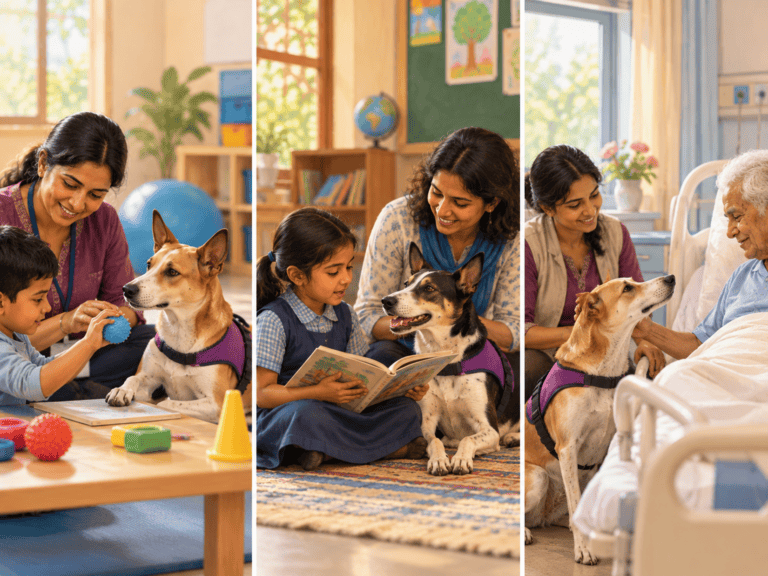
The largest and most developed evidence base comes from older adults in institutional or hospital settings, although much of it remains methodologically limited. This is probably not a coincidence. Social withdrawal and isolation can both contribute to and result from depression, and older adults in institutional care often have limited social contact and reduced sense of purpose. A therapy-dog visit may address several of those factors at once by providing social interaction, sensory engagement, and a structured reason to participate - without the interpersonal complexity of human relationships.
We have covered specific applications in earlier FootNotes pieces. Therapy dogs in dementia care - which involves significant depression and behavioural symptoms - have their own evidence base that we examined in our piece on dementia. The evidence for dogs in cancer care, including depression and anxiety in oncology patients, is covered in our cancer care piece. And the broader picture for therapy dogs in rehabilitation centres - including mental health outcomes - is in our rehabilitation piece.
Outside institutional settings, the evidence gets thinner. There is some research on therapy dogs in university settings for student mental health, and on therapy dog visits in community mental health contexts, but these are smaller and more varied in quality. The isolation-reducing mechanism that makes therapy dogs particularly plausible for depression in older institutional settings is less clearly operative in other contexts.
The proposed mechanisms
Research on the human-animal bond offers several plausible explanations for why dog contact might benefit people experiencing depression. These are proposed mechanisms, not fully established causal pathways.
Oxytocin and physiological calming. Some studies have found increases in oxytocin following positive human-dog interaction, and others have reported changes in cortisol or related stress markers. Results vary by study design and context, so these findings describe plausible pathways rather than a settled mechanism. We covered the human-animal bond science in our earlier piece.
Reducing social isolation. Social withdrawal and isolation can both contribute to and result from depression. Dogs provide non-judgemental, warm social contact that does not carry the interpersonal complexity of human interaction. For people who have withdrawn from social connection, a dog can be a lower-barrier entry point to engagement.
Behavioural activation. One evidence-based component of depression treatment is behavioural activation - the idea that doing things, even when motivation is low, builds energy and mood over time. The interaction may provide a small, structured behavioural activation opportunity, but it is not a substitute for behavioural activation therapy delivered by a clinician.
Sense of purpose and connection. Dogs respond visibly to human attention - they approach, wag, make eye contact. For some people in institutional settings who may feel invisible or purposeless, the dog's responsiveness may create a sense of being noticed and engaged. This is harder to measure than cortisol but may be one of the more important mechanisms.
Effects of Canine-Assisted Intervention on Stress and Depression in Humans, PMC 2025
Therapy dogs are not a treatment for depression
This is important enough to say plainly. Depression - particularly moderate to severe clinical depression - requires proper clinical assessment and treatment. That treatment may include psychotherapy, medication, lifestyle interventions, and social support. Therapy dogs sit alongside these as a complement, not instead of them.
A dog in a therapy programme cannot diagnose depression, monitor symptoms, adjust a care plan, or provide the sustained therapeutic relationship that psychotherapy involves. The benefit of a therapy dog visit is real, but it is short-term and context-dependent. Many studies measure effects immediately after the visit, and some evidence - including the 2025 pilot RCT - suggests that improvements in mood or anxiety may not persist over longer follow-up periods. This does not make therapy dog visits pointless, but it does mean they are not a substitute for ongoing depression care.
For anyone in India experiencing depression, the first step is reaching out to a mental health professional. NIMHANS and iCall are among the organisations providing mental health support. Tele-MANAS, India's national mental health helpline, is available at 14416. If someone is in immediate danger or cannot stay safe, they should contact local emergency services or go to the nearest emergency department rather than relying on a helpline or therapy programme alone.
A large need, a large gap, and a small but growing recognition
India's National Mental Health Survey estimated an approximately 85% treatment gap for common mental disorders; treatment gaps vary by condition and are not necessarily identical for depression alone. Barriers include stigma, shortage of professionals, cost, geographic access, and the fact that mental distress may be expressed or interpreted through physical symptoms rather than recognised as a mental health concern.
In this context, complementary approaches that can reach people who might not engage with formal mental health services have particular value. Therapy dogs are not a workaround for the mental health treatment gap - they do not replace the clinical care that people with depression need. But in institutional settings like hospitals, rehabilitation centres, elderly care homes, and palliative care facilities, structured therapy dog programmes could reasonably complement existing care and address some of the isolation and mood dimensions of depression that clinical services alone often struggle to reach.
We have written before about the shortage of hospital therapy dog programmes in India and the opportunity in rehabilitation settings. Depression is one of the areas where the consequences of limited access to complementary care can be substantial. A structured, well-governed therapy dog programme in a hospital mental health ward, a care home, or a palliative care unit could provide a useful complement to care - with the potential to support mood, anxiety, engagement, and social connection in some patients. Its outcomes should be monitored rather than assumed.
At HeartDogs, this is an area we are actively thinking about as we develop our therapy dog programme track. Our current focus is Cohort 1 - building the foundational training model with rescued Indies. Therapy dog work in mental health and institutional settings, including for people experiencing depression, is a direction we are exploring as the programme grows.
Bridging the Mental Health Treatment Gap in India, Journal of Mental Health and Human Behaviour 2024
Useful, not miraculous
The research on therapy dogs and depression points to something genuinely useful, particularly in specific settings and populations. In older adults in institutional care, the evidence suggests a possible real effect on depressive symptoms, though it appears modest, variable, and sensitive to study quality. In other populations and settings, the picture is less clear.
Across several studies, therapy-dog visits have been associated with short-term improvements in mood and anxiety. For people who are depressed, even a temporary improvement can have value. Depression often traps people in a cycle where nothing seems worth doing and everything feels grey. Something that interrupts that cycle, even briefly, matters.
That value is not the same as treatment. But it does not need to be treatment to be worth doing well.