Why a trained assistance dog is genuinely expensive to produce
Canine Companions, a long-established US assistance dog organisation, states that training a medical alert dog and providing ongoing support for its lifetime costs upwards of fifty thousand dollars. More broadly, its programme illustrates the substantial investment involved in breeding or selecting, raising, training and supporting an assistance dog generally: careful selection or breeding for temperament and health, eighteen months or more of raising and early training, professional trainers working with the dog for months on specific tasks, ongoing veterinary care throughout, and years of follow-up support for the handler after placement, not just a single handover.
This is worth knowing because it explains something that confuses a lot of people: how organisations can provide a dog "for free" to a family while the dog itself clearly cost a great deal to produce. The cost of producing an assistance dog and the price paid by the recipient are two different numbers. A programme may spend tens of thousands training and supporting a dog while charging the recipient nothing, subsidising the difference through donations, grants and fundraising. The family never sees a bill, but the actual cost of producing the dog does not disappear. It is simply paid by someone else, before the dog ever meets its handler.
No fixed number yet, but the same real costs underneath
India does not currently have a mature, standardised assistance dog sector with widely established pricing models of the kind seen in countries with long-standing provider networks. That is not a reason to assume the real underlying cost is dramatically lower here. The same core ingredients, health screening, months of structured training, a trained handler or foster-trainer's time, and follow-up support after placement, all still cost real money and real time in India too, even if labour costs for some of that work are lower here than in the US or UK.
Because India does not yet have a large, established network of charitable assistance dog providers with decades of donor relationships already in place, families may encounter more of this cost directly, or through personal fundraising, than they would in a country with a mature donor ecosystem built specifically around assistance dogs.
How the numbers roughly compare across the three routes
- A dog trained by an established, well-resourced organisation. Often involves the highest total programme investment, since the organisation absorbs selection, raising, professional training, matching and follow-up support. In countries with mature charitable funding systems, much or all of that cost may be subsidised for the recipient.
- Importing a trained dog from overseas. As we discussed in our piece on getting an assistance dog in India, the cost is not limited to the dog itself. International travel, import documentation, health certification, and the practical distance from a placing organisation that cannot easily visit you afterward all add real cost and complexity on top.
- Owner training with professional support. Can reduce the direct cost of acquiring a fully trained dog from a programme, but costs vary widely. Professional support, equipment, veterinary care and the real possibility that a particular dog may ultimately prove unsuitable for the work all need to be considered.
None of these paths is free of cost. They simply distribute the cost differently, between money, time and who ultimately absorbs the expense.
Ongoing care is a real, recurring number too
The upfront cost of training is only part of the picture. Every assistance dog needs ongoing food, routine and preventive veterinary care, occasional refresher training, and equipment replaced as it wears out, throughout its working life. The exact annual cost varies significantly by the dog's size, health, location and individual needs, but it is a genuine, recurring expense that a family or organisation needs to plan for well beyond the day a dog is placed, not just the upfront training cost.
Where we stand on this, honestly
We do not yet have a public price list to share, because Cohort 1 has not reached placement, and we think it would be premature to publish specific figures before we have real placement experience behind them. What we can say honestly is that we are building our programme the way many nonprofit assistance dog organisations do, funded through donors and grants rather than treating cost recovery from handler families as the plan, because we believe cost should not be the reason someone who needs this kind of support cannot access it.
Where the money actually goes
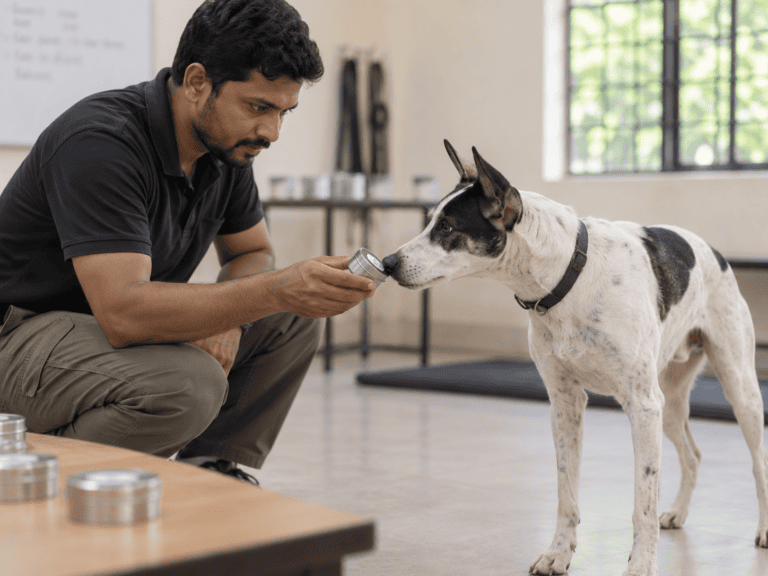
A meaningful share of our costs goes directly into the dogs themselves: food, veterinary care, training equipment and assessments, and the monthly income paid to our Heroes who raise and train them. For Cohort 1 specifically, we also needed to bring in international training expertise, since the kind of specialised assistance and therapy dog training methodology this work requires did not yet exist in India for us to draw on locally. Being upfront about that matters to us, because it shows that a genuine programme like this needs more than good intentions. It needs real expertise, much of which we have had to source from outside India simply because it was not yet available here.
Why we can aim for lower cost than the West
We are also conscious that costs of this kind are usually discussed in a Western context, and one thing we are actively building toward is doing this at meaningfully lower cost than equivalent programmes in the US or UK, while holding the same training standards. Rural Indian wages, veterinary costs and general overheads genuinely make this more achievable here than in the West, and we see that as a real opportunity rather than a compromise on quality.
What changes as we grow beyond Cohort 1
We expect costs per dog to come down further through simple economies of scale, alongside the knowledge and efficiency gained from having actually trained and placed dogs before, and from getting better over time at selecting the right puppies early rather than investing equally in every dog regardless of fit.
As we move closer to actual placements, we intend to be just as transparent about our own costs and funding model as we have tried to be about everything else on this blog. For now, the honest answer is that the real cost of a well-trained assistance dog is substantial wherever it comes from, and anyone telling you otherwise is probably leaving something out.