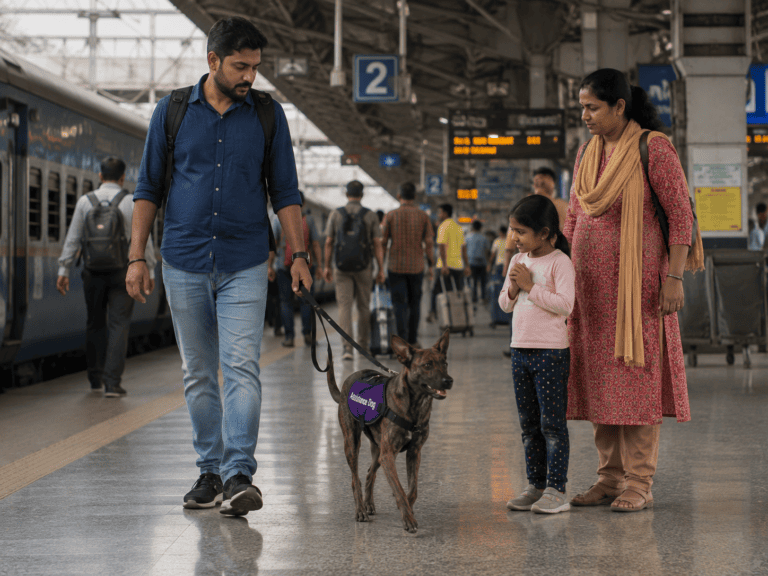
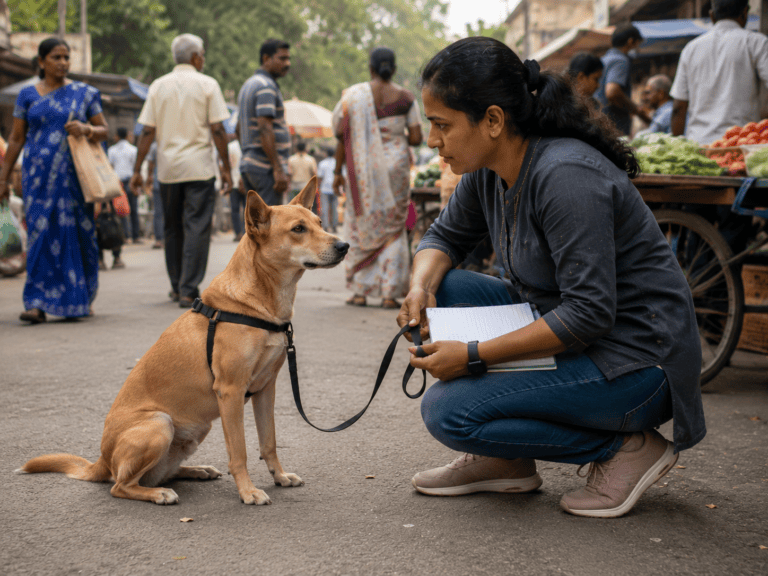
One umbrella, three main types - under one taxonomy
Assistance Dogs International (ADI), an international organisation that accredits assistance dog programmes, groups assistance dogs into three categories: guide dogs, hearing dogs, and service dogs. It is worth noting upfront that these are ADI's definitions - terminology and legal frameworks vary across countries and organisations. ADI itself acknowledges that there is currently no globally legislated legal definition of an assistance dog.
Guide dogs work with people who are blind or have low vision. They navigate physical environments, avoid obstacles, stop at kerbs, and help their handler travel safely and independently.
Hearing dogs work with people who are deaf or hard of hearing. They alert their handler to specific sounds - a smoke alarm, a doorbell, a baby crying, a name being called - by making trained physical contact and indicating or leading the handler toward the source.
Service dogs under ADI's taxonomy - a term used here in a narrower sense than the broader US legal usage - covers assistance dog work for disabilities other than blindness or deafness. This includes mobility assistance, seizure response, psychiatric support, medical alert, autism support, and more.
In the US, the Americans with Disabilities Act uses "service animal" as the term used in ADA regulations for dogs individually trained to perform work or tasks for people with disabilities. This covers guide work, hearing assistance, mobility assistance, medical response, psychiatric tasks, and others - it is not simply a mapping of ADI's three categories. India does not currently appear to have a comprehensive national framework defining assistance dogs, setting uniform certification standards, and establishing general public-access rights across sectors. Some sector-specific rules and policies do address guide dogs or disability assistance - a gap we have covered in detail in our piece on assistance dog certification and public access rights.
For organisations seeking ADI accreditation, ADI's standards require an assistance dog to be trained to perform three or more tasks that mitigate an individual's disability. National laws and other organisations may use different thresholds. The US ADA, for example, focuses on whether a dog is individually trained to perform work or tasks directly related to a person's disability, without specifying a minimum number of tasks.
The most recognised type - and why they are harder to train than they look
Guide dogs navigate. Not just to walk in a straight line, but to make real-time judgments about the environment - stopping at steps, steering around obstacles at shoulder and foot level, pausing at traffic, finding doors, seats, and pedestrian crossings. Guide-dog training also includes what is often called "intelligent disobedience": the dog is trained not to follow a directional cue when doing so would lead into an immediate hazard, such as moving traffic.
This requires a level of environmental generalisation and judgment that takes months to train and years of practice to maintain. Common guide-dog breeds include Labradors, Golden Retrievers, and Labrador-Golden crosses; some programmes also use other breeds depending on temperament, health, and working requirements. They wear a distinctive rigid harness, not a standard lead, which allows the handler to feel the dog's directional changes through their hand.
Guide dogs are used in India in small numbers, and organisations working with people who are visually impaired have contributed to guide-dog training and placement here. India's 2011 Census recorded about 5.0 million people under the "disability in seeing" category - a figure that does not map directly to guide-dog eligibility, but gives a sense of scale. Indian urban conditions can create additional training challenges, including unpredictable traffic, inconsistent footpaths, open drains, crowded public spaces, and free-roaming dogs.
Guide Dogs, Service Dogs, and Hearing Dogs: Know the Difference, Guide Dogs of America 2026
The least visible type - with the strongest RCT evidence of any assistance dog category
A hearing dog's job is to be the ears its handler cannot access. When a trained sound occurs - a smoke alarm, doorbell, alarm clock, baby crying, or someone calling the handler's name - the dog makes physical contact with the handler and leads them toward the source. For danger sounds, a different trained response signals evacuation rather than approach. This is a specific trained behaviour sequence, not a natural response to sound. The dog learns which sounds matter, how to alert through touch rather than barking, and how to distinguish routine alerts from emergency ones.
Severe or profound hearing loss affects far more than a person's ability to follow conversation. Research consistently documents its association with reduced social participation, greater dependence on others for everyday information, fearfulness at home particularly at night, social isolation, and significantly elevated rates of anxiety and depression. For many people with severe hearing loss, hearing devices do not fully address safety, environmental awareness, or daily independence needs.
The evidence for hearing dogs is actually the strongest of any assistance dog category. The PEDRO trial, published in Trials (Stuttard et al., 2021), is a randomised controlled trial led by the University of York - the first RCT ever conducted on hearing dogs. It enrolled more than 160 people with severe or profound hearing loss and found that those who had received a hearing dog had significantly better mental wellbeing, were less dependent on others, had fewer symptoms of anxiety and depression, and reported reduced social isolation and fearfulness compared to those still waiting. The caveats matter: the trial was conducted in the UK with participants who self-selected to apply for a hearing dog, and the findings may not transfer automatically to other populations and cultural contexts. But the evidence is more controlled than most assistance dog research.
It is also fair to ask whether smart home technology makes hearing dogs redundant. For some people, yes - visual alarm systems, phone vibration alerts and connected devices have taken over much of what hearing dogs once did uniquely. But a dog is mobile, present wherever the handler is rather than fixed to a device. A trained dog can generalise alert behaviours to new environments. And while technology may not be set up or available in every space, a dog travels with its handler. The two are not mutually exclusive; many hearing dog recipients use both.
Hearing-dog programmes may use small or medium-sized dogs, including suitable rescue dogs, because the work does not require weight-bearing mobility assistance. Temperament, health, trainability, and calm public behaviour are the decisive factors rather than size. This makes hearing dog work a potential fit for well-assessed Indies.
We have not identified a nationally established hearing-dog programme in India. The 2011 Census recorded about 5.07 million people under its "disability in hearing" category, though broader estimates are higher. The Indian household context makes specific hearing dog tasks particularly relevant: called-out communication between rooms, door knocks, and cooking sounds from commonly used appliances - pressure cooker alerts, for instance - carry household significance that may not translate directly from Western task lists but can be trained to Indian household specifics. A dog that enables a person with hearing loss to function without constant dependence on a family member changes daily dynamics in important ways.
A hearing dog does not help its handler hear. It tells them what to pay attention to. The dog's role is to bridge between the sound environment and a person who cannot access it - not to restore hearing, but to replace the information it provides.
PEDRO Trial, Stuttard et al., Trials 2021 | Assistance Dogs International
Everything else - and a wide range of unmet needs in India
Under ADI's taxonomy, service dogs cover every other way a trained dog can mitigate a disability. Some examples of what falls here:
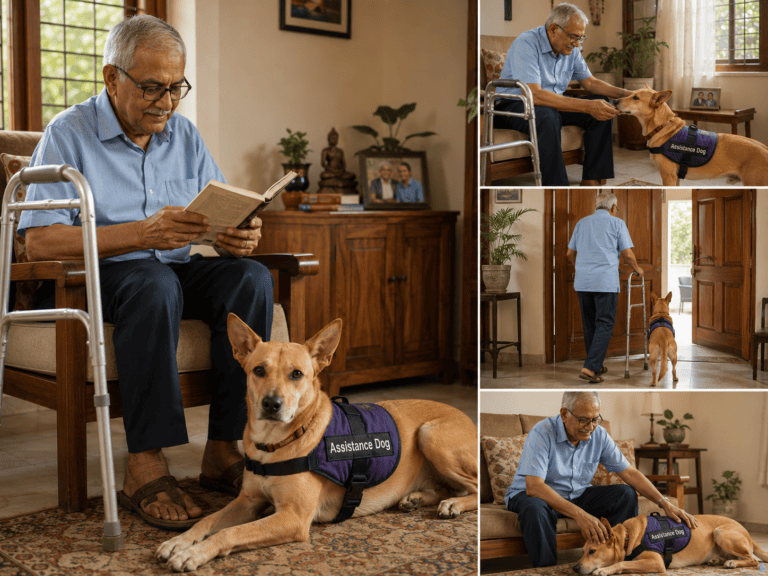
- Mobility assistance dogs retrieve dropped items, open and close doors, assist with transfers, and provide carefully assessed counterbalance for people who have difficulty with movement or stability. Weight-bearing assistance should only be used where the dog has been specifically assessed as appropriate. We covered mobility dog tasks in detail in an earlier piece.
- Seizure response dogs respond during or after a seizure - staying with the person, activating an alert device, retrieving medication, or seeking help. A separate and much less established capability is seizure prediction - alerting before an episode. We examined the evidence for this carefully in our piece on seizure alert dogs.
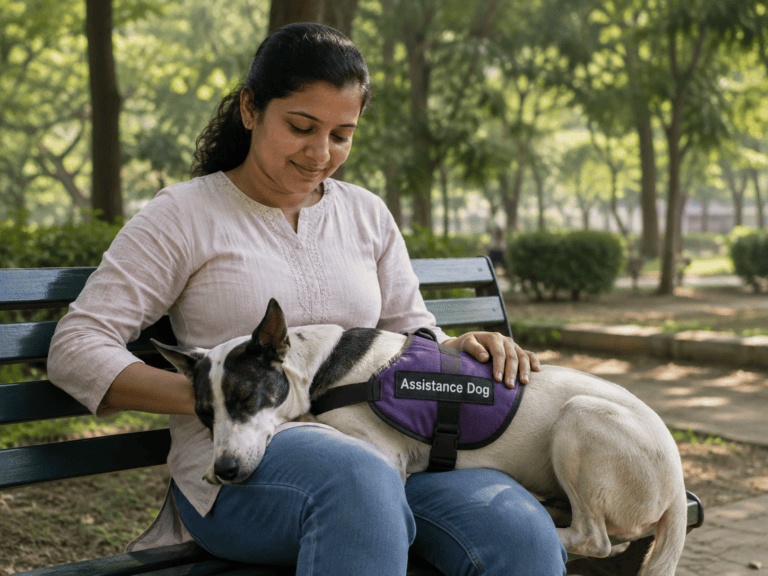
- Psychiatric assistance dogs perform trained tasks for people with mental health disabilities - interrupting self-harming behaviour where safely trained and individually appropriate, performing a trained room-check routine to help a handler inspect an environment, bringing medication, or grounding during dissociation. These are task-trained dogs, not emotional support animals. We covered this in our piece on psychiatric assistance dogs.
- Medical alert or response dogs may be trained to alert to, or respond to, signs associated with particular conditions - blood sugar changes in diabetes, pre-episode shifts in POTS, and similar. The evidence varies greatly by condition, and some alert claims remain insufficiently validated. We have covered diabetic alert dogs and POTS assistance dogs in separate pieces.
- Autism assistance dogs may support safety and regulation through individually designed tasks. Some programmes have used tethering or behaviour-interruption tasks, but these require specialist assessment, careful safeguarding, genuine respect for the child's autonomy and welfare, and should not be treated as automatically appropriate for every autistic child. We looked at what autism assistance dogs actually do day to day in an Indian home.
The common thread across all of these is the same: the dog performs specific trained tasks that directly relate to a person's disability. Comfort, companionship, and a general calming presence on their own do not meet ADI's definition of an assistance dog - and do not meet the task-based threshold in most national frameworks either.
The things that define a personal assistance dog
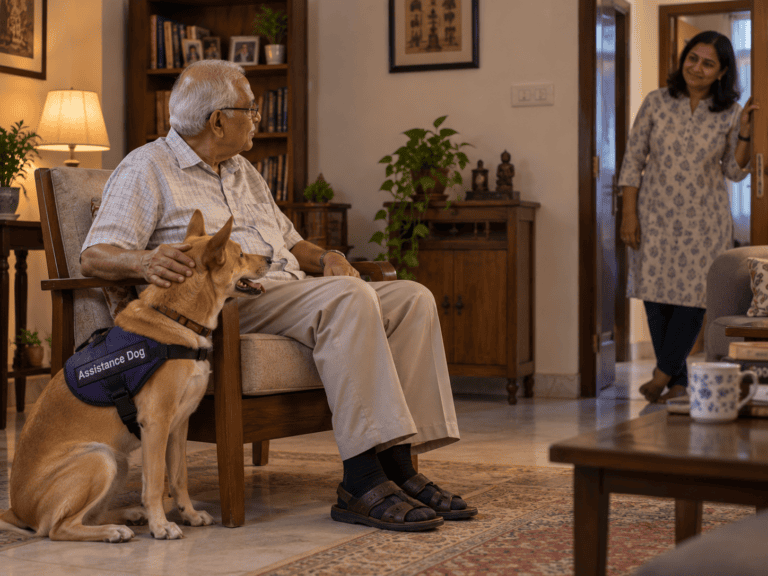
Personal assistance dogs across these categories share certain defining features that distinguish them from well-trained pets, therapy dogs, or emotional support animals.
Task specificity. Every personal assistance dog performs specific trained tasks directly related to its handler's disability. The tasks are learned, maintained, and deployed in response to specific situations. The number of tasks required depends on the governing standard or law - the key principle is that the dog performs trained disability-related work rather than providing companionship alone. A dog that is calm and well-behaved is not an assistance dog. A dog that retrieves dropped items for a person whose disability prevents them from bending safely is.
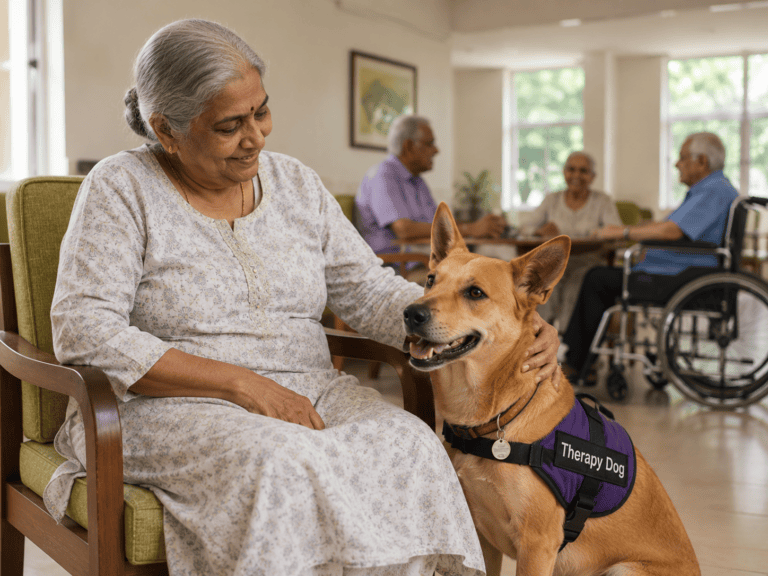
Individual pairing. A personal assistance dog is generally paired with an individual whose disability it is trained to mitigate. This differs from a therapy dog, which visits multiple people in different settings, and from a facility dog, which works within an organisation. Some assistance dog models also involve a family member or co-handler alongside the disabled person, particularly for children.
Public access behaviour. In jurisdictions that recognise public access rights for assistance dogs, the dog must be trained to behave safely and unobtrusively in ordinary public environments where those rights apply. This requires a level of distraction-proofing, calmness in unpredictable environments, and consistent behaviour that goes well beyond basic obedience. Access rights and the rules around them vary by jurisdiction.
Ongoing maintenance. Training does not end when the dog is placed. Tasks must be maintained throughout the dog's working life. The dog must be healthy, assessed regularly, and eventually retired when it can no longer work - at which point the handler typically needs a successor dog. This ongoing structure is one of the things that makes genuine assistance dog programmes expensive and organisationally complex.
Three ADI categories, three very different gaps
India's position on the three ADI categories is not uniform - the gaps are different in nature and size for each.
Guide dogs exist in India in small numbers, and organisations working with people who are visually impaired have contributed to guide-dog training and placement here. Publicly available national figures on active guide-dog teams are difficult to verify. Indian environments may require extensive route-specific training because of mixed traffic, inconsistent footpaths, crowds, open drains, stray animals, and other local conditions.
Hearing dogs - we have not identified a publicly documented, nationally established hearing-dog programme in India. Given the large population of people with hearing impairment in this country, this is a significant gap - but one that depends on building the foundational assistance dog infrastructure first before specialist sub-programmes can exist.
Assistance dogs for other disabilities - mobility, medical alert, psychiatric, autism - are what HeartDogs is working toward. Our current focus is Cohort 1, building the foundational training model with rescued Indies as part of a systematic programme of this kind in India. The broader category of assistance dog work for physical, medical, and psychiatric disabilities is an area we are actively building toward, and where the need is substantial.
A major shared barrier across all three areas is the limited development of infrastructure - trained dogs, trained trainers, public awareness, institutional partnerships, and clear access frameworks. India has not yet developed the national infrastructure needed for a functioning assistance dog ecosystem. Building that infrastructure is what comes before any particular type of assistance dog programme.
Why Doesn't India Have an Assistance Dog Ecosystem Yet? HeartDogs FootNotes
What an assistance dog is not
Because the terminology is loose and the concept is unfamiliar in India, it is worth stating clearly what does not make a dog an assistance dog.
A well-trained pet is not an assistance dog, even if it is exceptionally obedient and its presence is calming. A therapy dog is not an assistance dog - therapy dogs visit multiple people in institutional settings and do not live with or work for a specific disabled individual. An emotional support animal is generally distinct from a task-trained assistance dog - it may receive limited accommodation under some laws or policies, but it does not generally have the same public-access status. In India, the legal position on all of these categories is not clearly codified in a single comprehensive framework. And a dog that performs only untrained comfort or companionship behaviours is not generally performing a qualifying disability-related task under ADI's definition or most national frameworks.
These distinctions matter practically. If public awareness conflates all dogs-with-handlers as "assistance dogs," the concept loses the specificity that makes it meaningful - and makes it harder for genuine assistance dog teams to be recognised and respected. The Indian public, institutions, and policymakers will need to understand these categories clearly before an assistance dog ecosystem can function well here.