What conditions a mobility assistance dog is suited to
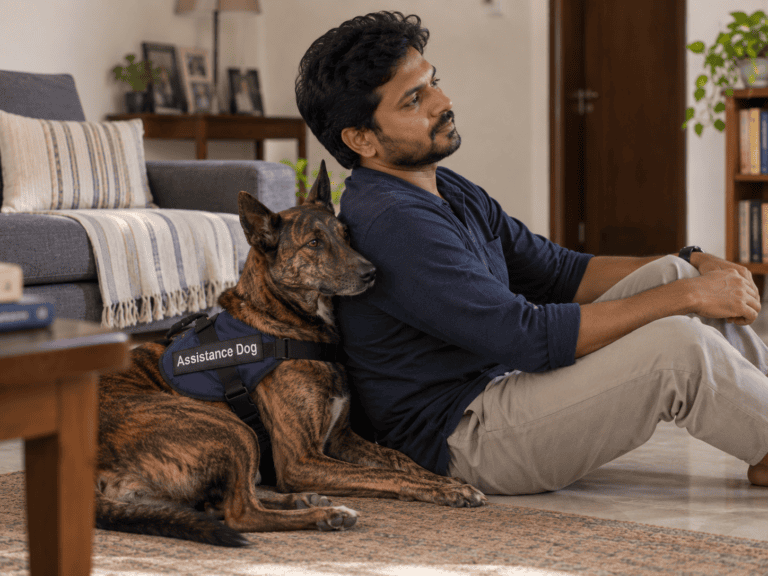
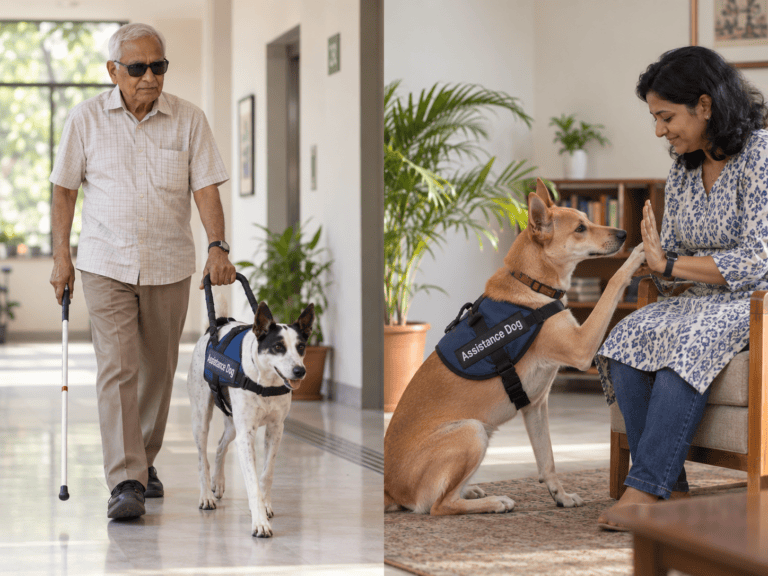
A mobility assistance dog, sometimes referred to in some programmes as a brace and mobility support dog (BMSD), is trained to help people whose disability affects how they move through the world. This includes people who use wheelchairs, those who walk with canes or walkers, and people who are unsteady on their feet due to a progressive or acquired condition.
Relevant conditions include spinal cord injury, multiple sclerosis, Parkinson's disease, cerebral palsy, muscular dystrophy, stroke, traumatic brain injury and other neurological or musculoskeletal conditions that affect strength, balance or coordination. The dog is trained to address the specific functional limitations the person experiences - not the condition itself.
What a mobility assistance dog is trained to do
Tasks are grouped here by type. Not all dogs are trained for all tasks - the programme is tailored to the individual's needs, the dog's size and capability, and the environment they'll work in.
Retrieve tasks
- Retrieving dropped items. Picking up objects the handler drops - keys, glasses, a phone, medication - and returning them to the handler. This is one of the most universally useful tasks and one of the most reliably trained. It reduces the need to bend, reach or ask another person for help with what might otherwise be a frequent daily occurrence.
- Fetching named items. More advanced dogs can be trained to retrieve specific labelled items from known locations - a medication container, a bag, a bottle of water.
- Carrying items. Transporting items for the handler using a specially designed pack, freeing the handler's hands during movement.
Door and switch tasks
- Opening and closing doors. Using a tug attached to the door handle, or pushing a pad to release an automatic door. This can include interior doors, refrigerator doors and cabinet doors modified with pull ropes.
- Pressing buttons and switches. Pressing elevator buttons, light switches (where modified with a target), or pre-programmed assistive devices. In homes adapted for accessibility, this can significantly reduce the assistance a person needs from other household members.
Balance and brace tasks
- Bracing and weight-bearing support. Some programmes train carefully selected, larger dogs to provide a stable point of support during transfers or rising. The use of brace tasks is debated across the assistance dog field - responsible programmes restrict it to brief, stationary moments with minimal pressure, and require careful assessment of the dog's size, musculoskeletal health and the handler's actual weight-bearing needs. Bracing is not suitable for all dogs or all handlers, and should not be treated as a substitute for adapted furniture, grab rails or other assistive technology. HeartDogs does not currently train Indies for weight-bearing brace tasks, as medium-sized dogs are not well-suited to sustained load-bearing work.
- Counterbalance while walking. The dog walks beside the handler in a harness, providing physical contact that may alter the handler's movement strategy during walking. A 2021 descriptive study published in Veterinary Sciences found statistically significant differences in selected joint angles across walking conditions - with a cane, with a mobility dog, and without a device. However, the study used a small non-disabled population and did not establish that mobility dogs improve balance, prevent falls or are safer than conventional mobility aids. The authors recommended individualised assessment and monitoring. Clinical effects on balance and fall risk remain individual and require proper assessment.
- Momentum pull. Providing forward momentum for a wheelchair user on flat ground or over minor obstacles - a threshold, a raised join in the floor. Many contemporary programmes restrict wheelchair pulling to specific short-duration situations - a threshold, a brief incline - rather than sustained propulsion, as ongoing pulling carries welfare risks for the dog and is not appropriate as primary wheelchair mobility support.
Safety tasks
- Alerting others. Going to another person in the household and signalling them when the handler needs help or has fallen - particularly valuable for people who live with family but cannot always be within earshot.
- Positioning and blocking. Trained positioning tasks where the dog creates a buffer of space around the handler in crowded environments. This is distinct from guide-dog work; mobility dogs are not trained to navigate for their handler but can provide physical presence that helps manage space.
PMC - Impacts of Mobility Dogs on Kinematics, 2021 · PMC - Wheelchair Ramp Ascent Study
What the research says about impact
The landmark study in this field is Allen and Blascovich's 1996 randomised controlled trial published in JAMA, which followed 48 people with severe ambulatory disabilities over two years. Within six months of receiving a service dog, participants showed significant improvements in self-esteem, psychological wellbeing and community integration. Notably, the study also documented a "dramatic decrease in the number of both paid and unpaid assistance hours" required - a practical, measurable reduction in caregiver burden.
Later studies have produced more mixed results. A large cross-sectional study found no significant group differences between wheelchair users with service dogs and those on the waiting list on standardised measures of depression, self-esteem, positive affect and community integration. The authors note, however, that depression and the progressiveness of the condition were significant moderating factors - suggesting that outcomes depend substantially on individual circumstances.
The honest picture is that mobility assistance dogs produce meaningful functional benefits - in tasks, in reduced assistance hours, in practical independence - but the psychological outcomes are more variable and depend on the person, the condition and the quality of the placement and ongoing support.
Trained service dogs can be highly beneficial and potentially cost-effective components of independent living for people with physical disabilities. - Allen and Blascovich, JAMA, 1996
Allen and Blascovich, JAMA, 1996 · Systematic review, PMC, 2019
Why the Indian home is different - and why it matters
Most mobility assistance dog research comes from Western settings - wheelchair-accessible homes with flat floors, lever-handle doors and standardised assistive equipment. The Indian home environment has specific features that shape which tasks matter most and how they need to be taught.
- Floor-level living. Indian households involve significantly more floor-level activity than most Western homes - sitting on the floor for prayer, meals, family gatherings, or simply daily routine. Rising from a floor position is a frequent task for many Indian adults, including those with mobility limitations. A dog trained to brace for floor-to-standing transitions is solving a problem that is far more common in Indian daily life than most assistance dog training frameworks account for.
- Smooth, often slippery surfaces. Indian homes - particularly in urban areas - commonly have marble or polished tile floors that can be genuinely hazardous for someone with balance or gait impairments. Counterbalance support during household movement is particularly relevant in these environments.
- Stairs. Lifts are absent in a large proportion of Indian residential buildings, and multi-storey homes without internal lifts are common. Navigating stairs is a daily reality that assistance devices like canes and walkers address imperfectly. Stairs may require carefully assessed, task-specific support. A dog should not be treated as a substitute for a railing, stair lift or cane on stairs - but limited counterbalance assistance at specific points, such as a single step or threshold, can be appropriate for some handlers after individual assessment.
- Multi-generational households. Most people with mobility disabilities in India live with family. A dog that alerts family members when the person needs help - in an adjacent room, at another floor, outside - extends the effective support network without requiring a caregiver to be continuously present.
- Bathroom access. Indian bathrooms, particularly in older homes, typically involve wet floors, low-level taps, and spaces not designed for mobility assistance. A dog trained to retrieve items, alert family members if needed, or provide limited counterbalance assistance during bathroom transfers addresses a genuine daily risk in these settings.
What a mobility assistance dog cannot do - and why size matters
Not every mobility task is suitable for every dog - and in the Indian context, this requires particular honesty. Indies are a naturally varied population - medium-sized as a general description, but individual dogs vary considerably in build, height and adult weight. Suitability for any mobility task must be determined from the individual dog's adult size, structure, health, temperament and veterinary assessment. Well-built medium-sized Indies are well-suited to retrieval tasks, door and switch tasks, and counterbalance support for some handlers. They are not suited to sustained wheelchair pulling or substantial weight-bearing support for any handler - tasks that require larger, specially assessed dogs.
Responsible mobility assistance dog programmes are explicit that brace tasks must be carefully matched to dog size, musculoskeletal health and the handler's specific weight-bearing needs. A dog used for tasks beyond its physical capacity risks injury to both dog and handler. HeartDogs assesses each dog and each person's needs individually, and is honest where a different approach - or a combination of dog support with other assistive devices - is the right answer.
The Mobility Dog Resource Group notes clearly that bracing "may be done occasionally and for short amounts of time" and that "the person must control their own movement." A mobility assistance dog complements other assistive technology - it does not replace it.
What we are working towards
HeartDogs trains Indies - India's native landrace dogs - for assistance roles that include mobility support. The tasks most relevant to the Indian home environment - retrieving dropped items, operating adapted doors and switches, providing carefully limited counterbalance assistance, and alerting family members - may be appropriate for selected dogs and handlers after individual assessment. HeartDogs does not train Indies for weight-bearing brace tasks. A mobility assistance placement from HeartDogs complements other assistive technology; it does not replace it.
Mobility assistance placements require careful individual matching between dog and handler - their size, their specific tasks, their home environment and their existing support. That process takes longer than a standard therapy dog placement. It also produces more durable results.