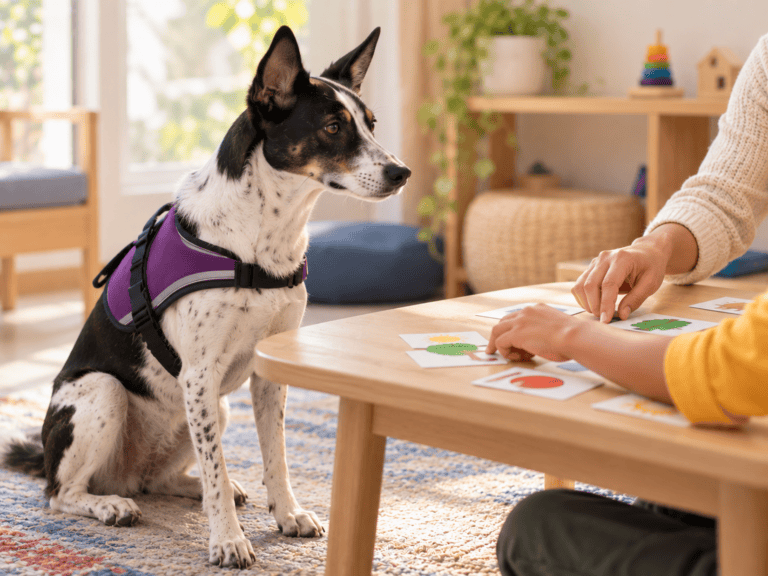
A dog trained by many people needs everyone to mean the same thing
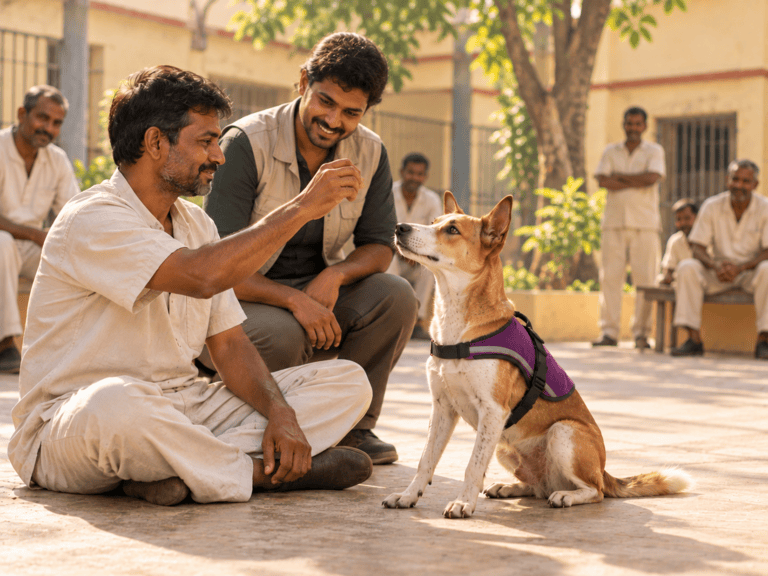
A pet dog usually learns from one or two people at home. An assistance dog (also known as a service dog in certain countries, including the US) learns from trainers, foster-trainers, instructors and eventually the person it will live and work with. If each of them uses words differently, the dog gets mixed signals and the handover to the client becomes harder.
That is why programmes teach a shared vocabulary. A trainer who says "criteria" and a foster-trainer who hears "criteria" must picture the same thing. A client who learns that a "marker" tells the dog it is right should not later be told to ignore it. This guide explains the terms we use, in plain language, and why each one matters when the dog's job is to help a person with a disability. For definitions of the dogs themselves, see our glossary of assistance dog terms.
Rewards, markers and the four quadrants
Reinforcement. Anything that makes a behaviour more likely to happen again. Food, play, praise or access to something the dog wants can all work. In assistance dog work: the reward has to matter to the individual dog. A dog that loves a ball may work harder for it than for a biscuit.
Primary and secondary reinforcers. A primary reinforcer, such as food, can be rewarding without prior learning. A secondary, or conditioned, reinforcer is a signal that gains its value through learning, such as a clicker or a marker word paired with a reward the dog values. In assistance dog work: it lets a handler mark correct work in the moment, even when a food reward cannot be delivered immediately. Food and other primary rewards are still used a great deal while skills are being learned and maintained.
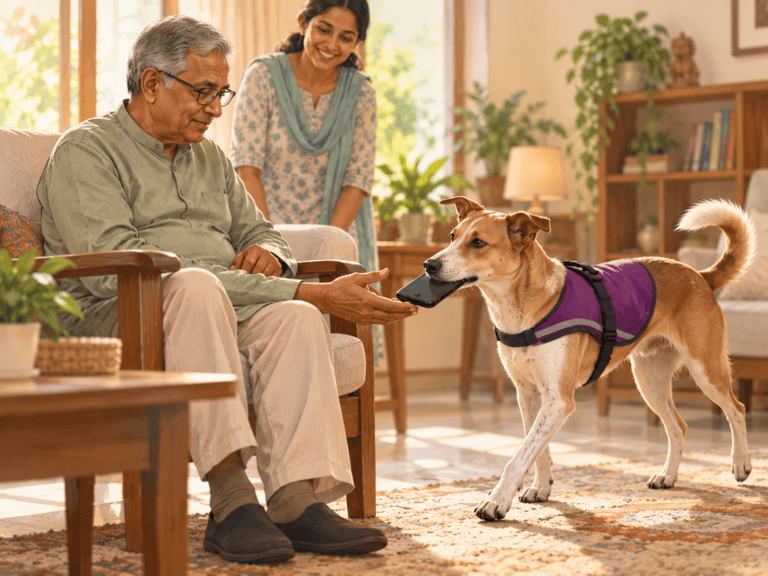
Marker. A short, consistent sound, such as a click or a word, that tells the dog "that exact thing earns a reward". It bridges the gap between the behaviour and the reward. In assistance dog work: a consistent marker helps the trainer identify the exact behaviour being rewarded, which helps the dog understand a task such as retrieving a dropped item or pressing a door button, where precision matters.
Learning psychologists describe four ways consequences change behaviour. "Positive" and "negative" here do not mean good and bad. They mean adding or removing something. These are technical terms, not recommendations for methods.
| Something is added | Something is removed | |
|---|---|---|
| Behaviour increases | Positive reinforcement: a dog sits and receives a treat | Negative reinforcement: an unpleasant stimulus stops when the dog performs the behaviour that ends it |
| Behaviour decreases | Positive punishment: an unpleasant consequence is added after a behaviour, making it less likely | Negative punishment: something the dog wants, such as attention, is removed after a behaviour, making it less likely |
Assistance Dogs International and the International Guide Dog Federation advocate positive reinforcement, reward-based methods and LIMA (least intrusive, minimally aversive) training, and have said that aversive, compulsive, punishment-based or mixed methods are in the interest of neither dogs nor clients. The veterinary behaviour position statement on humane training also says there is no evidence that aversive methods are necessary. We come back to this in the section on words that sound scientific.
ADI and IGDF, ethical training statement, 2023 | AVSAB, Humane Dog Training Position Statement, 2021
The ways a new skill gets built
Luring. Using food or a toy to guide the dog into a position. In assistance dog work: useful early on, but it has to be faded so the dog is not following a treat for life.
Capturing. Marking and rewarding a behaviour the dog offers on its own. In assistance dog work: good for natural behaviours the dog already does, such as settling.
Shaping. Rewarding small steps towards the final behaviour, such as first a glance, then a step, then a touch. In assistance dog work: shaping is useful for complex tasks, such as teaching a dog to touch a switch or open a cupboard door, by rewarding closer and closer approximations of the finished behaviour. Trainers also use capturing, luring and prompting.
Targeting. Teaching the dog to touch something, such as a hand or a sticker, with its nose or paw. In assistance dog work: many tasks are targeting in disguise, such as touching a light switch or a door plate.
Prompting and fading. A prompt is help given to the dog, such as a gesture or a lure. Fading means removing that help gradually until the dog responds to the cue alone. In assistance dog work: a client cannot carry a bag of treats or a gesture for every task, so what the dog does must hold up without extra help.
Behaviour chain. Several behaviours linked in order, such as going to a door, pulling it open and waiting. In assistance dog work: tasks like fetching medication or helping with a laundry basket are chains, and each link has to be reliable.
Cues, criteria and the three Ds
Cue, rather than command. A cue is a signal that tells a dog which behaviour is expected or likely to be rewarded. It can be a word, a hand signal or something in the environment, such as a doorbell. Some trainers use "command" interchangeably with "cue"; we prefer "cue" because it fits our reward-based approach. In assistance dog work: consistent cues help different trainers, and eventually the client, communicate clearly with the dog.
Criteria. Exactly what counts as correct. For a "down", criteria might be elbows and belly on the floor. In assistance dog work: criteria must be the same across trainers. If one trainer accepts a half-sit and another does not, the dog is confused and the client inherits the confusion.
The three Ds: duration, distance and distraction. How long the dog holds a behaviour, how far away the handler is, and how challenging the surroundings are. Build them up gradually, changing one at a time where possible, then combine them carefully once a behaviour is reliable at easier levels. In assistance dog work: a dog may need to stay settled for a long time in a noisy waiting room, for example, but each D is built up separately before they are put together.
Generalisation. The dog understanding that a cue means the same thing in every place, not just the one where it was learned. In assistance dog work: dogs do not do this automatically. A dog that sits perfectly in a training yard may not sit in a hospital corridor until it has practised there.
Proofing. Practising a behaviour across different places, people and distractions so that it becomes more reliable. In assistance dog work: this helps prepare a dog and handler for whatever public-access assessment their programme uses, where applicable.
Rate of reinforcement. How often the dog is rewarded. It is high when a skill is new and lower as the skill becomes reliable. In assistance dog work: a dog placed with a client will not be rewarded every few seconds, so reward has to be thinned out carefully.
Errorless learning. Structuring training to minimise mistakes while a dog learns a new skill, often by starting with easy steps and carefully increasing difficulty. In assistance dog work: it can support confidence and help stop repeated errors from becoming established.
Threshold, triggers and why calm matters
Threshold. The point at which a dog's response to a situation changes from coping relatively comfortably to showing significant difficulty coping. In assistance dog work: when a dog is too distressed or aroused to respond comfortably, reduce the difficulty or create distance, and let the dog recover before continuing.
Trigger. Something that causes a strong reaction in a particular dog, such as another dog or a loud noise. In assistance dog work: finding a dog's triggers is part of deciding whether it is suited to this work at all.
Trigger stacking. A commonly used training term for the possible cumulative effect of several stressful things close together. In assistance dog work: a busy clinic, a lift and a crying child may be fine separately but harder one after another, so trainers watch the dog's overall stress and allow recovery time.
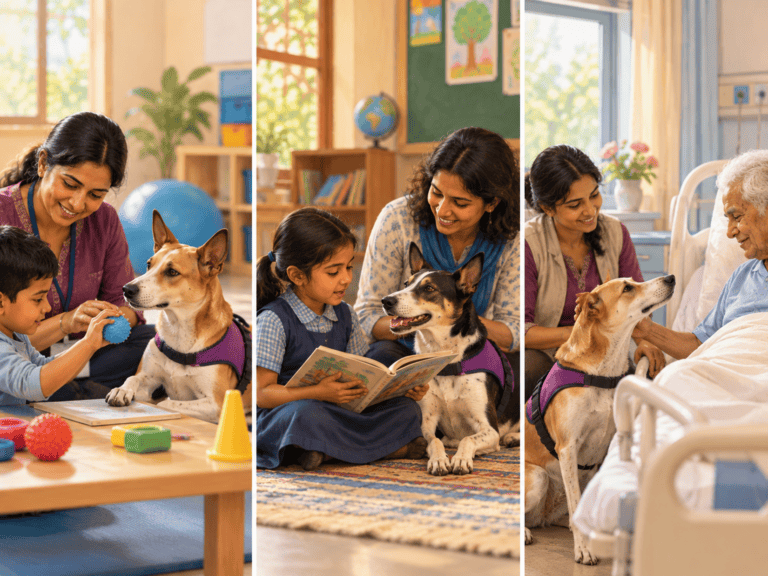
Desensitisation and counter-conditioning. Desensitisation is gradual exposure to something at a low level. Counter-conditioning is changing the dog's feeling about something by pairing it with something good. They are often used together. In assistance dog work: both help a young dog get used to things such as wheelchairs, walking aids, buses and crowds, at a pace it can handle.
Arousal. A dog's level of excitement or alertness. Too high and it cannot focus, too low and it is not engaged. In assistance dog work: an assistance dog needs to be calm and alert in places that are exciting for a dog.
Extinction burst. When a behaviour that used to be rewarded stops being rewarded, it may briefly get worse before it fades. In assistance dog work: this can be mistaken for the training failing, so trainers explain it to families in advance.
Reading a dog's body language and stress signals is a large topic of its own, and we will cover it in separate pieces.
Terms to be careful about
Some phrases in dog training sound technical but do not hold up, or are used to mean very different things. Knowing them helps you ask better questions of any trainer.
Alpha, dominance and "pack leader". The idea that you must dominate your dog to control it. In assistance dog work: the American Veterinary Society of Animal Behavior has raised concerns about dominance theory and about forcing dogs into submission to prevent or correct behaviour problems. We do not use these ideas.
Aversive. A stimulus or consequence used to suppress behaviour that the dog experiences as unpleasant, such as pain, fear or intimidation. In assistance dog work: ADI and IGDF have said that aversive and punishment-based methods are in the interest of neither dogs nor clients.
Balanced training. A label for training that combines rewards with corrections. It means different things to different trainers, so ask exactly what is used and when.
Force-free and LIMA. Force-free means training without physical or psychological intimidation. LIMA stands for least intrusive, minimally aversive, a guide to choosing the gentlest method that will work. ADI points to LIMA as an evidence-based approach. In assistance dog work: these are the ideas we are working towards in our own training.
"Certified". The word alone does not tell you how rigorous a qualification is. Ask who issued it, what training and assessment it required, and whether it is independently recognised. In assistance dog work: ask the same questions about both individual trainers and organisations that train or place dogs.
Why this vocabulary needs to be shared more widely
We have not identified a nationally recognised qualification or common regulatory standard specifically for assistance dog trainers in India. Dog owners and families may meet trainers with very different backgrounds and approaches. A shared vocabulary and transparent training methods can help them ask better questions and make informed choices.
It also matters for dogs. Indie dogs are often assumed to be "stubborn" or "untrainable" when what they have missed is a patient, reward-based teaching process. Many Indie dogs also come from the street, so getting used to new places and people at their own pace matters.
A shared language, from foster-trainers to families
Our dogs are trained in family homes with children around, not in kennels, by women in rural India working as paid foster-trainers. That only works if everyone in the chain, from the trainer to the family to the future client, understands the same terms and methods. Our training materials explain these terms in plain language, so that a foster-trainer, a lead trainer and a client can all say "criteria" or "cue" and mean the same thing.
We also train in line with the direction set by Assistance Dogs International on humane, reward-based methods, and we use cues rather than commands. Cohort 1, our first eight dogs, is where we are learning how to put this into practice in Indian homes and at scale with Indies.