The best-known workplace study is smaller and quieter than you might expect
The most commonly cited study here is a 2012 preliminary study from Virginia Commonwealth University, conducted at a single dinnerware company in North Carolina with about 75 employees. Researchers compared employees who brought their own dog to work, dog owners who left their dog at home, and employees with no pets, over the course of a working week. Morning saliva samples showed no meaningful difference in stress hormone levels between the groups. But as the day went on, self-reported stress told a different story: it dropped for employees who had their dog with them, and rose for both the dog owners who had left their dog at home and the employees with no pets at all. Because employees themselves chose whether to bring their dog in, rather than being randomly assigned to a group, the study can show an association but cannot prove that the dog caused the difference. The researchers were careful to call it a preliminary, exploratory study, given the small sample and single workplace.
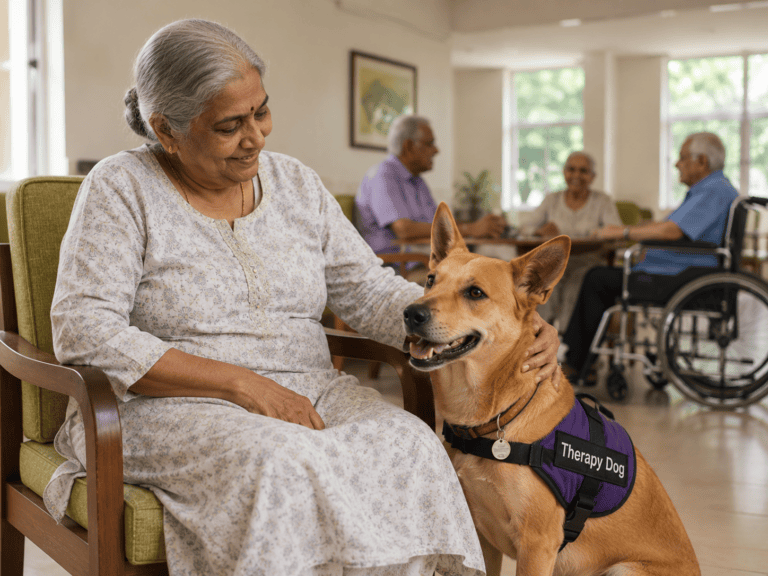
Studies in other settings, including healthcare and university campuses, point in a similar direction, though each comes with its own caveats. A small 2005 study of twenty healthcare professionals, assigned to twenty minutes of quiet rest, five minutes with a therapy dog, or twenty minutes with a therapy dog, found reductions in the stress hormone cortisol after brief interactions with a therapy dog, with reductions observed after as little as five minutes. The study also included quiet rest as a comparison condition, so some of the reduction may reflect taking a short break rather than something unique to the dog. A 2016 randomised crossover study by Barker and colleagues, published in Anthrozoös, found lower self-reported stress in university students after a 15-minute session with a therapy dog compared with a quiet control activity, though it did not find a matching change in the physiological measures the researchers tracked. Taken together, these are small studies, mostly outside actual corporate offices, and they mostly capture short-term shifts in how people feel rather than long-term changes in performance or burnout.
Barker et al., Virginia Commonwealth University, 2012 · Barker et al., Healthcare Professionals, 2005 · Barker et al., Anthrozoös, 2016 - Randomised Crossover Study, University Students
Separating what is proven from what sounds good
Some of what circulates online about therapy dogs and executives goes further than any study has actually tested. We found no credible published study testing therapy dogs before board meetings, during layoff announcements, or in succession planning sessions specifically, and no reliable evidence behind figures like people feeling "twice as productive" after a short visit. That does not mean the broader idea is wrong. It just means those specific claims are more anecdote and enthusiasm than measured science so far, and worth knowing the difference before repeating a number nobody actually measured.
What the research does support is narrower and still genuinely useful: in one workplace study, bringing a dog to work was associated with lower self-reported stress over the course of the day. Other small studies in non-corporate settings have reported short-term changes in cortisol or perceived stress after time with a therapy dog. None of this yet establishes that workplace dogs reduce long-term stress, burnout or organisational problems. That is a fair and still promising starting point, without needing to be stretched into a cure for boardroom crises or executive burnout.
It is not free of trade-offs either
A workplace dog programme is not automatically good for everyone in the room. Some employees have allergies, some are afraid of dogs, and some workplaces are simply not set up for it, from open floor plans to client-facing spaces. The dog's own wellbeing matters too. A dog in a noisy, unpredictable office all day is being asked to work, even if nobody thinks of it that way, and that only goes well if the dog is well suited to it and given appropriate breaks, a quiet retreat space, and the ability to disengage from interactions when showing signs of stress. None of this rules out the idea. It just means a workplace dog programme deserves the same planning a company would give any other wellness initiative, thought through properly rather than adopted overnight because a post online made it sound effortless.
An avenue we are working towards
Corporate and workplace settings are one of the avenues we are working towards as our dogs and Heroes grow. The honest research here is encouraging without being dramatic, which is exactly the kind of foundation we like to build on. As we develop this direction, it will be built the same way everything else in our programme is: around a specific dog's temperament and comfort, proper training for the setting, and realistic expectations about what a dog can and cannot do for the people around it.