What a seizure disorder actually is
A seizure disorder is a neurological condition characterised by recurring, unpredictable episodes of abnormal electrical activity in the brain. Epilepsy is the most common seizure disorder, affecting an estimated 12 million people in India - one of the largest epilepsy populations in the world.
Seizures vary enormously in how they look. Some involve convulsions and loss of consciousness. Others cause brief absence spells where a person stares blankly for a few seconds - often mistaken for daydreaming. Focal seizures begin in one part of the brain and may cause unusual movements or sensations without full loss of consciousness. Atonic seizures cause a sudden loss of muscle tone, making the person drop or fall without warning. What they share is unpredictability - and that unpredictability is what shapes daily life for the person and everyone around them.
For most Indian families, a seizure disorder means constant supervision. Someone always needs to be nearby, aware and ready to respond - shaping every decision from whether a person can bathe alone to whether they can travel independently. Stigma compounds this: despite affecting millions, epilepsy in India carries significant social stigma rooted in longstanding misconceptions, and many families manage it quietly, which deepens isolation.
Alert and response - a critical distinction
The terms "seizure alert dog" and "seizure response dog" are often used interchangeably. They describe meaningfully different things, and the difference matters.
A seizure alert dog - sometimes called a seizure prediction dog - is one that signals to its handler before a seizure occurs, giving them time to find a safe position, take medication or call for help. This is the version people most often imagine when they hear "seizure dog."
A seizure response dog is trained to perform specific tasks during or immediately after a seizure - staying with the person, activating an alarm, fetching help, retrieving medication. These tasks can be reliably trained. The alert behaviour is a different matter entirely.
As the Epilepsy Foundation notes: "If you are looking for a seizure response dog, you can discuss what you want the dog to do and work out a plan with a trainer. However, getting a dog with the special skill of recognising seizures in advance is another matter." That sentence captures the distinction precisely.
Can dogs reliably predict seizures? The evidence does not yet support a reliable yes
The honest scientific position on seizure prediction is this: some dogs appear to alert before seizures in some people some of the time. The mechanisms are not understood, there is currently no strong evidence that reliable seizure-alert behaviour can be trained from scratch or guaranteed in an individual dog, and the evidence base is limited.
A 2018 scoping review by Catala and colleagues, published in PLOS ONE, examined all peer-reviewed research on seizure alert and response dogs. Of 28 studies found, only five contained quantitative data meeting inclusion criteria. Their conclusion: "appropriate empirical evidence that dogs can alert or respond to epileptic seizures is still missing." The review noted that reported alert times before seizures varied wildly - from 10 seconds to 5 hours - making systematic study extremely difficult.
A 2023 review in Epilepsy and Behavior reached a similar conclusion: "the scientific literature has revealed circumstantial evidence supporting the use of trained and untrained dogs in people with epilepsy...there is a lack of well-controlled, prospective studies to demonstrate how effective seizure detection dogs are."
The Epilepsy Foundation's position, informed by researchers at the University of Florida, is direct: "A dog can cue in on minute behavioral differences, but can't be trained to alert. What we know on how dogs can alert to a seizure before it occurs is still a mystery."
Alert ability appears to be partly natural and partly bond-driven. Dogs who closely watch their handlers tend to develop alert behaviours more readily - but it cannot be trained from scratch in a dog that doesn't already show these tendencies. - National Seizure Alert and Response Coalition
Catala et al., PLOS ONE, 2018 · Epilepsy and Behavior, 2023 · Epilepsy Foundation
What dogs might be detecting - the proposed theories
Several theories have been proposed for how some dogs appear to anticipate seizures, though none has been conclusively established.
- Behavioural cues. Before a seizure, many people show subtle changes in behaviour, gait or facial expression that they may not notice themselves. Dogs - highly attuned to human body language - may detect these changes. This is one of the leading explanations among trainers and researchers, though there is no firm consensus ranking the hypotheses.
- Scent. Several studies have investigated whether seizures produce a distinctive odour detectable by dogs. Research by Catala and colleagues found that dogs could distinguish seizure-associated sweat samples from non-seizure samples above chance level. A study by Powell and colleagues explored whether volatile organic compounds (VOCs) associated with seizures might be detectable. These findings are suggestive but not conclusive, and importantly they come from controlled laboratory discrimination tasks rather than demonstrating spontaneous alerting in everyday settings. The mechanisms remain unclear.
- Electrical changes. Some researchers have speculated that pre-ictal (pre-seizure) brain electrical activity might produce signals detectable by dogs. This remains theoretical and undemonstrated.
The current best summary is that alert behaviour in dogs is probably a combination of fine-grained behavioural observation and possibly scent detection, both shaped by a close bond developed over time living with one specific person. It is individual, bond-dependent and not systematically replicable through standard training alone.
What seizure response dogs are trained to do reliably
While seizure prediction remains scientifically uncertain, seizure response is a different story. These are specific behaviours that can be trained and assessed for reliability - and they may provide meaningful, practical support for some people living with epilepsy. However, there is limited high-quality evidence on how reliably response dogs perform these tasks in real-world emergencies or how much they improve safety outcomes overall. A seizure response dog should never be the sole safety plan.
- Staying with the person. Remaining calmly beside the person during a seizure, without panicking or leaving. This provides physical reassurance and ensures the dog is present to perform other tasks.
- Alerting others. Barking, going to another person in the household and returning, or pressing an accessible alert button connected to a caregiver or monitoring system. In a home where the person with epilepsy may be alone or with family members in another room, this may help summon assistance more quickly. The reliability of any alert technology, the availability of responders, and backup plans should all be tested in the individual home.
- Remaining nearby during a seizure. Some dogs are trained to lie alongside the person or position themselves nearby to provide a calm, familiar presence as the seizure passes. Dogs should not be trained to restrain the person's movements, block convulsive movement, or be used as a physical barrier during a tonic-clonic seizure.
- Providing tactile contact after the seizure. Licking, leaning or pawing after a seizure, where this is part of the dog's trained response, to provide tactile contact as the person recovers from the post-ictal period - the disorientation that follows many seizures.
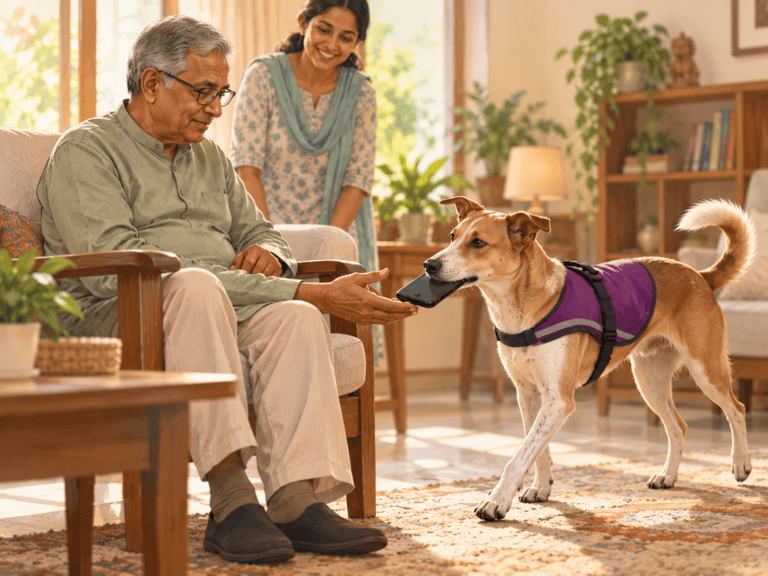
- Retrieving a phone or emergency item. Fetching a clearly labelled medication container or mobile phone from a known location. The dog cannot decide whether medication should be taken, administer it, or replace a clinician-approved seizure action plan - retrieval supports the person in following their own established plan.
- Activating an emergency response system. Dogs can be trained to press a wall-mounted button or smart-home device to trigger an alert to emergency contacts or, where appropriate, an emergency response system.
These tasks can be trained and assessed. A seizure response dog is not a substitute for medical care, prescribed treatment, seizure-safety planning or appropriate supervision - but for some people, particularly those who live alone or have seizures at night, a trained response dog may offer a useful additional layer of support.
Catala et al., PMC, 2018 · American Kennel Club - Seizure Response Dogs
When alert behaviour does emerge - and how it's shaped
Interestingly, the Catala et al. scoping review notes that in some programmes, alert behaviour emerged spontaneously in dogs that were originally placed for response tasks only. After months of close daily contact with their handler, some dogs began showing alert behaviours that hadn't been present at placement.
When this happens, experienced trainers may be able to recognise and reinforce those behaviours - making the alert clearer and more consistent. Current evidence does not show that reliable alert behaviour can be manufactured through standard training. When a dog begins displaying possible alert behaviour naturally, that is when shaping becomes possible.
This is why responsible seizure dog programmes train for response, not prediction. Response tasks can be trained and assessed. Alert behaviour, if it develops, is a bonus - not a guarantee and not a training target.
Why this matters for Indian families living with epilepsy
Epilepsy affects an estimated 10 to 12 million people in India - around one-sixth of the global burden, according to a peer-reviewed epidemiological review in the Annals of the Indian Academy of Neurology. A significant proportion remain undiagnosed or inadequately treated. The unpredictability of seizures is a major source of anxiety for both the person with epilepsy and their family, and it restricts independence, employment and daily participation in ways that extend well beyond the seizures themselves.
In an Indian household context, a trained seizure response dog addresses specific daily realities. A dog trained to alert family members in another room could be useful when a seizure is unwitnessed. For someone living alone, a dog trained to activate an alert system or retrieve a phone may provide an additional layer of support, alongside a seizure action plan, appropriate technology, and human backup.
The broader psychological value should not be underestimated either. The Catala et al. review found reports of improved quality of life among people living with seizure dogs, including reduced anxiety and greater willingness to engage in daily activities. These experiences are meaningful, but the underlying studies were methodologically weak - so they are best read as promising indicators rather than established outcomes.
What we are working towards
HeartDogs trains Indies - India's native landrace dogs - for assistance roles that include seizure response. We train for response tasks, not seizure prediction. The tasks listed above - staying, alerting, lying alongside, retrieving, activating alarms - are specific, trainable behaviours that provide real value to people living with epilepsy in Indian homes.
If alert-like behaviour develops naturally in a dog through its bond with its handler, a trainer may choose to observe and carefully reinforce it. But we will not promise something the science cannot support. What we can offer is training in specific response tasks, with the dog's suitability and performance assessed carefully over time. A dog should never be the sole safety plan for seizures - but for many families, a well-trained response dog is a meaningful addition to what is already in place.