Genuinely promising results, mostly from small, early studies
Cancer detection is one of the more extensively studied areas of medical scent-detection research, although the evidence remains uneven and is not yet sufficient for routine clinical use. Individual studies have reported striking results. One small preliminary study reported 100 percent sensitivity and specificity for identifying breast cancer urine samples, while a separate breath-sample study reported sensitivity of approximately 88 percent and specificity of approximately 98 percent for breast cancer. Other studies have reported high results for lung cancer and for colorectal cancer detection compared against colonoscopy, in the range of 91 to 97 percent sensitivity in some studies. These figures came from different studies and should not be treated as a single established performance estimate. Results vary considerably according to the cancer type, sample type, dogs, training method and study design. Breath samples have often produced encouraging results across this research, although performance varies by cancer type, sample type and study design. Researchers have proposed that volatile compounds may reach exhaled breath through several biological pathways, but the precise chemical signals involved are still not fully understood.
A notable recent example comes from India itself. A 2025 phase II, assessor-masked, multicentre case-control study across six hospitals in Karnataka evaluated trained dogs using breath samples collected on cotton surgical masks. The study included seven major cancer groups and combined individual dog responses with Bayesian modelling. Its reported results are promising, but the work should still be understood as analytical-validation research rather than evidence of a ready-to-use clinical screening test, and it was initially published as a preprint rather than a fully peer-reviewed paper. This kind of multicentre, India based research is exactly the sort of rigorous testing this field needs more of.
Kulgod et al., Multicancer Detection From Breath Samples, Phase II Study, India, medRxiv preprint, 2025 · Small Preliminary Study, Breast Cancer Detection From Urine by Dog Sniffing
Small studies, real heterogeneity, and no established clinical use yet
It would be easy to read those numbers and assume this is a solved problem waiting to be deployed. It is not, and researchers working in this field say so themselves. Many of the individual studies behind these encouraging figures involved a single dog, or a handful of dogs, tested on a relatively small number of samples, which limits how confidently the results can be generalised. Reviews pulling together this research consistently describe real heterogeneity between studies, meaning results vary considerably depending on the cancer type, the sample type, the specific dogs, and the training method used, and few studies have been run under the kind of large scale, double blind, prospective conditions that would be needed before any regulator or hospital could rely on this as an approved diagnostic method.
There is also a more basic scientific gap worth naming honestly: researchers still do not fully understand exactly which chemical compounds a dog is actually responding to when it correctly identifies a cancer sample. Some newer approaches are trying to combine canine detection with chemical breath analysis technology specifically to identify and validate those compounds, precisely because relying on a dog's judgement alone, without understanding the underlying chemistry, makes the whole approach harder to standardise, certify and scale.
Non-Invasive Multiple Cancer Screening, Scientific Reports, 2024
Why a therapy dog is not, and should not be, a detection dog
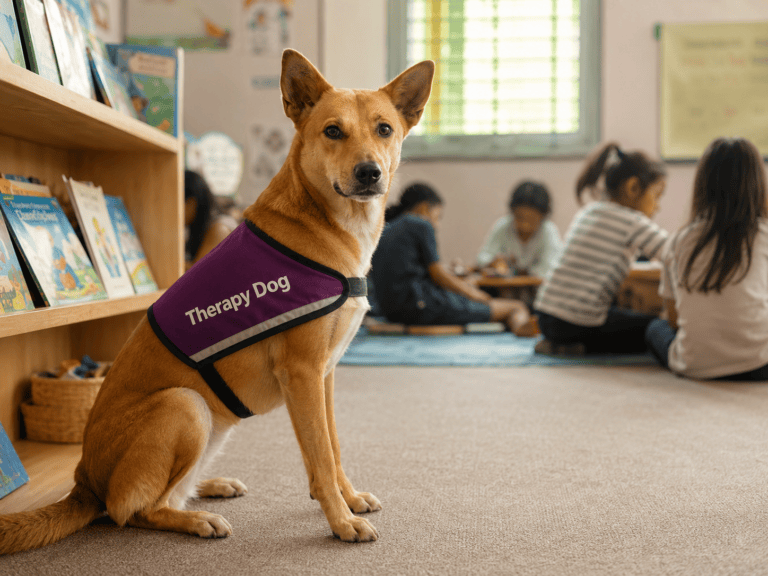
Beyond the science itself, there is a more practical reason these two roles do not overlap. A therapy dog's training is primarily built around calm, predictable behaviour around people, tolerance of hospital equipment and unfamiliar handling, and comfort in a busy, unpredictable ward. A detection dog's training is built around recognising an extremely specific scent target under controlled laboratory conditions, often working with collected breath, urine, tissue or other samples rather than being asked to comfort or assist a patient directly. These are genuinely different skill sets, developed through different training pathways, and these roles are not normally combined in established therapy dog or clinical cancer screening programmes.
This distinction matters for the same reason we wrote about the difference between a pet visit and a structured therapy dog programme. Using precise language protects the credibility of both fields. A therapy dog sitting beside a patient during chemotherapy is doing something real and valuable, offering comfort, exactly as we described in our earlier piece on therapy dogs in cancer care. It is not, and should not be described as, evidence that the same dog could also diagnose the cancer being treated.
Why this is not a direction we are pursuing
Cancer detection work is not part of our training programme, and is not a direction we plan to pursue. This is a specialised research field, closer to laboratory science than to the assistance and therapy dog work we actually train for, and it would need an entirely different kind of infrastructure, expertise and oversight than what we are building. Our dogs are trained for comfort, presence and specific assistance tasks involving direct, ongoing work with a person, not for laboratory-based diagnostic screening.
What we do think is worth doing is being clear about the difference, because the confusion between these two fields is genuinely common, and understandably so, given how emotionally compelling the idea of a cancer-sniffing dog is. The research on canine cancer detection deserves to be taken seriously on its own terms, as a real, if still early-stage, area of medical science, rather than folded into the very different, and equally real, work our therapy dogs already do.