Communication and travel run through touch
People with deafblindness communicate in many ways, depending on what they can still see or hear. The Indian Pediatrics article lists touch cues, gestures, object symbols, sign language, finger spelling, Braille and Tadoma, among others. A review of deafblindness in India adds that protactile communication, which is based on touch, still lacks training modules in the country.
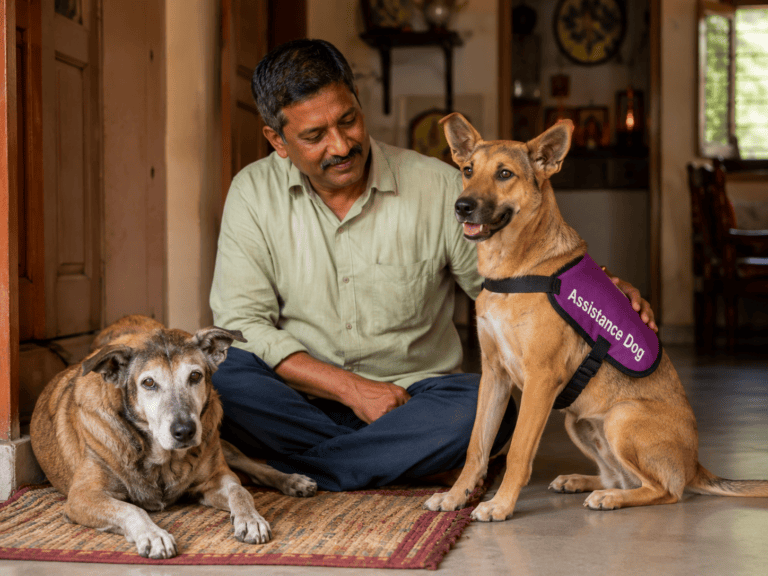
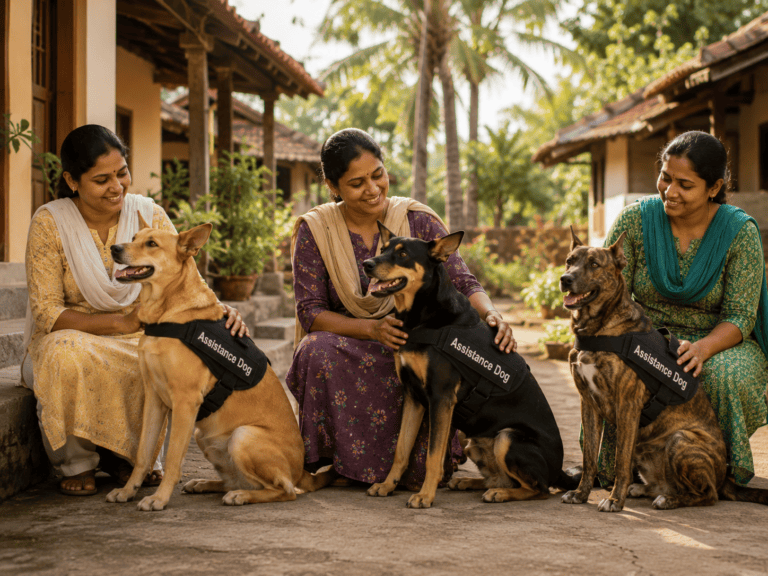
That matters for a dog. A hearing dog normally gets a person's attention with a touch and leads them to the source of a sound. A guide dog helps a person move around obstacles and drop-offs. Those roles are usually described for a person with one sense affected. With both affected, the dog's work and the way it is cued would need to be planned around the individual, with input from specialist trainers.
Sources: Indian Pediatrics (2019), deafblindness in India | Indian Journal of Clinical Psychology (2023), review of deafblindness in India | Sense International, our work in India
Guide work, hearing work, and dogs trained for both
The International Association of Assistance Dog Partners lists the tasks of guide dogs (avoiding obstacles, stopping at kerbs and stairs, finding doors and seats) and of hearing dogs (alerting to doorbells, alarms, a person's name, and leading the handler to the sound). It notes that guide dogs are sometimes partnered with deafblind students, and describes experiments combining the role of a hearing dog with that of a guide dog. It also says guide work is suited to large, sturdy dogs with sound joints.
One of the few written accounts we found is from the UK. In 2014, Guide Dogs and Hearing Dogs for Deaf People marked ten years of working together, and reported that they had trained 25 assistance dog partnerships for people with combined hearing and sight loss. One user described her dual-trained guide dog as making it possible to carry on. That is a personal account from a charity press release, so it shows that such partnerships exist, not how well they work. Over a decade, the organisations reported training 25 partnerships, which gives a sense of how specialised the work is.
Sources: IAADP, tasks performed by guide, hearing and service dogs | Veterinary Nurse Online (June 2014), a decade of collaboration between assistance dog charities
What research tells us, and what it does not
We did not identify studies specifically measuring outcomes for deafblind people partnered with assistance dogs. The closest research is on hearing dogs. A 2024 survey in Animals (Driscoll and colleagues) examined the relationships between hearing dog owners and their dogs, as well as the expectations of people on the waiting list, through responses from 58 owners and 23 prospective owners of Australian Lions Hearing Dogs. Owners reported that their dogs helped alert them to sounds including the door (96.6 per cent), smoke alarm (94.8 per cent) and oven (86.2 per cent). These are owner-reported figures, not independently measured alert accuracy. Waitlisted people expected companionship and security from the dog as well as sound alerts.
The authors list limits: self-reported answers, moderate response rates, one Australian provider, and no before and after comparison. The paper did not report whether participants had deafblindness, so it cannot establish outcomes for dual sensory loss. It tells us something about hearing dogs, not about deafblind partnerships.
Dogs trained for people with both hearing and sight loss do exist, but we did not identify published studies directly evaluating their outcomes. Any potential placement would need careful, individual planning with specialists.
Source: Driscoll et al., Animals (2024), hearing dog owners survey
What a dog cannot replace
A dog does not replace communication support, specialist education or rehabilitation. The Indian Pediatrics article describes a team approach, including early identification, individual education plans and ongoing review, and a dog would only ever sit alongside that. A dog also cannot make up for gaps in the environment, such as signage, public transport and information that are not accessible. Anyone who is considering a dog should talk to specialists in deafblindness and to the people who support them, since what suits one person may not suit another.
Deafblindness and assistance dogs in India
The Rights of Persons with Disabilities Act 2016 includes deafblindness, a recognition that Sense International India credits to years of advocacy. The organisation says that few people with deafblindness in India receive specialist support. Our post on the RPWD Act explains the law more widely.
We have not identified a nationally standardised route for obtaining or funding a guide dog, hearing dog or other assistance dog (service dog) for a person with deafblindness in India, and such dogs may not yet be widely available. For the single-sense picture, see our posts on hearing loss and what each type of assistance dog does.
Where HeartDogs stands
HeartDogs does not currently train dogs for people with deafblindness, and we are not making claims about doing so. We wrote this post because the question comes up, and because it is an area where careful, individual planning with specialists would have to come first. Our work is focused on building a systematic programme for assistance dogs (known as service dogs in some countries) in India.