The gap between training and the real world
Most training happens in conditions that are calmer and more controlled than the environments a working dog will eventually operate in. A hospital has unpredictable noise, strong smells, unfamiliar equipment, people in distress, trolleys moving suddenly, alarms going off. A school has crowds of people, running, calling out, sudden movement in every direction. A busy Indian market can combine movement, noise, smells, vehicles, animals and close human contact in ways that may challenge an individual dog.
A dog that has not been prepared for these environments cannot reasonably be expected to perform reliably in them. That does not necessarily make the dog unreliable - it may simply mean the behaviour has not yet been generalised to that level of difficulty. The tasks may be well established in calm conditions, but performance may not transfer automatically to environments that differ substantially from those in which the tasks were trained. Distraction proofing is the work that makes tasks stable across environments, not just within them.
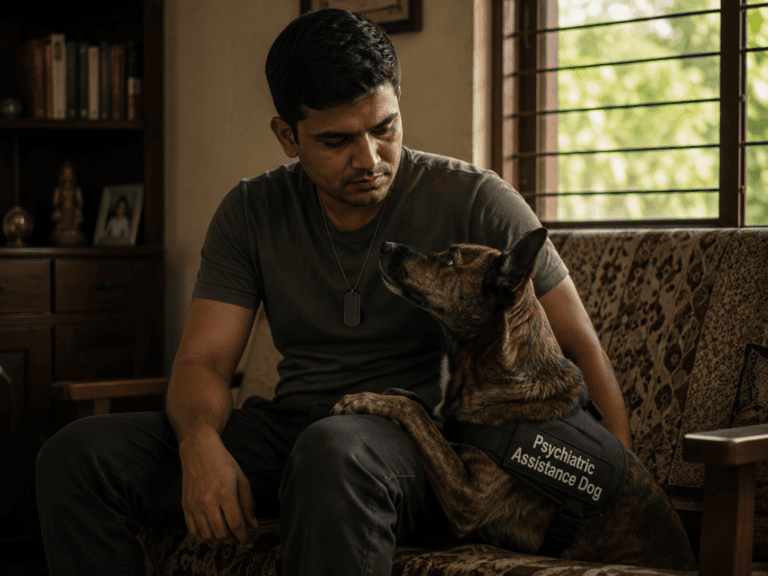
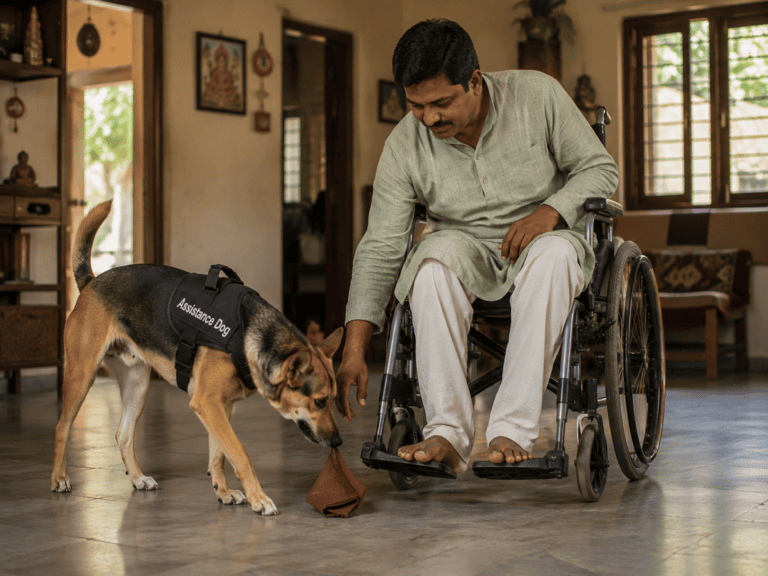
For an assistance dog, this stability has direct safety implications. A mobility assistance dog that loses focus when someone drops something nearby may pull its handler off balance at exactly the wrong moment. A psychiatric assistance dog that becomes overwhelmed in a public space cannot provide grounding when its handler needs it most. A therapy dog that reacts to a school bell during a reading session has done the opposite of its intended purpose.
What research on distraction in working dogs actually tells us
Research using dogs to model how distraction affects learning and performance has produced some counter-intuitive findings relevant to anyone training assistance dogs. Both studies cited below used pet dogs rather than operational working dogs, so their findings should be understood as informing working-dog training principles rather than directly measuring assistance dog performance in real-world settings.
A 2023 study published in Applied Animal Behaviour Science examined how training with an auditory distractor affected dogs' ability to learn a task and later perform it in the presence of novel distractions. The key findings were: dogs trained with an auditory distractor present during learning acquired the task less efficiently than dogs trained in silence. And - importantly - dogs trained with a specific distractor did not automatically perform better when tested with novel distractions. Training with one distractor did not automatically generalise to tolerance of different distractors.
This is a significant finding for how distraction proofing should be sequenced: the initial stages of learning a task should happen in a calm, low-distraction environment. Distractions are introduced after the task is established, not during the learning of it. The research supports beginning new-task learning in a calm, low-distraction environment, then introducing relevant distractions after the behaviour is established - though this does not mean every form of distraction must always be excluded during every stage of learning.
A 2024 PLOS One study using 12 pet dogs representative of various working-dog types found that acoustic distraction significantly impaired both physical and cognitive task performance. Most strikingly, nine of the eleven dogs that underwent the acoustic distraction condition dropped out before completing it - with one of the twelve enrolled dogs excluded from that condition due to health issues. The researchers interpreted this pattern as sensitisation in most dogs, though two dogs appeared to habituate. In this experiment, repeated exposure to a sudden acoustic distractor appeared to produce sensitisation rather than habituation in most dogs - the opposite of what unstructured exposure might be assumed to achieve.
In this study, sudden changes in noise and, to a lesser extent, flickering light impaired aspects of dogs' physical and cognitive task performance. The findings suggest that effective distractor-response training may be important for dogs expected to work in similarly dynamic environments. Repeated uncontrolled exposure may amplify rather than reduce these effects.
These findings are from studies using pet dogs in laboratory settings, and their direct application to purpose-trained working dogs should be interpreted carefully. But they point to principles that experienced trainers consistently report: distractions must be introduced systematically, and exposure alone does not reliably produce the tolerance that working dogs need.
Applied Animal Behaviour Science, 2023 · PMC - Working dogs in dynamic environments, 2024
The types of distraction a working dog must manage
Distractions fall into several categories, each of which requires systematic attention in a distraction proofing programme:
- Food on the ground or nearby. One of the most powerful and universal distractors. A dog that breaks a stay or loses attention because food is nearby cannot perform reliably in kitchens, canteens, markets or any public space where food is present. For many assistance-dog programmes, reliable non-scavenging and the ability to disengage from food when cued are important public-access and safety behaviours. The exact standard varies by programme, role and handler context.
- Other animals. Other dogs, cats, cows, stray animals - particularly relevant in Indian environments. A dog that reacts strongly to another animal may be unable to maintain its working role safely in settings where animals are present.
- Unfamiliar people and behaviour. People moving suddenly, approaching unexpectedly, bending down towards the dog, speaking in unusual tones, wearing unusual clothing - including uniforms, medical attire or face coverings. An assistance dog will encounter all of these in its working life.
- Acoustic distractions. Sudden loud noises, alarms, bells, crowd noise, vehicles, construction, animal sounds. The research above specifically identifies acoustic distraction as one of the most challenging categories - one that can produce sensitisation rather than habituation if managed poorly.
- Unfamiliar equipment and objects. Wheelchairs, crutches, IV drips, medical monitors, trolleys, luggage, prams. Any unfamiliar object that moves or makes sound is a potential distractor. A dog working in a hospital or school should be systematically introduced to, and able to work safely around, the range of equipment it will encounter.
- Environmental novelty. Different flooring textures, smells, lighting conditions, enclosed spaces, lifts, stairs. A dog comfortable on marble floors may react differently to carpet or rubber matting. Each environmental variable is a potential disruption to stable performance.
How distraction proofing is built - and why order matters
Based on these findings and established training principles, a practical distraction-proofing sequence looks like this:
- Establish the task first. In a calm, low-distraction environment, the task must be solid before distraction is introduced. A dog that can sit and stay reliably in a quiet room is a different starting point from a dog that sometimes sits in a quiet room.
- Introduce the weakest distraction first. Distraction is introduced at its lowest intensity - a mild noise at a distance, a person moving slowly at the periphery, food present but far away. The dog is rewarded for maintaining its behaviour in the presence of the mild distraction. Success at this level is the condition for moving forward.
- Increase one variable at a time. Distance to the distraction decreases, or intensity increases, or duration extends - but not all at once. Increasing multiple variables simultaneously tends to push the dog past its threshold and produce failure rather than learning.
- Vary the distraction, not just the intensity. Because training with one distractor does not automatically generalise to others, a wide range of distractor types must be covered. A dog proofed against food on the ground is not automatically proofed against a passing dog. Each category of distraction requires its own systematic introduction.
- Work below threshold. The dog should be challenged but not overwhelmed. Repeatedly breaking the trained behaviour may indicate that the current distraction level is too difficult. In those cases, reducing the intensity or increasing the distance from the distractor - rather than persisting - is the appropriate response. Progress happens at the edge of capability, not beyond it.
- Proof in the actual environments. A dog proofed against acoustic distraction in a training facility may still struggle in a hospital corridor where the acoustics, the smells and the context are all different. Proofing must eventually happen in the environments where the dog will work, not only in training settings that approximate them.
Why trainers often identify this as one of the most demanding aspects
Distraction proofing is hard for a specific set of reasons that compound on each other.
It is slow by design. Progress is measured by how reliably the dog performs across an ever-wider range of conditions - which means the measurement of progress is itself gradual. A task that is solid in five environments may need ten more before it is genuinely stable.
It is highly individual. Dogs vary dramatically in what they find distracting. One dog may be unbothered by loud noise but reactive to other animals. Another may ignore food on the ground but lose focus when people move quickly nearby. Distraction proofing cannot be delivered as a standard curriculum - it must be mapped to each dog's specific sensitivities and to the specific environments it will work in.
It is never fully complete. A dog proofed against the distractions it has encountered may still show disruption when encountering a truly novel situation. This is not a failure of training - it is the nature of generalisation. Experienced handlers know to manage novel environments carefully even with well-proofed dogs.
And in the Indian context, it requires specific attention. Indian public environments - markets, temples, hospital waiting rooms, school assemblies - can each combine movement, noise, smells, animals and close human contact in ways that may challenge an individual dog. Building reliable performance therefore requires exposure to a sufficiently broad range of these environments, rather than assuming that success in one setting will automatically transfer to another.
How HeartDogs approaches distraction proofing
In the HeartDogs programme, distraction proofing begins after tasks are established in the home environments where our Heroes raise each dog. The home itself provides the first layer - the dog learns to work despite the normal noise and activity of a real Indian household, rather than learning only in a controlled training facility.
Beyond the home, systematic exposure to progressively more complex environments - markets, public spaces, institutional settings - builds the range of distraction tolerance the dog will need. This is not a checklist to complete. It is an ongoing process that continues until placement and, through post-placement support, beyond it.
It is also one of the reasons our minimum training timeline is what it is. A dog may learn the mechanics of a task in days or weeks. Developing reliable performance across a broad range of environments generally requires much longer - often months of structured practice, generalisation and assessment.