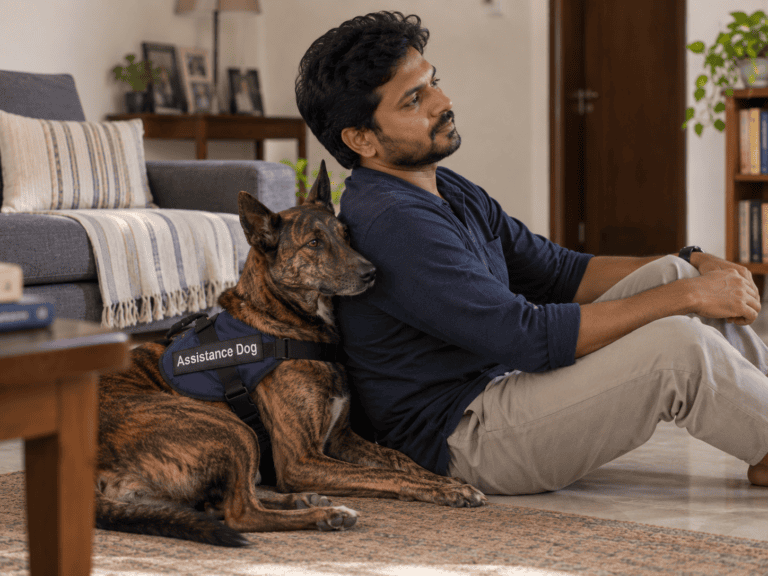
What a trained assistance or service dog can help with
- Retrieving and carrying. Picking up dropped items such as keys or a phone and bringing them to the person. This is among the most common mobility tasks and does not depend on the dog bearing any weight.
- Doors, lights and household tasks. Typical tasks include opening and closing doors and drawers or pressing switches, using cues the person can give with limited hand movement.
- Support during transfers. A Quebec research summary reports that service dogs provided practical support during transfers to and from bed, reducing reliance on reaching aids or another person's help for some tasks. This should not be read as the dog bearing the person's body weight. Tasks must be matched to the individual's abilities and to what is safe for the dog.
- Getting around. The same summary reports that users were better able to pass through doors and over kerbs, slopes and soft surfaces. Some dogs also pull a manual wheelchair, but only some dogs are suited to it.
- Getting help. A dog can be trained to bring a phone or to alert another person. Our post on whether assistance dogs can detect medical emergencies explains why this is different from detecting a medical problem.
For a longer list, see our post on what tasks a mobility assistance dog can perform, and for the wider picture, what a physical disability involves.
Source: Quebec Chief Scientist, research impact summary on mobility service dogs
What the research shows so far
- A systematic review. A 2020 review in PLoS One (Rodriguez and colleagues) covered 27 studies of assistance dogs and psychosocial health. Eighteen involved mobility assistance dogs. Some included people with spinal cord injury, but the review did not analyse SCI outcomes separately. Of 147 comparisons, 68 per cent showed no difference, 30 per cent were positive and 2 per cent were negative. The positive findings included psychological wellbeing, emotional functioning, self-esteem and vitality. The review was about psychosocial health, not physical independence.
- The authors' own caution. They said several methodological weaknesses make it difficult to draw definitive conclusions. Most positive results came from published papers, while most null results came from theses.
- A small Quebec study. Researchers assessed 21 manual wheelchair users before and after they were paired with a service dog. The summary reports less shoulder and wrist pain and less need for help with some tasks. This is a small study reported through a research summary, so it is better read as encouraging than conclusive.
The evidence suggests assistance dogs (service dogs) may support wellbeing and aspects of daily participation for some people with mobility impairments. The studies are small, and few that we found look at spinal cord injury on its own.
Sources: Rodriguez et al., PLoS One (2020) | Quebec Chief Scientist, research impact summary
What a dog cannot, or should not, be asked to do
- Bearing a person's weight. Bracing dogs may provide limited balance support during sit-to-stand movements, but they should never be expected to carry a person's body weight. Depending on the injury and the person's ability to bear weight, bracing may not be appropriate for many people with SCI, and a rehabilitation professional and a suitably qualified mobility-dog trainer should assess whether any form of support is suitable. HeartDogs does not train dogs for weight-bearing support.
- Physically demanding work needs individual assessment. One US training organisation's guidance says tasks such as bracing and wheelchair pulling put repeated load through a dog's frame, and call for veterinary clearance, purpose-built equipment and a dog assessed as physically suitable. Tasks that do not involve load, such as retrieving, opening doors, pressing switches and getting help, suit a wider range of dogs.
- Medical monitoring. A dog is not a substitute for medical care or an emergency plan. We have not identified research showing that dogs can detect or prevent medical emergencies linked to spinal cord injury.
- Fit with the person. An assistance dog or service dog suits some people and homes better than others. Hand function, wheelchair type, living situation and the ability to care for a dog all matter, and a rehabilitation team can help with that decision.
Sources: Partners Dog Training, bracing and stabilizing | Partners Dog Training, wheelchair pulling
Spinal cord injury and daily support in India
The International Health Policies article notes gaps in prevention, assistive technology and rehabilitation services, and that many patients and carers are daily wage earners who struggle to reach hospital-based rehabilitation. In that setting, family members are likely to provide much of the day-to-day help, though we have not seen national figures on this. Our post on why assistance dogs and not just human caregivers looks at how the two fit together.
We have not identified a nationally standardised route for obtaining or funding an assistance dog (service dog) for SCI in India, and such dogs may not yet be widely available. Our posts on how to get an assistance dog in India, what one costs and what the RPWD Act says explain the current picture.
What HeartDogs is doing
HeartDogs is working towards training assistance dogs (known as service dogs in some countries) for mobility-related tasks that do not involve bearing a person's weight, matched to the needs of an individual person. Decisions about each dog's tasks are meant to be made one dog at a time, with veterinary input, so that the dog's welfare is protected as well as the person's independence.