A body that requires constant management
The challenge with EDS is not one big event. It is the accumulation of small ones. Dropping something and not being able to bend safely to retrieve it. Needing to open a heavy door with already-strained wrists. Losing balance briefly and grabbing for something that isn't there. A joint shifting during a task that should have been completely ordinary.
Chronic pain and fatigue are common for many people with hEDS. So is the cognitive load of planning every physical action in advance. Getting dressed, cooking, moving from one room to another - all of these can require a level of physical planning that most people never have to think about. Over years, this is exhausting in a way that is difficult to communicate to people who haven't experienced it.
EDS and hypermobility disorders can also occur alongside POTS - a condition that can cause dizziness, a racing heartbeat, or near-fainting when standing - though how often the two co-occur varies between studies. Anxiety and depression are also reported more often among people with EDS. Living with chronic pain, fatigue, physical limitations, and an often-misunderstood condition can affect mental health. Getting a diagnosis can take many years, and misdiagnosis - anxiety, fibromyalgia, "just being flexible" - is common along the way.
Specific tasks for specific problems
A mobility assistance dog for EDS is trained to reduce the physical risk and daily burden of living with unstable joints and unpredictable symptoms. The Ehlers-Danlos Society itself lists retrieval, carrying, opening things, light switches, balance assistance, and alerting as tasks that service dogs may be trained to perform for people with EDS. These are also among the most concrete and trainable assistance dog tasks there are.
- Picking up dropped items. For many people with hEDS, this is one of the most useful tasks a dog can perform. For someone whose joints are unstable, repeatedly bending to retrieve things from the floor can be painful, tiring, or increase the risk of a subluxation or injury. A dog trained to pick things up - keys, phones, medication, pens - removes that strain from dozens of ordinary moments every day.
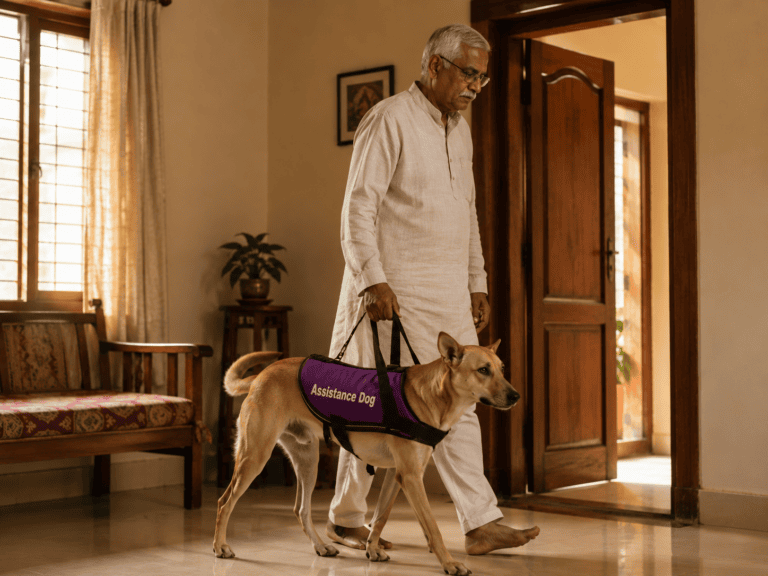
- Opening and closing doors. Pulling open heavy doors strains the shoulders and wrists. A dog trained to push doors open with their nose or paw, and pull them closed, removes that load.
- Carrying items. A dog trained to carry a bag, fetch items from another room, or bring things from a lower surface reduces how often the handler has to reach, bend, or strain unnecessarily.
- Alerting after a fall. A dog trained to activate an alert device, bark to attract attention, or fetch a designated person can provide a safety measure after a fall. It cannot assess medical seriousness or replace emergency care, but having something that responds when you go down and can't get up quickly matters.
- Switching lights on and off. Reaching for light switches strains the shoulder. A dog trained to operate adapted switches throughout the day reduces that cumulative load.
- Staying close during dizziness. For someone with EDS and co-occurring POTS, a dog may be trained to stay close during episodes of dizziness, help the handler reach a safer position, or alert another person when help is needed.
- Helping the handler push up from the floor. If the handler has carefully lowered themselves, or has fallen without serious injury, a dog can be trained to provide a stable point of contact for pushing up - not taking the handler's weight, but offering something firm and steady to push against. How this is done needs to be assessed individually by a qualified trainer, because the safest method depends on both the handler's joints and the dog's size, structure, and conditioning.
Service Dog Tasks for EDS, The Ehlers-Danlos Society | EDS Service Dog Tasks, Hope Service Dogs
The weight-bearing question
Here is the honest part of this article, and it matters particularly in the context of HeartDogs.
Many EDS assistance dog guides talk about bracing - where the dog positions itself so the handler can lean on them heavily while walking, or use them as a full counterbalance to stay upright. This is a real task. But weight-bearing or counterbalance work requires a dog whose size, structure, joints, conditioning, and training have been specifically assessed for that task. Asking a dog to bear a handler's weight without that assessment risks injuring the dog.
The Indies we train at HeartDogs are generally medium-sized, lean, and athletic. At HeartDogs, we do not train our dogs for tasks that involve bearing a person's weight. This is a welfare decision as much as a practical one: we will not put a dog in a role that risks their joints and long-term health. Whether any particular dog is suitable for weight-bearing work is a separate assessment that should consider the individual dog's size, structure, joints, conditioning, and the demands of the specific task.
What this means for someone with EDS considering a HeartDog: retrieval, alerting, door work, carrying, light switches, and the safety tasks around falls - all of these are within what a well-trained Indie can do well. Full weight-bearing bracing while walking is not in our programme. If that is the central need, a larger specifically assessed dog through a specialist programme would be the right fit.
The most important EDS assistance dog tasks - retrieving dropped items, alerting after a fall, carrying, door work - do not require a large dog. They require a well-trained one. That is a distinction worth making clearly.
Looking fine while managing a lot
EDS is often invisible. Many people with hEDS do not have visibly obvious symptoms. They are often young, often women, and their symptoms - joint pain, fatigue, the constant physical planning - are not visible from the outside. They may be told they are exaggerating, that everyone's joints click, that they should push through. Years can pass before someone identifies what is actually going on.
An assistance dog can make an otherwise invisible disability more visible. For some people, that makes it easier to explain why they need additional space, time, or accommodation in public spaces, workplaces, and social situations. We covered invisible disabilities more broadly in an earlier FootNotes piece. EDS is one of the clearer examples of the category.
EDS also connects naturally to blog 83 on POTS, since the two conditions frequently occur together. A dog trained for EDS-related tasks may also support some POTS-related needs - staying close during dizziness, alerting after a near-faint, retrieving medication. The task sets overlap more than they conflict.
A condition that is difficult to diagnose even where it is well known
There are no reliable India-specific prevalence figures for EDS. The condition can be difficult to diagnose even in countries with established diagnostic pathways and specialist centres - the Ehlers-Danlos Society notes that the true prevalence of hEDS is not yet known and that current estimates are likely to be underestimates. Without India-specific data, the size of the undiagnosed population here is genuinely difficult to quantify.
Diagnosis can be challenging even in countries with established pathways. People may initially be told they are simply very flexible, or receive treatment for individual symptoms such as pain and fatigue without the underlying connective-tissue disorder being recognised. This is not unique to India - misdiagnosis before a correct EDS diagnosis is common worldwide. Limited specialist services and lower awareness may make the path to diagnosis longer for many people in India, though India-specific data on this is not available.
We have not identified a documented EDS assistance dog programme in India. At HeartDogs, mobility disability is one of the central areas we are building toward. EDS is a condition we are actively thinking about as we develop what kinds of assistance tasks the programme will eventually support.
Are the Ehlers-Danlos Syndromes Rare or Common? The Ehlers-Danlos Society
Practical tasks, real limits, part of a larger plan
The case for assistance dogs in EDS is practical: many of the tasks are specific, concrete, and directly connected to everyday difficulties caused by joint instability, pain, or fatigue. Retrieval, carrying, door work, and alerting are established types of assistance dog tasks. The right task set depends on the person's needs and the dog's capabilities - and that assessment should always involve a qualified trainer.
A dog does not fix EDS or stabilise joints. It reduces the daily risk and energy cost of managing a condition that never fully goes away. For someone with EDS in India - where we have not identified a documented EDS-specific assistance dog programme - that reduction could matter a great deal.
This article is for information only and is not medical advice. Anyone who thinks they might have EDS should seek assessment from a doctor familiar with connective tissue disorders. Assistance dog tasks should be designed with qualified professional trainers and, where relevant, clinicians.