Obsessions, compulsions and a lot of lost time
The US National Institute of Mental Health (NIMH) describes obsessive-compulsive disorder (OCD) as a long-lasting condition involving recurring, unwanted thoughts, urges or images (obsessions), repetitive behaviours (compulsions), or both. Common examples are fear of germs, fear of harm, a need for symmetry, and compulsions such as washing, checking, counting or arranging. People with OCD generally spend more than an hour a day on these, find them hard to control even when they know they are excessive, and get relief that lasts only briefly.
Symptoms can begin at any time, but usually start between late childhood and young adulthood. They often fluctuate and tend to worsen under stress. In a US survey from 2001 to 2003, about 1.2% of adults had OCD in the past year, and just over half of them had serious impairment. Cognitive behavioural therapy involving exposure and response prevention (ERP), and selective serotonin reuptake inhibitors (SSRIs), are evidence-based treatments. Many people manage symptoms with treatment, although symptoms can persist or return.
A dog is not a treatment for OCD, and must not become part of the symptoms
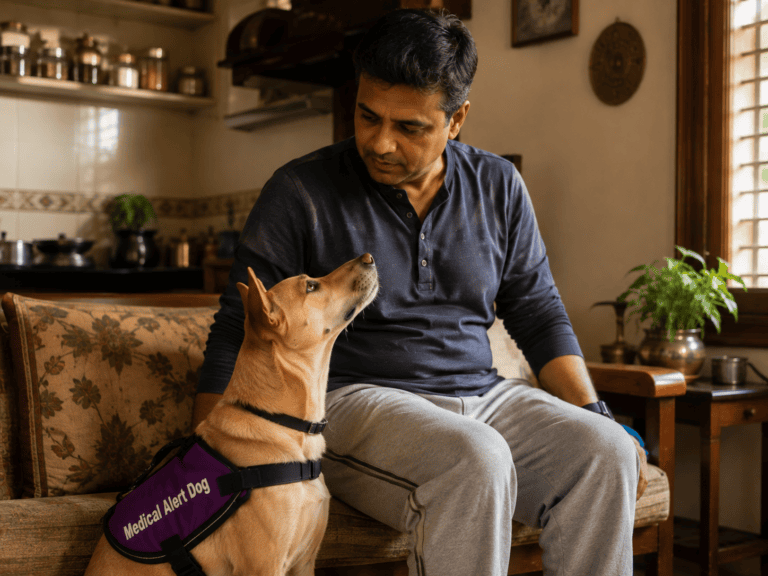
A trained dog does not treat OCD. Therapy such as ERP, and medication where appropriate, remain the foundation of care. An assistance dog (also known as a service dog in certain countries, including the US) is, at most, one part of a wider plan agreed with the person's clinician.
OCD also raises a particular concern that most other conditions do not. ERP works by helping a person face a feared trigger without carrying out the compulsion. A dog that is trained to interrupt, soothe or reassure could, if poorly designed, become one more way of avoiding the discomfort ERP is meant to build tolerance for. Whether and how a dog fits alongside therapy is a question for the person and their treating clinician, and it is one reason we are cautious about this topic.
Possible, but individual and mostly borrowed from other conditions
Most of what is described for psychiatric assistance dogs comes from work on conditions such as PTSD, anxiety and depression. A 2023 scoping review of assistance dogs in mental health care, drawing on evidence that includes a survey of Australian psychiatric assistance dog handlers, listed tasks such as providing touch to reduce anxiety, nudging or pawing to interrupt distress, interrupting undesirable behaviour, and deep pressure. OCD was among the less common conditions in that group, and the review gave no OCD-specific tasks or evidence. See our pieces on what a psychiatric assistance dog actually does and assistance dogs and anxiety.
For a person with OCD, tasks that might be considered, with clinical input, include the following. These are examples to discuss, not established OCD tasks or proven benefits.
- Responding to distress. Staying close, or offering touch or deep pressure when the person asks for it during an anxious period, as in other anxiety-related work.
- Prompting routines. Responding to the person's own alarm cue for a medication time or a planned activity, so that the person is reminded to act. The dog does not know the time. It responds to a cue the person sets up.
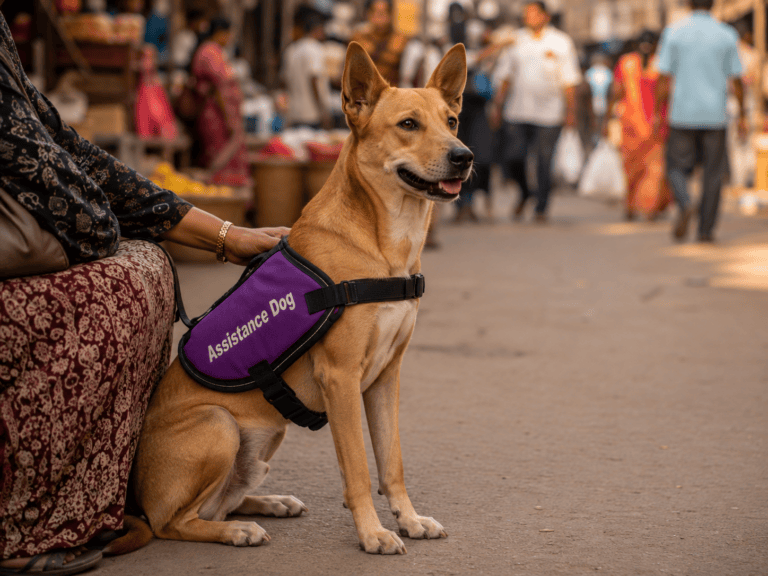
- Supporting leaving the house. Some people find it easier to go out with a dog beside them. This is a possible benefit of companionship and routine, and we did not find evidence on it for OCD.
Tasks that interrupt a compulsion directly, for example by nudging a person who is washing or checking, are sometimes described online. We did not identify evidence on them, and they are the kind of task that needs the most careful discussion with a clinician, for the reason given above.
Almost nothing specific to OCD
We did not identify any study of assistance dogs or service dogs trained specifically for people with OCD. The broader evidence on psychiatric assistance dogs is itself limited. The 2023 scoping review notes that few studies look at the tasks dogs perform, that none separate the effect of trained behaviours from the effect of simply having a dog, and that welfare research on the dogs is scarce. It also reports that in the Australian survey, more than half of the handlers did not self-report a drop in their need for psychiatric care. The authors call for more rigorous, longer-term studies.
So the honest picture is that some people with OCD may find a dog comforting or helpful with daily routines, but there is no research that tells us how often, for whom, or which tasks matter. Anyone considering a dog for OCD should be wary of a programme that promises it will reduce symptoms.
Questions that are particular to OCD
These are considerations for programmes, based on how OCD works, not research findings.
- Contamination fears. A dog brings hair, saliva, paws that have been outdoors and toileting needs. For someone with contamination obsessions, this may be very hard to live with, or could draw the dog into cleaning rituals.
- Rituals around the dog. Care routines such as feeding, grooming and walks can turn into checking or washing routines, which would be bad for the person and for the dog's welfare.
- Reassurance. A person with OCD may seek reassurance repeatedly, and a dog should not become the source of it.
- Timing. A dog is a long commitment. Timing should be discussed with the person's treating clinician, taking account of current symptoms, treatment goals and the practical demands of caring for a dog.
Little data, and likely under-recognition
A 2025 expert opinion article reports an OCD prevalence of about 0.76% from India's National Mental Health Survey 2015-16, and suggests that stigma and reluctance to disclose intrusive thoughts may contribute to under-reporting. An earlier 2010 review from NIMHANS in Bengaluru found only one Indian population study at that time, reporting a lifetime prevalence of 0.6%, and said more Indian research was needed. These estimates come from different sources and measures, and should not be treated as a current, definitive national rate. The 2010 review also described OCD as causing disability and family burden comparable to schizophrenia, and the 2025 article notes that diagnosis is often delayed because patients are reluctant to share their symptoms.
We have not identified information on assistance dogs for OCD in India, or on how widely ERP is available. Public access rights for assistance dogs are also not set out in a single national framework, as we explain in our piece on assistance dog certification and the law. A person with OCD should check the rules for each setting, such as workplaces, colleges and transport, and not assume a dog will be admitted.
Reddy et al., An overview of Indian research in obsessive compulsive disorder, Indian Journal of Psychiatry, 2010 | Porandla et al., Expert opinion on challenges in the diagnosis and treatment of OCD in India, 2025 (reports the National Mental Health Survey 2015-16 figure)
Starting with the foundations of anxiety and psychiatric support
Supporting people with mental health conditions, including OCD, is part of the long-term direction we are working towards. For a condition where the line between help and reinforcing symptoms is thin, we would want psychiatrists and psychologists involved from the start, and a careful assessment of the person, the family and the dog together. Our dogs are trained in family homes with children around, not in kennels, by women in rural India working as paid foster-trainers, using cues rather than commands and reward-based methods, so they grow up calm in real household life.