More than being sleepy
Narcolepsy is a long-term neurological condition that disrupts the brain's control of sleep and wake cycles. According to the US National Institute of Neurological Disorders and Stroke (NINDS), everyone with narcolepsy has excessive daytime sleepiness, which can come on suddenly as a "sleep attack" and can persist even after enough night-time sleep. Night-time sleep is often broken as well.
Some people also have cataplexy, a sudden loss of muscle strength, often set off by strong emotions such as laughter. It can range from drooping eyelids to a full collapse. The person stays conscious, and episodes usually last from seconds to minutes. Other symptoms include sleep paralysis and vivid hallucinations while falling asleep or waking. Narcolepsy with cataplexy or low hypocretin levels is called type 1, and narcolepsy without these features is type 2. Symptoms usually begin between ages 7 and 25. There is no cure, but medication and lifestyle changes can help manage symptoms.
Cataplexy can be mistaken for epilepsy or fainting, and narcolepsy is often misdiagnosed as a psychiatric condition, which can delay the correct diagnosis for years. For many people the hardest parts are unpredictability, safety around falls and driving, and how others misread them as lazy or inattentive.
A dog does not treat narcolepsy or keep a person awake
A trained dog does not treat narcolepsy, reduce sleepiness or prevent cataplexy. Medical care, a regular sleep routine, planned naps and, where relevant, advice on driving remain the foundation. An assistance dog (also known as a service dog in certain countries, including the US) may help with some safety and daily-life tasks around the condition. It is one part of a plan, not a replacement for any of it, and it is never a reason to drive when sleepy.
Responding after an episode, and supporting routines
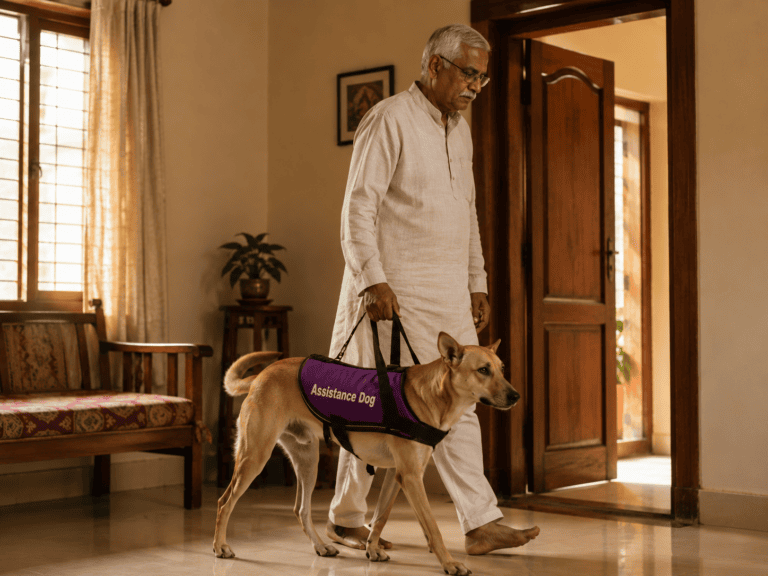
Assistance dog or service dog tasks for narcolepsy have to be designed around one person's situation. Depending on the person, they might include:
- Getting help. Going to find another person, or activating an alert device, when the person has collapsed or cannot respond.
- Fetching. Bringing a phone, water or another pre-agreed item that the person can safely use, and helping them follow their recovery plan after an episode.
- Responding to the person's alarms. A dog can be trained to respond to a cue, such as a phone alarm set for a medication dose, by going to the person and nudging or staying close. The dog does not tell the time. It responds to a cue the person sets up, and the person still has to act on it.
- Waking cues. Some people use a dog to help rouse them from sleep, for example in response to an alarm, using touch. This should be agreed with the person, since sudden contact can startle someone who is half asleep.
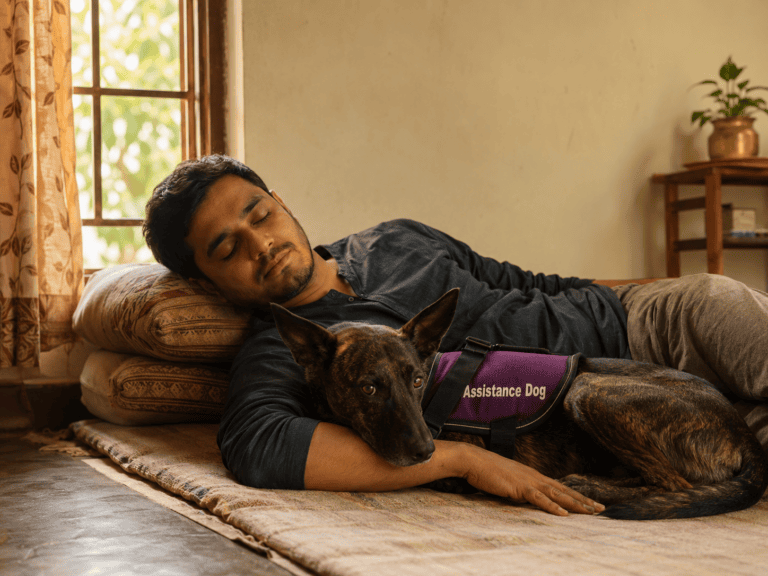
- Staying with the person. Remaining calmly beside the person after an episode, which may also help others see that they need space and time.
Because cataplexy and seizures can look alike, tasks that help a person get assistance after a collapse overlap with those for other conditions. Our piece on what a mobility assistance dog can do in an Indian home covers some of the retrieving and getting-help tasks in more detail.
This is the claim people ask about most, and it is the least proven
Some programmes and trainers say that dogs can warn of an oncoming sleep attack or cataplexy, in some accounts several minutes in advance, so the person can sit down or get to a safe place. In one 2014 trade magazine report, a trainer attributed this to a change in body odour. We did not identify any published study that tests whether dogs can reliably do this.
The research people most often point to is a small Spanish study from 2013. Two trained Labrador retrievers from the Spanish Civil Guard were given sweat samples from 12 people with narcolepsy and 22 people without it, in a double-blind set-up. The dogs picked out 11 of the 12 samples from people with narcolepsy and also flagged 3 of the 22 control samples. The authors suggested that people with narcolepsy may have a distinctive body odour, and that a smell-based screening test could be worth studying. They noted that a positive result would not be enough for a diagnosis on its own.
That is a different question from whether a dog can warn a person minutes before an attack. The study tested samples from people with narcolepsy against controls, not samples taken before an episode. It was very small, described by its authors as preliminary, and has not, to our knowledge, been replicated. It does not show that a dog can predict an attack for an individual.
If a programme says it trains dogs to alert to sleep attacks, it is fair to ask how that was tested, how often the dog was right and wrong, and what it would mean for the person if the dog missed one. A person should never rely on a dog's warning for safety.
Dominguez-Ortega et al., Narcolepsy and odor: preliminary report, Medicina de Familia SEMERGEN, 2013 | Sleep Review, Service dogs support narcolepsy patients, 2014 | UK Health Research Authority, study summary: medical alert assistance dogs for Addison's disease, narcolepsy and PoTS
Mostly accounts from trainers and programmes
We did not identify any controlled study of assistance dogs or service dogs for narcolepsy, or any published study measuring how they affect safety, injuries or quality of life. What exists is mainly descriptions from trainers and programmes, which are worth listening to but do not tell us how often the dogs help, for whom, or which tasks matter most. A UK research protocol has been designed to assess whether medical alert assistance dogs reliably and accurately alert people before narcoleptic sleep attacks, as well as episodes in Addison's disease and PoTS. We did not identify published results from that study, so it is a planned evaluation and not evidence of effectiveness. The honest summary is that the response tasks are plausible and widely described, the warning claim is unproven, and the research has not yet caught up with the practice.
What a programme has to think about
Narcolepsy raises some questions that are particular to it, and they are mostly considerations for programmes, not research findings.
- Falls and weight. Some programmes describe training dogs to position themselves so a person can lean on them during a collapse. This puts physical load on the dog and can injure either of them. HeartDogs does not train dogs to bear weight or provide bracing support.
- Emotion as a trigger. Because strong emotions can trigger cataplexy for some people, a programme should consider whether a highly excitable dog fits that person's triggers and daily routine. A calm temperament matters.
- A dog that rests a lot. A person with narcolepsy may nap during the day and sleep unpredictably, so a dog must be comfortable settling for long periods, and must still get exercise and a life of its own.
- Clear cues. The dog's tasks need to be set up around cues the person can reliably give, including when sleepy.
Narcolepsy is under-recognised, and data are limited
We did not identify national data on how common narcolepsy is in India. A 2015 case series in the Indian Journal of Sleep Medicine described 19 children under 18 diagnosed at an Indian sleep centre. All had excessive daytime sleepiness, and 7 (about 37%) had cataplexy. The authors noted that narcolepsy remains under-diagnosed until adulthood. Case series like this show what the condition looks like in a clinic, not how many people have it.
We have not identified information on assistance dogs for narcolepsy in India, or on narcolepsy being listed as a specific category under Indian disability law. Public access rights for assistance dogs are also not set out in a single national framework, as we explain in our piece on assistance dog certification and the law. A family or a person with narcolepsy should check the rules for each setting, such as workplaces, colleges and transport, and not assume a dog will be admitted.
Clinical profile of narcolepsy in children in India, Indian Journal of Sleep Medicine, 2015
Calm, task-trained dogs raised in real households
Supporting people with conditions like narcolepsy, where the need is for safety and help in a crisis, is part of the long-term direction we are working towards. Our dogs do not provide weight-bearing support, so the work we focus on is getting help, fetching and responding to cues. They are trained in family homes with children around, not in kennels, by women in rural India working as paid foster-trainers, so they grow up used to the noise, movement and unpredictability of a real household.