A lifelong movement condition, with a lot of variation
The CDC describes cerebral palsy (CP) as a group of disorders that affect a person's ability to move and to maintain balance and posture. It results from abnormal development of, or damage to, the developing brain. About 85 to 90% of cases are congenital, meaning the brain disturbance occurred before or during birth, and a small number are acquired in early life, for example after an infection such as meningitis or a head injury.
CP is not one condition with one pattern. About 80% of cases are the spastic type, with stiff muscles. Others involve uncontrolled movements (dyskinetic) or problems with balance and coordination (ataxic), and some are mixed. It can affect one side of the body, the legs mainly, or all four limbs. Many people with CP also have other conditions, such as seizures, intellectual disability, or problems with vision, hearing or speech. The brain disturbance that causes CP is non-progressive, but movement, function and secondary complications can change over a person's life.
This is why "a dog for cerebral palsy" is not a single idea. A child who walks with a gait trainer, a teenager who uses a powered wheelchair, and an adult with dyskinetic CP who lives independently would each want very different things from a dog.
A dog does not treat CP or change it
A trained dog does not treat cerebral palsy, reduce spasticity or improve the underlying condition. Physiotherapy, occupational therapy, equipment, medical care and school or workplace support remain the foundation. An assistance dog (also known as a service dog in certain countries, including the US) may take over or ease specific everyday tasks, and may change how a person moves through the world socially. It is one part of a support plan, not a replacement for any of it.
Matched to the person, not to the diagnosis
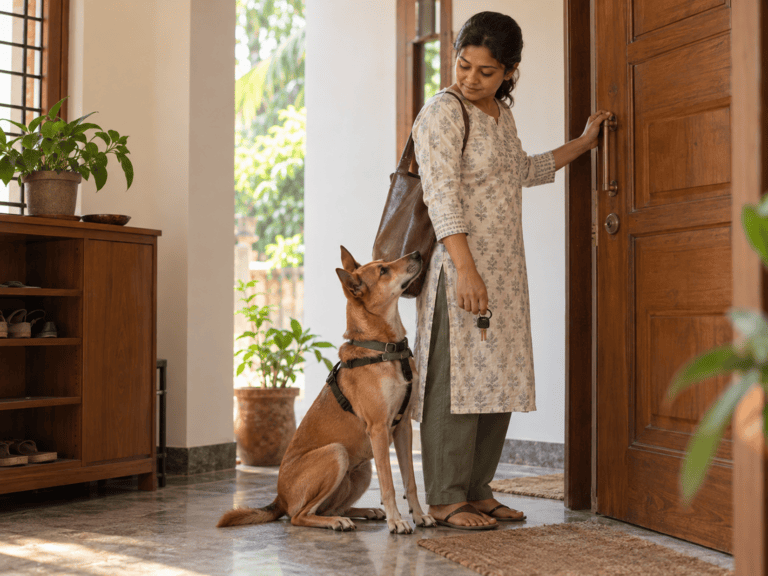
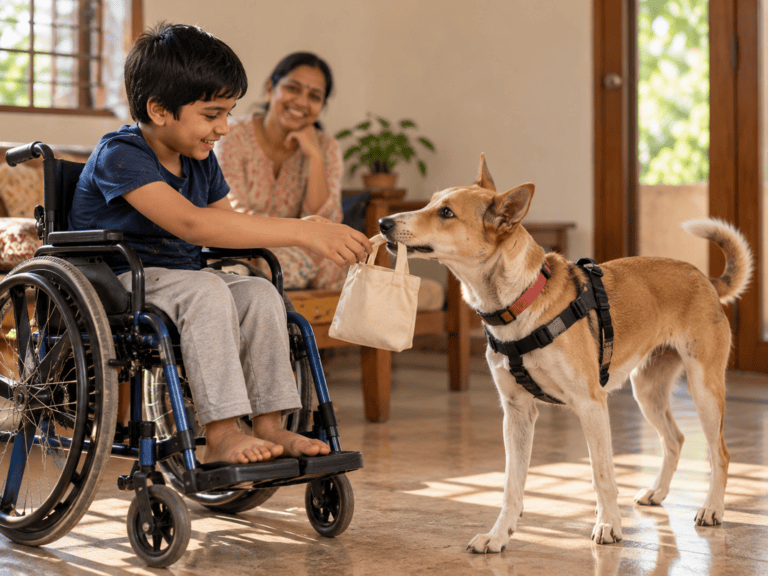
An assistance dog or service dog for cerebral palsy would be trained around the tasks that one person finds hard. Depending on the person, these might include:
- Retrieving and carrying. Picking up dropped items such as a phone, keys or a water bottle, and bringing things from another part of the house. For someone who cannot easily bend or reach, this saves energy and removes a source of frustration.
- Opening and closing. Opening doors, cupboards or the fridge using a pull strap, and closing them again. For some people it also means pressing switches or door buttons.
- Helping with dressing and daily routines. Some dogs are trained to help remove items such as socks or a jacket, or to bring a bag or a towel.
- Getting help. Fetching another family member, or activating an alert device, when the person needs assistance. We cover this and other tasks in our piece on what a mobility assistance dog can do in an Indian home.
- Responding to seizures, where relevant. Because epilepsy is more common in people with CP, a dog might be trained to respond to a seizure, for example by getting help. This needs individual assessment and specialist training. Whether a dog can warn of a seizure beforehand is a separate and much less certain question, and not something we would assume.
Which of these matter depends on the person's mobility, hand function, communication, age and home. The child and family need a reliable way to cue the dog, reinforce its trained behaviours and manage its care. Depending on the child's age and abilities, a parent or another responsible adult may need to act as the primary handler.
A different kind of work, and where the research is
The research we identified on dogs and cerebral palsy has mainly examined walking, balance, rehabilitation or quality of life, and it is important to be clear about what it covers. Some programmes train dogs to give a person physical support while standing or walking, for example by acting as a steadying point or a moving support. This is different from the retrieving and opening tasks above, and it places physical load on the dog. HeartDogs does not train dogs to bear weight or provide bracing and balance support.
Two examples show the shape of the evidence. A 2025 case series in Canada followed four children aged 7 to 16 with CP who could walk (GMFCS levels I and II). A rehabilitation dog worked alongside a physiotherapist for eight weekly sessions, acting as a moving or stationary support, similar to a gait aid. Each child's balance score improved by 4 to 5 points, more than the minimum change the test can detect, walking speed rose in all four children, and the children reported feeling more comfortable, safe and confident when walking with the dog. The authors note that this was a very small case series with no control group and that it included only children who could walk. The dog needed rest breaks during sessions, and the study did not establish wider feasibility, cost or long-term sustainability.
The second is research from Trinity College Dublin on children living with mobility assistance dogs supplied by an Irish charity. In a six-month qualitative study published in Physical Therapy Reviews, parents of 10 children aged 6 to 12 with neurological or physical impairments affecting walking reported perceived improvements in physical activity, social engagement and family life, along with extra caring work for the family. The findings are encouraging, but they reflect parents' experiences, include children with different conditions, and do not establish that every child will benefit. A separate article by the lead researcher notes that for children with greater difficulty, a conventional walker may be more energy-efficient, and that little research has been done in this area.
Caron et al., 2025, animal-assisted physiotherapy case series, children with cerebral palsy | Trinity College Dublin, parent-reported effects of mobility assistance dogs, 2025 | Trinity College Dublin, mobility assistance dogs and children with cerebral palsy, 2025
Promising signals from small studies, little on everyday tasks
Putting it together, we did not identify any controlled study of assistance dogs trained for everyday tasks in people with cerebral palsy. What exists is a handful of small studies and parent reports, most focused on walking and balance, and one using a rehabilitation dog in physiotherapy sessions, which is a different arrangement from an assistance dog living with a family. The signals on confidence, motivation to go out and social experience are encouraging, but they come from very small samples, mostly ambulatory children, and mostly self- or parent-reports.
We also did not find studies on adults with CP, on children who use wheelchairs, or on the long-term welfare of dogs doing this work. These are real gaps, and anyone considering a dog should ask any programme what it has seen, and not assume outcomes.
Questions that matter before a dog is placed
CP often shows up in infancy, so many people who might benefit are children. That raises questions that adults with other conditions may not face. A young child usually cannot be the dog's sole handler, so a parent or carer often has to be trained too. A dog is a long commitment of often eight to ten years or more, and a child's abilities, school life and needs will change over that time. The match needs to be reviewed as they grow, and the dog's own welfare, including rest and a life outside work, needs as much attention as the child's needs.
Practical details matter as well. A dog must be comfortable around wheelchairs, walkers, braces, hoists and sudden involuntary movements, and the family must have the time and resources to care for it. The question to ask is not only "can the dog do the tasks" but "can this family, with this dog, make it work day to day".
Many children, limited data on support
A 2019 systematic review of studies in India, published in the Indian Journal of Pediatrics, found a pooled prevalence of about 2.95 per 1,000 children, with figures of 1.83 in rural, 2.29 in urban and 4.37 per 1,000 in mixed rural-urban populations. The authors described a shortage of high-quality prevalence studies, which limits how confidently a national figure can be given. A 2026 systematic review across South Asia reported a pooled prevalence of about 2.4 per 1,000 children.
We have not identified information on how many people with CP in India use or have asked for assistance dogs. Cerebral palsy is recognised as a disability under the Rights of Persons with Disabilities Act, 2016, but public access rights for assistance dogs are not set out in a single national framework, as we explain in our piece on assistance dog certification and the law. A family should check the rules for each setting, such as school, transport and housing, and not assume a dog will be admitted. Also, many Indian homes are small, have steps or uneven floors, and use narrow doorways, which shapes both which tasks are useful and which are practical.
Prevalence of cerebral palsy in Indian children, systematic review and meta-analysis, Indian Journal of Pediatrics, 2019 | Prevalence of cerebral palsy among children in South Asia, systematic review and meta-analysis, 2026
Everyday task support, built around Indian homes and families
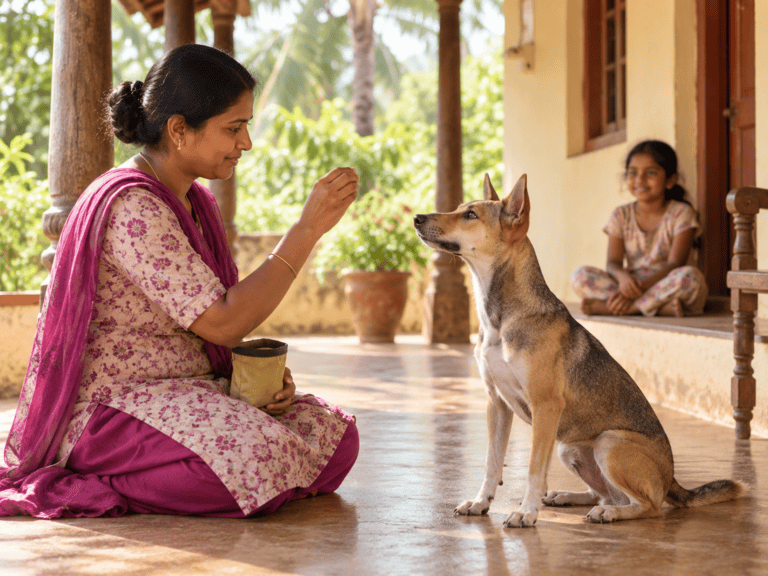
Supporting people with physical disabilities, including cerebral palsy, is part of the long-term direction we are working towards. Our dogs do not provide weight-bearing support, so the work we focus on is the retrieving, opening, carrying and getting-help tasks described above. They are trained in family homes with children around, not in kennels, by women in rural India working as paid foster-trainers, which means they grow up used to the noise, movement and routines of a real household.