What an assistance dog actually is
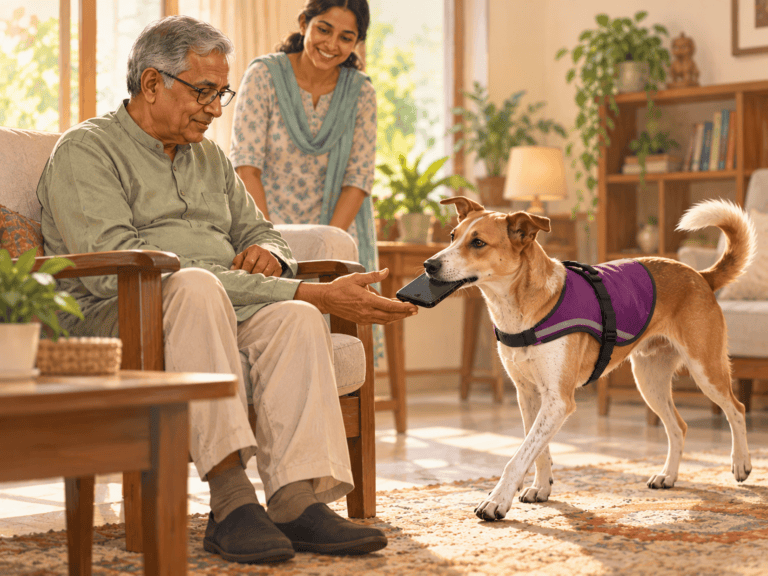
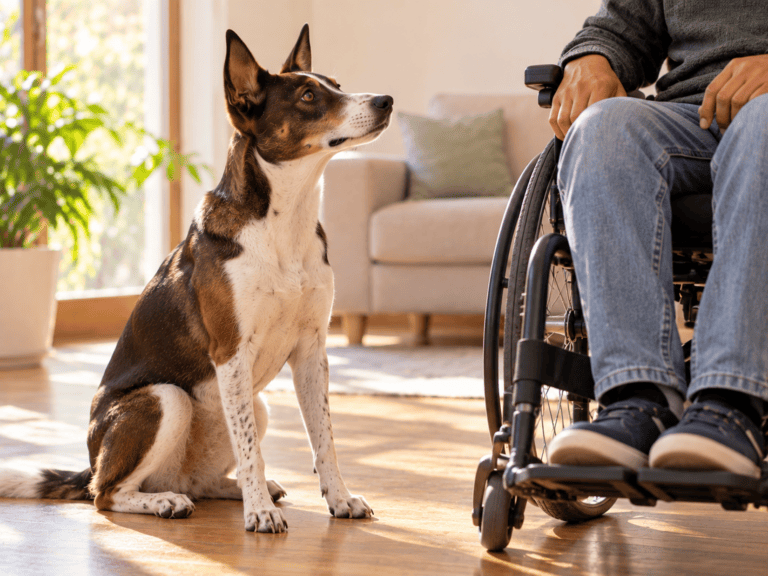
An assistance dog - also called a service dog in the United States and some other countries - is individually trained to perform specific tasks for one person with a disability. The tasks are directly tied to that person's specific needs and limitations. A dog guiding a blind person navigates pedestrian environments so the person can move safely. A dog trained for a person with epilepsy may alert before a seizure or respond after one. A dog for someone with PTSD may interrupt flashbacks, check rooms for safety before the person enters, or apply pressure during a panic episode.
The critical word is "tasks." An assistance dog is not primarily providing emotional comfort through its presence - it is performing specific, trained behaviours that directly address what a disability takes away from the person. The training is intensive and often takes many months to around two years, depending on the dog, programme, tasks, and handler's needs. It is built around that individual handler's needs rather than general obedience or temperament work alone.
Assistance dogs live with their handlers and work alongside them in daily life. In countries with legal protections for assistance or service dogs, such as the US, UK and Australia, handlers may have rights to access public places and services, although the rules and certification requirements differ between countries. Under the US ADA, for example, it is the dog's trained tasks - not its breed, appearance, or certification - that establishes the right of access.
What a therapy dog actually is
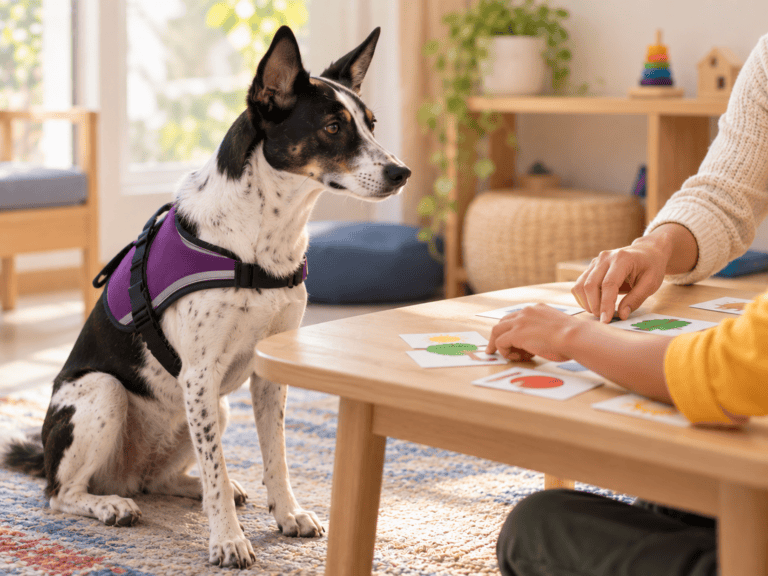
A therapy dog is trained to visit people in institutional or clinical settings - hospitals, schools, care homes, rehabilitation centres, courthouses - and provide comfort and social interaction to many different people. The dog belongs to and is handled by a volunteer or professional handler, not the person receiving support. The handler takes the dog on visits; the dog is not placed with one individual.
Therapy dog training focuses on temperament, social ease, and the ability to stay calm and friendly across unpredictable environments, unfamiliar people, medical equipment, and the range of physical and emotional states that turn up in clinical settings. It is not about learning specific disability-related tasks for one person. It is about being reliably calm and approachable with everyone.
Therapy dogs do not have general public access rights. Instead, each institution decides for itself whether to invite them. A hospital therapy dog programme requires the hospital's approval. A school reading programme requires the school to set it up. In both cases, the institution's invitation - not the law - determines where the dog can go.
The evidence for therapy dogs is growing, though still developing. Research on animal-assisted therapy in dementia care has found promising reductions in behavioural symptoms and depression in some studies, although the evidence base remains limited and the studies vary considerably in quality and methodology. Research on dogs specifically in schools, cancer wards, and mental health settings points in a broadly positive direction for mood, anxiety, and social engagement - with the same caveat that many studies are small and cannot establish causation.
What an emotional support animal actually is
An emotional support animal - usually shortened to ESA - provides comfort and companionship to its own guardian, simply through its presence. It does not need to be trained to perform specific disability-related tasks. The therapeutic value comes from the relationship and the comfort of having the animal around, not from anything the animal has been specifically trained to do.
In the United States, emotional support animals have historically been considered in housing reasonable-accommodation requests under fair-housing rules. However, the rules and enforcement approach have changed over time - a 2026 federal housing guidance shift moved toward requiring that an animal be individually trained to perform disability-related tasks for accommodation claims. ESA rules are jurisdiction-specific and should not be assumed to apply outside the US. ESAs have never had the general public access rights that trained assistance dogs have under the ADA - they cannot be taken into shops, restaurants, or on most flights simply by virtue of being an ESA.
The ESA category is probably the most frequently misused of the three, in part because it requires no formal training and in some countries has been used to get pets into no-pet housing or onto planes without genuinely meeting the criteria. This misuse has made institutions increasingly sceptical of any animal presented as an emotional support animal - which is one reason the distinction between ESAs and properly trained assistance dogs matters so much for people who genuinely need the latter.
An assistance dog performs trained tasks. A therapy dog provides comfort to many people through a handler. An emotional support animal simply needs to be present for its guardian. Three different jobs, three different levels of training, three very different legal standings.
The key differences at a glance
The clearest way to distinguish them is to ask three questions: who does the dog work for, what has it been trained to do, and where is it allowed to go?
| Factor | Assistance Dog | Therapy Dog | Emotional Support Animal |
|---|---|---|---|
| Who they work for | One specific person with a disability | Many different people, via a handler | Their own guardian |
| Training required | Extensive - task-specific, often many months to two years | Temperament assessment, socialisation, institution visits | No disability-related task training required |
| Where they live | With their handler, full time | With their handler/volunteer, visits institutions | With their guardian |
| Public access rights | Broad (where legislation exists) | Invited institutions only | No general public access rights |
| Primary function | Specific trained tasks for one person's disability | Comfort and engagement for many people | Companionship and emotional support for guardian |
Why people mix these up - and why it matters that they do
The confusion is understandable. All three involve a dog. All three are associated with wellbeing or disability. And the emotional benefit of having a dog around - any dog - is real and well documented; people's stress hormones drop, their mood improves, their sense of connection increases. That genuine benefit makes it easy to assume that a comforting dog and a trained assistance dog are doing essentially the same thing, just in different settings.
The practical consequences of mixing up the categories are significant. Consider a hospital that agrees to a "therapy dog visit" thinking it has approved a weekly reading programme - that is a completely different situation from one asked to allow a trained assistance dog to accompany a patient throughout their stay. Someone told they have an "emotional support dog" may believe they have public access rights they don't actually have. Meanwhile, a family asking whether their pet dog could help their child with autism is asking a genuinely different question from one asking whether a trained autism assistance dog would be appropriate - and both deserve a genuinely different answer.
Getting the terminology right also protects people who genuinely need trained assistance dogs. When institutions and the public cannot tell the difference between a trained working dog and a pet someone has labelled as a service animal, the credibility of legitimate programmes suffers - and that makes access harder for the people who actually need it.
Why this matters more in India, not less
India does not currently have a single, nationally applicable legal framework that defines assistance dogs, therapy dogs, and emotional support animals as distinct categories. There is no consistent standard for training, certification, or public-access rights across any of them. The Rights of Persons with Disabilities Act, 2016 establishes important non-discrimination principles and reasonable accommodation requirements - but it does not address working dogs or their access rights. No national certification system exists for assistance dogs, and no accreditation body covers therapy dog programmes.
The practical gap this creates
Without a clear framework, real problems follow. Someone with a trained assistance dog in India may not have a specific legal remedy to invoke when a business refuses entry. Hospitals considering therapy dog programmes have no established national standard to follow. Families seeking an assistance dog for a child with autism have no reliable way to distinguish a properly trained dog from one someone has simply labelled accordingly.
The confusion between the three categories makes all of these problems worse. So long as nobody agrees on what these terms mean, building credible programmes is harder, families cannot make informed decisions, and institutions do not know what they are being asked to accommodate. Defining the terms clearly - and insisting on the distinction in practice - is the starting point for changing that. We covered the legal picture for assistance dogs in India in more detail in our piece on assistance dog certification and the law.
Which one do you actually need?
If you or someone you care for has a disability and needs a dog that performs specific tasks to address what that disability takes away from daily life - an assistance dog is the category to look at. The training is intensive, the process is long, and the dog needs to be matched carefully to the person's specific needs. But that is also what makes it genuinely useful in the way the other two categories are not.
If you are a hospital, school, care home, or other institution looking to bring dog-related support into your setting on a programme basis - a therapy dog programme is the relevant model. The dog visits, the handler manages, and the institution defines what access looks like.
If what you are looking for is a companion animal whose presence genuinely helps with anxiety, low mood, or loneliness - that is real and valuable, but it is a pet, not a trained working dog. Calling it an emotional support animal or a therapy dog does not change what it is, and may create expectations it cannot meet.
The honest answer to "which one do I need" is almost always: talk to a clinician about what your actual needs are, and then find out what kind of trained dog, if any, addresses those needs specifically. Starting with the dog and working backwards rarely ends well.