Scent, not substance - and why that matters
Foods containing allergens produce odour compounds that dogs can learn to associate with the target allergen. The dog is detecting an odour associated with the allergen, rather than directly detecting the allergenic protein itself. A dog's nose has roughly 300 million olfactory receptors compared to around 6 million in a human nose, and dogs can detect some odours at extraordinarily low concentrations - far below the threshold of human smell. Research on scent detection in dogs suggests sensitivities down to one part per trillion in some contexts, though that figure relates to general canine scent capability rather than specifically to allergen detection.
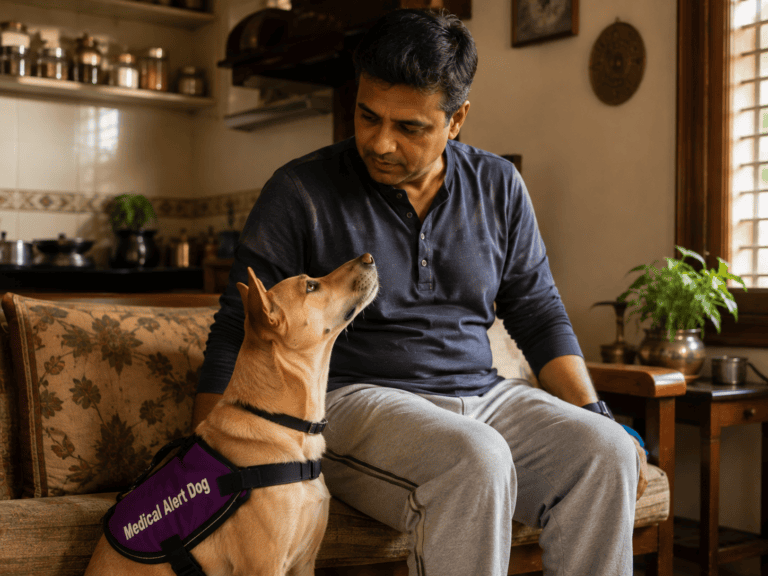
An allergy detection dog is trained to recognise the specific VOC profile of a target allergen and to signal - through a trained alert behaviour such as a sit, a paw, or a nudge - when it detects that scent. The dog is detecting the odour signature of the allergen, not the allergen molecule itself. This is a subtle but important distinction.
This means that if allergen residue remains on a surface after the associated odour has diminished below the dog's detection threshold, the dog may not alert - even though allergenic material is still present and potentially dangerous. The allergen can persist after its detectable scent has faded. This is one of the core limitations of the model, and it's worth naming upfront rather than as a footnote.
The same method as explosive and drug detection
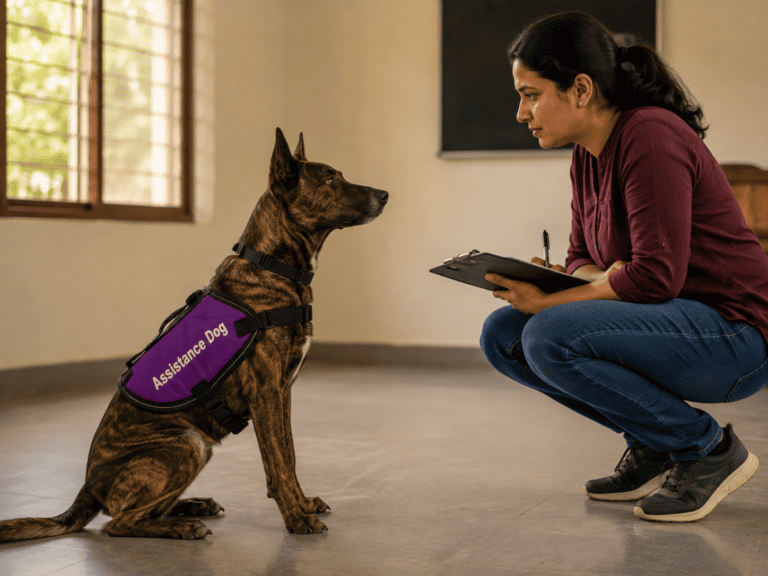
The underlying scent-detection principles used to train allergy detection dogs are similar to those used in drug and explosive detection work. The process moves through three main stages, though the specific training and validation requirements depend on the programme and target allergen.
- Detection. The dog is introduced to the target scent - say, peanut protein VOCs - in a controlled environment, and learns to associate detecting that scent with a positive reward (a treat, a toy, praise). At this stage the dog learns what it is looking for.
- Discrimination. The dog is trained to distinguish the target scent from other odours, including other allergens that the handler is not allergic to, and common food smells that might otherwise cause a false alert.
- Generalisation. This is where allergy detection training becomes particularly demanding. Peanuts smell different in different forms - raw, roasted, as peanut oil, baked into a biscuit, mixed into a sauce. Ideally, the dog needs to learn to recognise the target across the different forms in which it may be encountered, rather than only the pure form used in initial training. Without this, a dog trained on raw peanut may not alert to peanut paste in a curry.
Blind testing follows - the allergen is hidden in locations unknown to both the trainer and the handler, to ensure the dog is genuinely detecting the scent and not responding to subtle human cues. Critically, this training is not a one-time achievement. It must be maintained throughout the dog's working life, which means the handler needs to regularly work with the actual allergen - something that requires care when the allergen is life-threatening.
Real-world applications - and where they add value
The practical value of an allergy detection dog is clearest in situations where no other method of allergen detection is available before exposure. A dog can scan a room before an allergic child enters it. It can sniff food at a restaurant before it's eaten. It can check bags, toys, or library books entering a home. It can accompany someone with a severe allergy to social events, parties, or school - places where cross-contamination is difficult to control and ingredients are often unknown.
In a school setting, a parent can send the dog in to scan the classroom in the morning. At a friend's birthday party, the dog can check the food table before a child with a peanut allergy approaches it. These are situations where label-reading is either impossible or unreliable, and where asking questions doesn't always produce accurate answers. A dog that can provide an independent check - even an imperfect one - adds something genuinely useful.
Families who use allergen detection dogs consistently describe reduced anxiety and a greater ability to participate in normal daily life. That quality-of-life benefit is real and should not be dismissed, even in the absence of large controlled trials measuring it directly.
Allergy Detection Dogs: How They Work, US Service Animal Registrar
What the research actually shows - and where it runs thin
This is where honesty matters. The evidence base for allergy detection dogs is thinner than popular accounts suggest. Figures citing 80-90% accuracy in controlled settings circulate widely, with references to a 2020 Journal of Allergy and Clinical Immunology study. However, we were not able to independently verify the specific study behind that figure from available sources, and the claim appears to have become somewhat detached from its original context as it has circulated online.
What we can say with confidence is that dogs have a demonstrated, scientifically established capacity for fine-grained scent detection at concentrations far exceeding any human ability. The training methodology used for allergy detection dogs is the same methodology that produces explosive and drug detection dogs, whose accuracy is well established in operational settings. The principle is sound.
The gap is in real-world, independently conducted trials of allergy detection dog accuracy across varied settings, allergens, and detection scenarios. Such trials are difficult to conduct and have not been produced in significant number. Most of what exists is programme-reported data, practitioner accounts, and family testimonials - all useful, but not the same as independent controlled research.
Dogs can detect allergen scents with extraordinary sensitivity. The training methodology is established. What is lacking is a substantial body of independent peer-reviewed research on how allergy detection dogs perform across varied real-world conditions. The capability is real; the evidence base for operational accuracy is still developing.
What these dogs cannot do
These limitations are not minor footnotes. For someone whose reaction to a missed allergen could be fatal, they are the most important part of this piece.
- No dog is perfectly accurate. Even well-trained allergy detection dogs can miss an allergen. A false negative - missing the allergen when it is present - is the critical failure mode. Unlike a false positive (alerting when no allergen is present, which is annoying but safe), a false negative in this context can result in anaphylaxis. No allergy detection dog should be treated as an infallible safety guarantee.
- Old scent, active allergen. If the allergen's VOC profile has degraded - because it's been on a surface for weeks, or because it's sealed inside packaging, or because other strong odours are masking it - the dog may not alert even though the allergen is genuinely present. The substance persists long after the smell fades.
- Physical barriers. A completely impermeable barrier can prevent odour from reaching the dog's nose. Packaging is therefore not a guarantee that a dog will detect what is inside - different materials allow different degrees of odour transmission, and detection through sealed packaging cannot be assumed.
- Environmental interference. Strong competing odours and distracting environments can make detection more difficult and may affect reliability. The controlled setting in which dogs are trained is rarely identical to the real-world settings in which they work.
- Handler dependency. The dog's effectiveness is inseparable from the handler's skill. A handler who misses the dog's alert, misreads the behaviour, or allows the dog's maintenance training to lapse has compromised the system's reliability. The dog and handler together are the unit - neither works well without the other.
For someone at risk of anaphylaxis, an allergy detection dog should be regarded as an additional risk-management tool, not as a diagnostic device or a substitute for allergen avoidance and emergency treatment. The handler must still carry emergency medication at all times. The dog supplements an allergy management strategy; it does not replace it. Epinephrine auto-injectors, label-reading, asking about ingredients, and informing people around the allergic person are not optional extras that a detection dog makes unnecessary. They remain essential.
The classification question - and why it matters in India
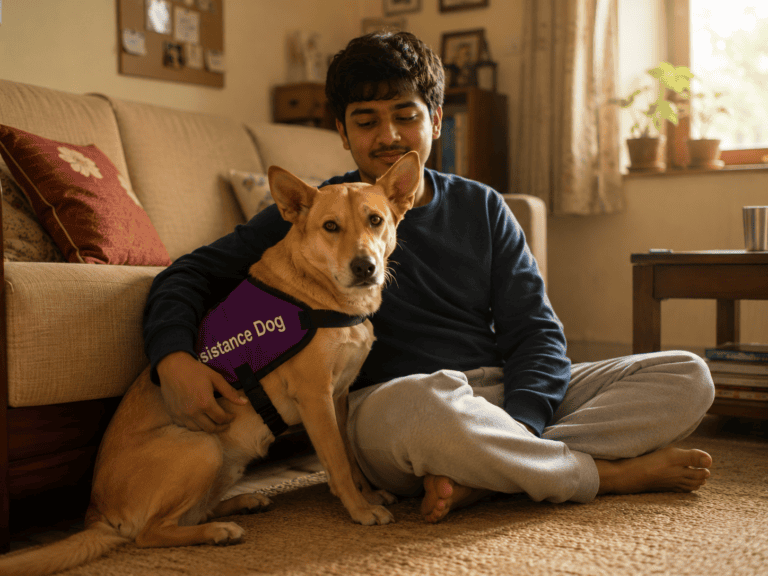
In countries with formal assistance dog frameworks, allergy detection dogs may be classified as assistance dogs (also known as service dogs in certain countries, including the US) when they are trained to perform a specific task directly related to a person's disability - in this case, detecting a life-threatening allergen. In the US, this means they may qualify for public access rights under the Americans with Disabilities Act, allowing them to accompany their handler into food establishments, schools, and other public spaces, provided the dog meets the applicable service-animal definition.
In India, the legal framework for assistance dogs remains underdeveloped. India does not currently have a dedicated statutory framework equivalent to the US ADA that clearly sets out public access rights for assistance dogs. The Rights of Persons with Disabilities Act 2016 (RPWD Act) does not specifically address assistance dogs or allergen detection dogs - a gap we've covered in our earlier pieces on assistance dog certification and public access rights. This matters practically: an allergy detection dog in India has no established legal right of entry to the kinds of spaces where it would need to work.
Disability Rights in India: What the RPWD Act Actually Says, HeartDogs FootNotes
A gap worth understanding
Food allergy in India is genuinely underreported and underdiagnosed. The epidemiology is not well established - partly because systematic allergy testing is not widely available outside urban centres, and partly because reactions are sometimes attributed to food intolerance or other causes rather than identified as IgE-mediated allergy. Peanuts, shellfish, milk, and wheat are among the more commonly reported food allergens in Indian clinical literature, but population-level data remains limited.
We have not identified publicly documented allergy detection dog programmes in India, though this is a cautious observation based on what is publicly available rather than a claim that no such activity exists anywhere. The assistance dog field here is still building the foundational infrastructure - trained dogs, trained handlers, public awareness, institutional protocols - that would need to exist before a specialist application like allergen detection can be developed responsibly.
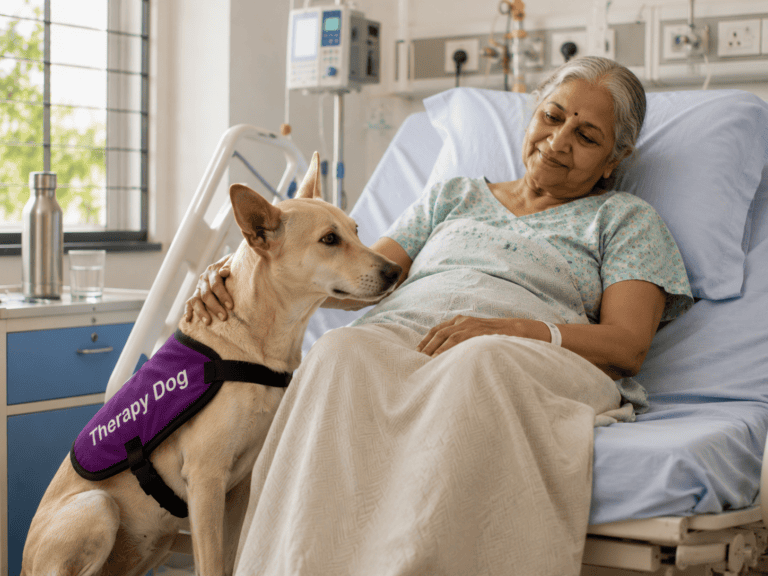
At HeartDogs, we are actively thinking about where detection-based assistance dog work fits into the future of what we're building. Our current work is completing Cohort 1 - training rescued Indies as assistance and therapy dogs through what we believe to be India's first systematic programme of this kind. Allergen detection work is a specialised extension of scent detection training, and it is a direction we are exploring as the programme grows.
A real tool, not a complete solution
Allergy detection dogs are a real and plausible application of canine scent capability. The mechanism is sound - dogs genuinely can detect odours associated with allergens at concentrations far below human sensory thresholds. The underlying scent-detection principles are similar to those used for drug and explosive detection, and the training approach is established in practice. Families that use these dogs report meaningful quality-of-life improvements.
The evidence base for operational accuracy in real-world settings is still developing. The limitations are genuine - old scent, physical barriers, competing odours, and the impossibility of 100% accuracy in any living detection system. A false negative in this context is not just an error; it can be a medical emergency.
The honest framing is this: an allergy detection dog, well trained and well maintained, can add a layer of safety in situations where no other convenient, real-time method of environmental allergen detection is available. It is not a replacement for any part of a comprehensive allergy management plan. It is an addition to one. For families living with the constant cognitive load of a severe, potentially fatal food allergy, that addition can be significant.