What positive reinforcement actually means
In behavioural science, positive reinforcement has a specific technical meaning that differs slightly from everyday usage. It means adding something desirable immediately after a behaviour to increase the likelihood that the behaviour will occur again in future. Both words matter.
"Positive" does not mean nice, kind or gentle. It means adding something - the way addition in mathematics adds to a number. "Reinforcement" means the behaviour increases in frequency. Positive reinforcement therefore means: adding something the dog finds desirable, which causes a behaviour to happen more often.
This precision matters because it helps distinguish positive reinforcement from the other three quadrants of operant conditioning - the scientific framework that underpins all dog training, whether trainers acknowledge it or not:
- Positive reinforcement: add something the dog likes → behaviour increases. A dog sits and receives a treat → sitting happens more often.
- Negative reinforcement: remove something the dog dislikes → behaviour increases. Leash pressure releases when the dog moves into position → the dog moves into position more readily to end the discomfort.
- Positive punishment: add something the dog dislikes → behaviour decreases. A sharp sound or physical correction follows an unwanted behaviour → the behaviour happens less.
- Negative punishment: remove something the dog likes → behaviour decreases. The guardian turns away when the dog jumps → jumping for attention happens less.
In HeartDogs' approach to force-free training, the focus is on positive reinforcement as the primary driver of behaviour change. Where consequences for unwanted behaviour are needed, negative punishment is preferred - withdrawing attention or access rather than adding discomfort. The deliberate aim is to avoid relying on positive punishment or negative reinforcement as training strategies.
American Kennel Club - Operant Conditioning and Positive Reinforcement
Where this comes from - and why it works
Operant conditioning was developed and formalised by the American psychologist B.F. Skinner in the mid-twentieth century. Skinner's foundational insight was that behaviour is shaped by its consequences: animals (including humans) repeat behaviours that produce good outcomes and decrease behaviours that produce neutral or bad outcomes. This is a well-established principle of learning, documented across many species including dogs.
When a dog performs a behaviour and immediately receives something it values, that behaviour becomes more strongly associated with its context and more likely to recur. The association is strengthened by repetition. Over many training sessions, behaviours that are consistently reinforced become increasingly reliable - the dog doesn't need to think through the decision, it has simply learned that this action produces that outcome in this context.
What the research additionally shows is that training method affects not just behaviour but welfare. A landmark 2020 study by Vieira de Castro et al., published in PLOS ONE, observed 92 companion dogs across seven training schools in Portugal, filming sessions and measuring cortisol levels before and after. Dogs trained using aversive methods showed higher cortisol levels after training and displayed more stress behaviours during sessions than dogs trained with reward-based methods. Dogs trained exclusively with aversive methods also showed more pessimistic responses in a subsequent cognitive bias task - a behavioural marker for negative emotional state that persisted outside the training context.
This matters because it suggests the effects of training method go beyond the training session itself. A dog trained through reward is in a different emotional state - outside of training as well as during it - from a dog trained through correction.
The one thing that makes or breaks positive reinforcement
The single most important technical aspect of positive reinforcement is timing. The reinforcer must follow the behaviour as quickly as possible - ideally immediately or within a very brief window - for the dog to connect the two. If the reward comes too late, the dog reinforces whatever it was doing in the moment the reward arrived, not the behaviour you intended to mark.
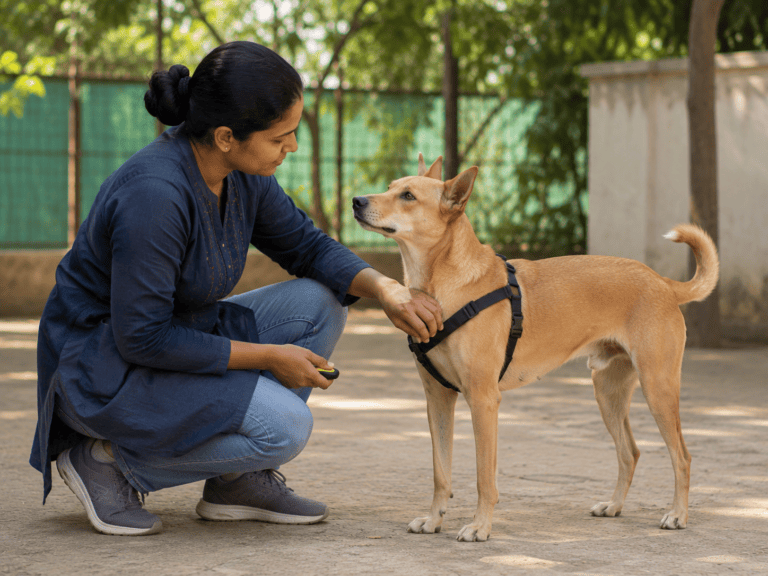
This is why marker training - using a short, precise signal like a click or a verbal "yes" to mark the exact moment the desired behaviour occurs - is so widely used in professional training. The marker acts as a bridge between the behaviour and the reward, allowing the reward to be delivered slightly later without losing the precision. The dog learns that the marker means "what you just did earns a reward," and the training becomes significantly more clear and efficient as a result.
Getting timing right is a skill. It takes practice. And it matters especially in assistance dog training, where the behaviours being taught are specific, complex and need to be reliably performed under conditions very different from the training environment.
Not all rewards are equal
A reinforcer is anything that increases the behaviour it follows. This is defined by the dog's response, not by the trainer's intention. If a treat follows a behaviour and the behaviour doesn't increase, the treat hasn't functioned as a reinforcer - regardless of whether the trainer expected it to. This is a useful corrective to assumptions about what dogs "should" value.
Reinforcers vary widely across individuals and contexts:
- Food. The most commonly used reinforcer in training, because food is widely valued by dogs and easy to deliver quickly. Not all food is equally reinforcing - the value of a treat depends on the dog's hunger level, its preference for that specific food, and what's available in the environment. High-value food is typically reserved for new or difficult tasks and high-distraction environments.
- Play and toys. For some dogs, access to a ball or a brief tug game is as motivating as food - or more so. Play reinforcers require more management during training sessions but are genuinely powerful motivators for the right dog.
- Social interaction. Praise and contact work as reinforcers for dogs that value human attention. This varies significantly between individuals - some dogs find social interaction highly motivating, others find food more compelling in a training context.
- Access to the environment. The opportunity to sniff, explore or run can function as a reinforcer in the right context - typically used as a "life rewards" approach where desired behaviour is followed by access to something the dog wants to do anyway.
The practical implication is that effective positive reinforcement training begins with understanding what each individual dog values. High-value reinforcers are used for new or challenging tasks; lower-value reinforcers maintain already-learned behaviours. Understanding what motivates each individual dog is the foundation of the approach.
"Isn't this just bribery?"
The bribery objection is common, and it's worth addressing directly. What many people describe as bribery is actually luring - showing the dog a treat before asking for the behaviour to guide it into position. That is not positive reinforcement; it is a teaching tool used in early training to help a dog understand what is being asked. Positive reinforcement, by definition, follows the behaviour - the dog performs first, then receives the reward.
What the bribery objection is really pointing at is luring - using a treat in hand to guide a dog into a position, rather than waiting for the behaviour and marking it. Luring can be a useful early teaching tool, but it's a temporary scaffold, not the finished product. A well-trained dog doesn't need a treat visible to perform a behaviour. The behaviour has become reliable through reinforcement history, not through the presence of food in the trainer's hand.
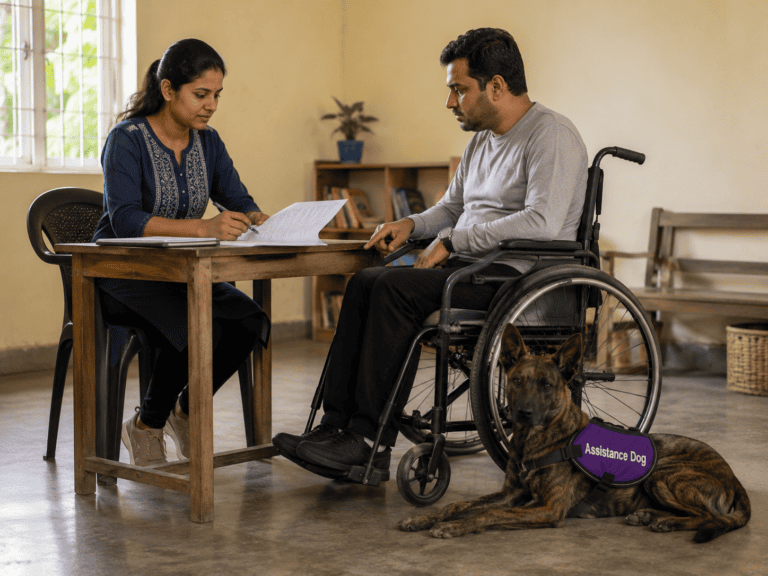
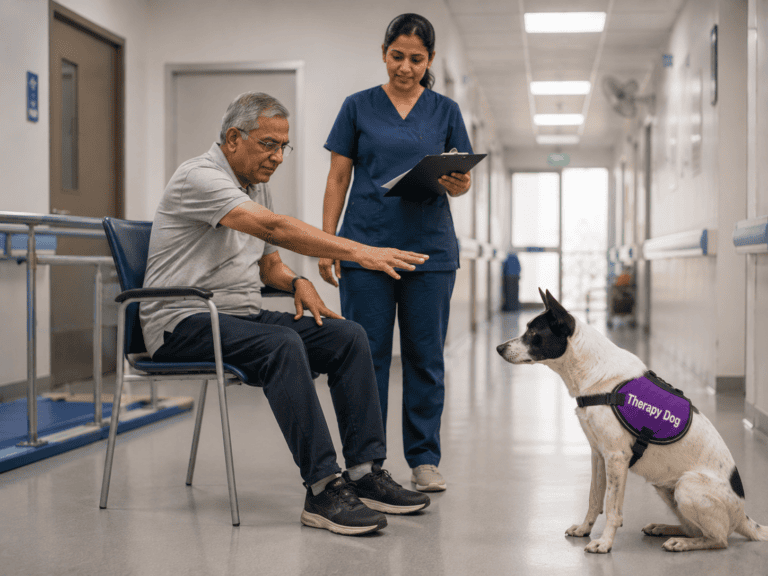
An assistance dog that sits quietly beside its handler in a hospital corridor, recalls reliably in a crowded environment, or retrieves a dropped item without prompting is not doing these things because food is visible. It is doing them because those behaviours have been reinforced consistently enough that they are the dog's default response to the relevant cues.
How positive reinforcement shapes our programme
HeartDogs uses positive reinforcement as the foundation of all training in the programme. Every cue taught to every dog begins with reward - the dog learns what the cue means through clear marking and consistent reinforcement, before any distraction is introduced or complexity added.
This approach shapes how our Heroes - the foster-trainers who raise each dog in their homes in rural Karnataka - work with the dogs daily. Positive reinforcement is teachable, repeatable and doesn't require physical force or specialist equipment. A woman working with a dog in her home can apply it consistently and accurately, because the method is built on communication and relationship rather than physical control.
For assistance dog work specifically, there's a deeper reason to care about this. A dog that has learned through positive reinforcement approaches its handler and its work with willingness - it has learned that engagement produces good outcomes. That quality - a dog that wants to work, that orients towards its handler, that finds the partnership rewarding - is foundational to everything an assistance dog needs to do well over a working life of many years.