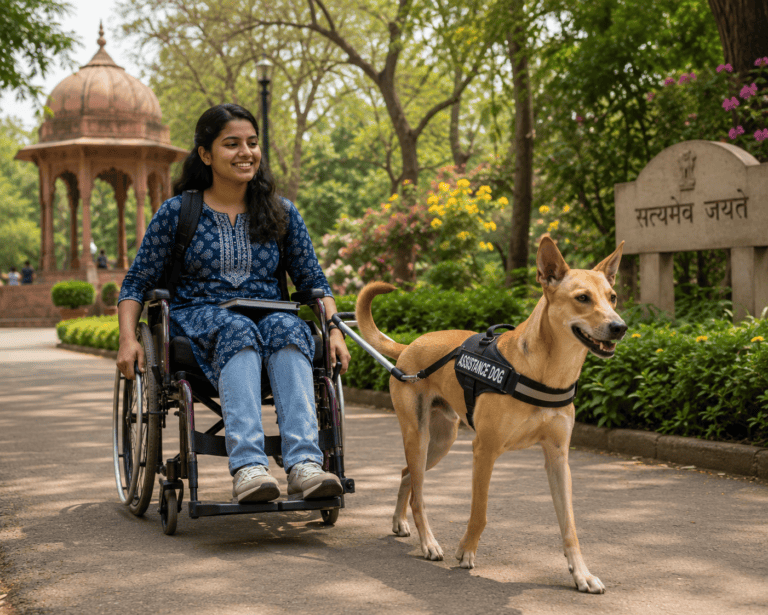
Programme-trained: the most structured path, and the hardest to access in India right now
An established assistance dog programme selects or breeds dogs, raises them, trains them professionally, matches them to a specific handler, and typically provides follow-up support after placement. This is the route that produces many of the assistance dogs seen in countries with long-established provider networks, and it is a highly structured and accountable option.
What a family receives is not just a trained dog. It is a dog that has been assessed throughout its development, trained to a defined standard by people with specific expertise in assistance and service dog work, matched to a particular handler's needs, and backed by an organisation that can support you when things come up after placement, because new questions and challenges often arise after a dog goes home. The programme knows the dog's history, health, temperament, and training. If something is not working after placement, there is someone to call.
The tradeoff is access. Waiting lists at some established programmes can run one to three years or longer. Programmes are concentrated in certain countries and regions. In many countries, including India, the number of accredited, fully operational assistance dog programmes is very small. Families outside those countries face either a long wait to access a reputable overseas programme, a considerable journey for in-person training, or both.
For families in India today, this is often not a live option in the immediate term, unless they are specifically working with one of the small number of organisations that are building this kind of programme here. That matters to name honestly, because telling someone to "find a good programme" without acknowledging that the infrastructure does not yet widely exist here is not actually useful advice.
Assistance Dogs International, Accreditation FAQs · IGDF, Standards
Owner-training: a common route where programmes are inaccessible, with highly variable outcomes
Owner training means the handler, or a family member, trains the dog themselves, usually with some professional guidance. It is the route most people end up on when a programme is not accessible. In the United States, the Americans with Disabilities Act explicitly permits owner-trained service dogs: the law defines a service dog by its function, not by who trained it, so no professional programme is required for public access rights under that law. This is a US-specific provision; India does not currently have a clear, comprehensive national framework guaranteeing assistance dog public access comparable to the ADA.
The appeal is obvious. It avoids waiting lists. It can cost less in direct terms. It allows the handler to build the training relationship from the ground up. And for some people with certain disabilities, being closely involved in training their own dog is genuinely meaningful and beneficial to the partnership.
The real challenges are also substantial. Dog selection is the first and most consequential one. Choosing a dog with the right temperament, health, and capacity for the specific work required is not a simple task, and it is the point where the most significant errors happen. A dog that is not well suited to assistance dog work, however well intentioned the choice, is likely to fail at some point in training, and that failure comes after months or years of work and emotional investment. Established programmes commonly report that a substantial proportion of dogs they raise do not complete assistance dog training, due to health, temperament, or behavioural reasons identified during assessment. They apply rigorous selection throughout, and even with that structure they do not get it right every time. An owner choosing a dog without that expertise is working with considerably less information.
The second major challenge is training knowledge. Training a dog to perform assistance tasks reliably, particularly more complex tasks related to medical conditions, psychiatric symptoms, or physical disability, requires real expertise. Reliable here means performing the task consistently across varied environments, under distraction, and when it genuinely matters, not just at home in a quiet room. Building that kind of performance requires structured training over time, an understanding of learning theory and behaviour, and ideally access to someone with specific assistance dog training experience who can assess the work honestly.
In India, the challenge is sharper still. The community infrastructure that exists in countries such as the US or UK - including owner-trainer communities, experienced trainers offering one-to-one support, and established organisations able to assess and certify an owner-trained team - does not yet exist in India at anything like the same scale. An Indian family pursuing owner training is largely doing so without the peer community or accessible expertise that makes it more viable elsewhere.
Owner training is not the "easy" or "budget" route it can sometimes be presented as. It is a serious undertaking that requires significant time, skill, and a dog that is genuinely suited to the work. The families who do it well are putting in extraordinary effort, often without much support.
Privately trained: professional help outside a programme, with quality that varies significantly by trainer
A third route is hiring an independent professional trainer, someone who is not affiliated with a formal assistance dog programme, to train a dog to assistance dog standards. The trainer may work with the owner's existing dog, source a suitable dog, or do both. The handler is more involved in ongoing training than in a programme route, and the process is more customised to individual needs.
The key factor here is the specific trainer's experience and expertise in assistance dog work. Skilled general dog trainers and skilled assistance dog trainers are not the same thing. General dog training, even excellent general training, does not automatically translate to the ability to train reliable task work for medical conditions, the ability to assess a dog's suitability for specific assistance work, or the understanding of what a placement after training actually requires. A trainer who is excellent at obedience or sport dog work but has no background in assistance dog training is not the right fit for this, and finding that out after months of paid work is a painful and expensive lesson.
The privately trained route does not come with the programme accountability structure either. There may be no organisation providing ongoing programme-level support after the trainer's initial work is done. If the dog's performance deteriorates after placement, or if the dog turns out not to be suited to the work after all, the handler is largely on their own. This is not a reason to avoid it, but it is a reason to go in with clear expectations about what is and is not included in what you are paying for.
In India, finding a trainer with genuine, demonstrated assistance dog training expertise is currently a significant challenge. The sector is still developing, and the difference between a trainer who understands what is required and one who is confident without that specific background is not always immediately obvious. Asking for evidence of previous assistance dog placements, references from families they have trained with, and an honest account of what they do and do not have experience with are all reasonable things to ask before committing.
Importing a trained dog from overseas: real option, real complications
Some Indian families look into importing a fully trained assistance or service dog from an established overseas programme or trainer. On the surface this looks attractive, because it sidesteps the domestic access problem. In practice it comes with a set of complications worth understanding clearly before pursuing it.
The first is cost. International travel, veterinary documentation, import health certification, and animal-quarantine and clearance requirements all add significant cost and complexity on top of the dog itself. As we covered in our earlier piece on the cost of an assistance dog in India, the real cost of a trained dog is substantial even domestically. Importing one can push the total cost considerably higher, and the total figure needs to be understood before treating it as a straightforwardly cheaper alternative to waiting for a domestic programme.
The second is the placement relationship. Established assistance dog programmes typically invest significantly in the matching and placement process, including in-person training with the handler before the dog goes home, and follow-up support afterward. That support is designed to be delivered nearby. An overseas programme placing a dog with a family in India may not be in a position to provide the kind of ongoing support they would normally deliver, simply because of the distance. A dog arriving without that structured handover and follow-up is arriving with less of what makes the programme model work well.
The third is ongoing support. A dog trained to a certain standard in another country will need continued training and maintenance throughout its working life. Finding qualified local support for that ongoing work, in India, for a dog placed by an overseas organisation, is an additional challenge that does not go away once the dog arrives.
None of this makes it an impossible route. Some families have pursued it and found it worked for them. But it is worth going in with realistic expectations rather than treating it as an easy solution to the domestic access problem.
Questions worth working through honestly
The right route depends heavily on your specific situation. A few questions that tend to matter most:
- What tasks do you actually need the dog to perform? Simple retrieval tasks or physical mobility support look very different from complex medical alert work or psychiatric assistance tasks. The more complex the task, the more it matters that the training comes from someone with proven expertise in that specific area.
- Do you have the time and capacity for active involvement in training? Owner training is a substantial commitment, measured in months and years, not weeks. A family where the handler is a child, or where the primary caregiver has significant other demands, may not be in a position to own-train effectively regardless of motivation.
- What ongoing support will you have after placement? This is an underrated question. The placement is not the end of the process. A dog's training needs maintenance, and new challenges come up over time. Knowing who you will call when something is not working is as important as knowing who is doing the initial training.
- What is the trainer's or programme's specific track record with the tasks you need? Not general dog training experience. Specifically assistance or service dog work, ideally for the kind of condition or need you are dealing with. Asking for this directly, and expecting a clear answer, is entirely reasonable.
- What happens if the dog does not work out? Not every dog trained for assistance work will succeed, even with the best selection and training. Understanding what the fallback is, whether the trainer or programme will replace or refund, what happens to the dog, and what that means for your family, is important to think about before you are in that situation.
Why we are working towards a programme model, and what that means in practice
We are working towards building a programme model, not because we think it is the only valid route, but because we think it is the right structure for what we are trying to do. A programme allows us to select dogs carefully, maintain consistent training standards, assess task performance honestly before placement, and provide support to families after a dog is placed, all of which matter for the people we hope to work with.
Cohort 1 has not reached placement yet, so we do not have completed placements to point to. What we can say is that the investment we have made in building the programme properly, including bringing in international training expertise that was not yet available locally, reflects our view that doing this well requires more than enthusiasm. It requires the kind of structured methodology and genuine experience that makes the programme model worth the investment it takes to build.
We are not in a position to support owner-training journeys in any structured way at this point. What we can do is be honest about what the different routes involve, so families in India who are trying to navigate this can make informed decisions rather than discovering the complications later. The assistance dog and service dog field is still developing here, and part of what we hope to contribute is clearer information about how this actually works.
If you are currently working through a route decision and want to share where you are with us, our contact page is the best place to start that conversation.