What PTSD actually involves - and why a dog can help
Post-traumatic stress disorder (PTSD) develops in some people following a traumatic event - sexual violence, accidents, natural disasters, the death of someone close, combat, sustained abuse or other experiences of profound threat. Its symptoms cluster into four main areas: intrusive memories and nightmares, avoidance of trauma-related situations, negative changes in mood and thinking, and heightened physiological arousal including hypervigilance and sleep disruption.
These are not character weaknesses or matters of willpower. They are the nervous system's response to an overwhelming experience. And critically for the purpose of this post - some episodes may involve observable changes - restlessness, altered breathing, changes in body language - that a dog may learn to respond to. A dog should not be presented as reliably detecting the underlying psychiatric state, but may respond to these outward, observable signs in ways that handlers report as useful.
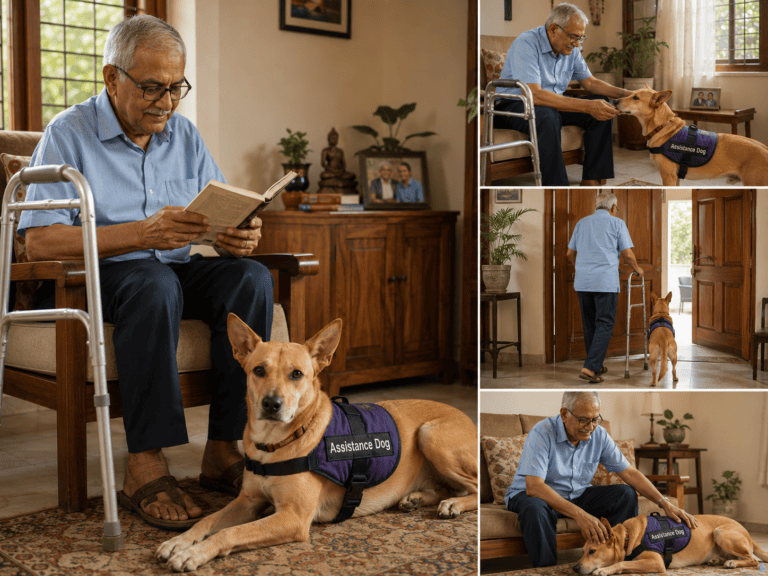
A psychiatric assistance dog is trained to respond to these signs with specific tasks. The dog does not treat PTSD. It provides targeted, symptom-specific support that enables the person to function better in daily life, and that works alongside, not instead of, appropriate clinical treatment.
What a PTSD assistance dog is trained to do
Tasks are grouped here by the symptom cluster they address. Not all dogs are trained for all tasks - the programme is tailored to the individual's specific PTSD presentation and daily challenges.
For nightmares and sleep disruption
- Nightmare interruption. Some psychiatric assistance dogs are trained to wake their handler during a nightmare using a trained behaviour such as nudging, pawing or making contact. Veterans report nightmare interruption as a valued task. The dog may respond to observable movement or vocalisation during sleep, but the mechanisms by which dogs detect nightmares and the clinical effectiveness of this task have not been adequately studied. Whether it reduces nightmare intensity or improves sleep varies by person.
- Room check after waking. After waking the handler, the dog can be trained to move through the space and return to the handler. This may help the handler reorient to the present. It is worth noting that the Leighton et al. 2022 review specifically identifies repeated checking behaviours as an area requiring careful clinical assessment, as they may reinforce avoidance or safety-seeking in some people with PTSD.
For hypervigilance and threat perception
- Room search on cue. Some dogs are trained to search a room on cue and return to their handler. For people who experience intense hypervigilance, this may reduce the immediate burden of scanning the environment themselves. These safety-related tasks require careful clinical and behavioural assessment, as repeated checking can also reinforce hypervigilance or avoidance in some people.
- Back watch / cover. The dog is positioned behind the handler in a public setting, creating physical awareness of the space behind them and providing a signal if someone approaches from that direction. People with PTSD often experience intense discomfort with their back unguarded; this task directly addresses that specific trigger.
- Crowd blocking. The dog positions its body to create space around the handler in crowded environments, reducing uncontrolled contact from strangers. This can be particularly useful for people whose PTSD symptoms are aggravated by close physical proximity to strangers.
For flashbacks, panic attacks and dissociation
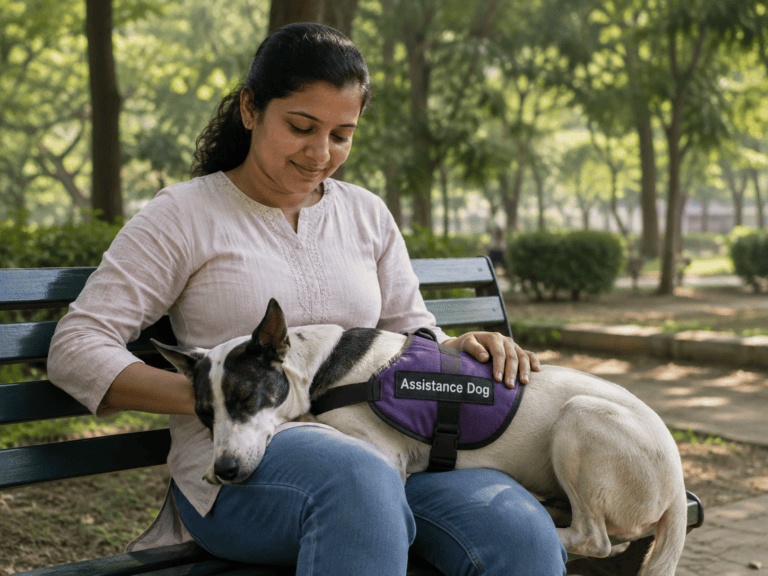
- Grounding on cue. During a flashback or dissociative episode, the dog makes physical contact - a paw on the lap, leaning against the handler - providing a present-moment sensory anchor that can help interrupt the episode. The dog's physical presence and warmth serves as a grounding stimulus.
- Deep pressure therapy. The dog applies body weight on cue - across the lap or against the handler - during a panic or anxiety episode. This provides firm sensory input that some people experience as calming. As covered in our separate post on deep pressure therapy, the precise physiological mechanism and dog-specific effectiveness remain areas of active study. It is one of the most commonly trained tasks for psychiatric assistance dogs working with PTSD.
- Interrupting escalating behaviours. Where PTSD involves self-injurious coping behaviours, a trained dog can interrupt the early observable signs of those behaviours, providing an alternative focus before the episode escalates.
For daily functioning
- Medication and routine reminders. Some dogs are trained to prompt their handler - by nudging or retrieving a labelled item - at set times to take medication. For people whose PTSD significantly disrupts routine and concentration, this may support adherence to a medication routine - though it does not replace a medication-management system or clinical guidance.
- Retrieving a phone or alerting others. During a crisis episode, the dog can retrieve a phone to enable the handler to call for help, or alert another person in the household to the handler's distress.
What the research actually says
The strongest current evidence comes from a 2022 systematic review and meta-analysis by Leighton and colleagues, published in PLOS ONE, which examined 41 studies (29 peer-reviewed publications and 12 dissertations) on psychiatric assistance dogs for military veterans with PTSD. Across the included quantitative studies, the authors reported improvements in PTSD severity, mental health and social health. Their meta-analysis of nine studies found a large, statistically significant effect on PTSD symptom severity. Evidence for physical health and overall quality of life was inconclusive.
Since that review, a 2024 non-randomised controlled trial published in JAMA Network Open, involving 156 military members and veterans with PTSD, found that adding a trained service dog to usual care was associated with significantly lower PTSD symptom severity, anxiety and depression after three months compared with usual care alone. The study strengthens the evidence base, though its non-randomised design limits the conclusions that can be drawn.
An earlier systematic review (2021) took a more conservative position, concluding that "at best, the current evidence raises the hypothesis that dogs are beneficial in PTSD. Further research is required with a focus on rigorous design." The authors noted that most studies were small and methodologically limited.
The honest summary: the evidence suggests real benefits across PTSD symptom severity and mental health for people partnered with psychiatric assistance dogs, particularly for military veterans. The evidence base is growing and improving in quality, but most research is from Western veteran populations and methodological limitations remain. The specific task mechanisms are well-documented in practice even where controlled trials are limited.
It is also worth noting that the research focuses almost exclusively on military veterans in the US and Europe. While the tasks themselves are relevant across all trauma types, the degree to which these findings transfer to civilian populations, and to Indian populations specifically, has not been studied.
Leighton et al., PLOS ONE, 2022 · Systematic review, PubMed, 2021 · Leighton et al., JAMA Network Open, 2024
Why PTSD support matters in India - and why assistance dogs are particularly relevant
PTSD in India appears to be underidentified and undertreated. The condition is not widely recognised in mainstream discourse, stigma around mental health remains strong, and access to specialised mental health and trauma-informed care remains uneven, with important barriers involving availability, cost, awareness and stigma that are likely to be greater outside major urban centres. The result is that many people living with PTSD in India are managing it without any formal support, often within families that are themselves affected by the same traumatic events.
The sources of trauma in India are also different from the combat-focused research literature. Natural disasters, road accidents, industrial incidents, domestic violence, sexual violence and caste-based violence are among the significant sources of trauma in Indian populations. The tasks that address PTSD symptoms translate across trauma types - nightmare interruption, grounding, hypervigilance support - but the cultural and social context in which those symptoms play out is specific to India.
A psychiatric assistance dog is particularly relevant in the Indian context for a few reasons. Some people may find a task-trained working dog easier to explain socially than a formal mental health intervention - though this is a reasonable hypothesis rather than an established finding. The dog's practical, task-based nature may make support feel more integrated into everyday life. And in a multi-generational household, the dog can be present during the hours of daily life where symptoms are most disruptive.
Public access remains limited in India, which means most of the support a psychiatric assistance dog provides will be home-based and community-based rather than across all public settings. Many of the tasks most relevant to PTSD - nightmare interruption, grounding during flashbacks, hypervigilance support - can be performed at home, which is where much of the daily burden of PTSD is experienced.
What we are working towards
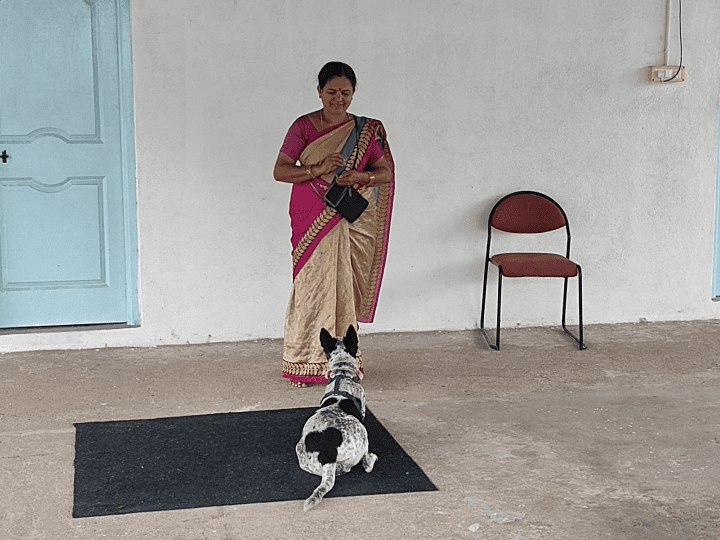
HeartDogs is developing assistance roles that may include psychiatric support for PTSD. We select for and develop the calm, alert and socially confident behaviour required for psychiatric assistance work through the home-based training our Heroes provide from the earliest stages of the programme.
PTSD assistance placements require careful individual assessment - the dog's tasks are shaped by the specific PTSD presentation of the person it will live with, not a generic task list. A placement is followed by ongoing support and monitoring, because the handler's needs change over time and the dog's tasks may need to evolve with them.
A psychiatric assistance dog is not a substitute for trauma-informed clinical care. But for many people in India who cannot access that care, or who need more than clinical appointments can provide across the hours of daily life, a well-trained dog is a meaningful and practical part of the support picture.