The daily impact of severe hearing loss - beyond not hearing
Severe or profound hearing loss affects far more than a person's ability to follow conversations. Research consistently documents its association with reduced social participation, greater dependence on others for everyday information, fearfulness at home (particularly at night), social isolation and significantly elevated rates of anxiety and depression. For some people with severe or profound hearing loss, hearing devices do not fully address safety, environmental awareness or daily communication needs. The PEDRO trial was designed specifically for people for whom audiological interventions had provided limited functional benefit - not as a replacement for hearing aids or cochlear implants, but as additional support for those not adequately served by them alone.
Hearing loss in India carries its own specific social weight. Communication barriers, reduced employment access, dependence on family members and the stigma that still attaches to disability in many communities compound the direct challenges of not hearing. A hearing assistance dog addresses the practical dimensions of this - not the stigma, not the employment barriers, but the daily household safety and independence gap - in a way that few other tools can.
The specific tasks a hearing dog is trained to perform
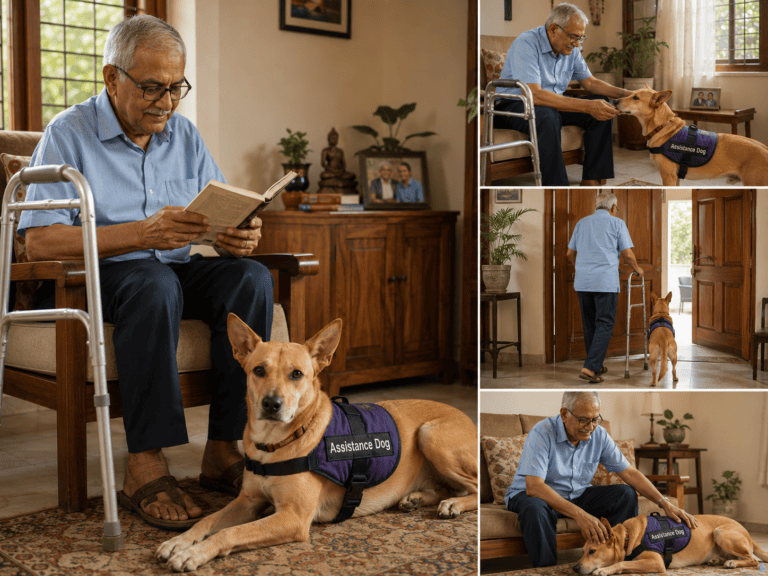
A hearing dog - sometimes called a signal dog or sound dog - is trained to alert its handler to specific sounds and to lead them to the source. The method is consistent: when a trained sound occurs, the dog touches its handler (typically a nudge or a paw) and then leads them to the source of the sound, or in the case of a danger signal, moves away from it to indicate evacuation.
- Doorbell or door knock. The dog alerts its handler when someone is at the door and leads them there. In Indian homes where the doorbell may be unreliable or where visitors knock rather than ring, this task adapts to what the household actually uses.
- Smoke and fire alarm. When a danger alarm sounds, the dog alerts its handler with a nudge and then gives a trained danger signal - typically lying down rather than leading the handler towards the source. Hearing Dogs for Deaf People trains a distinct response for danger sounds to distinguish them from everyday sound alerts. This is a safety-critical task for people living alone or in households where a co-resident may not always be present.
- Alarm clock or timer. The dog alerts its handler when a set alarm sounds - enabling independent time management without depending on another person to wake or remind them.
- Name being called. When a specific person's name is called, the dog alerts its handler and leads them towards the caller. Particularly relevant in multi-room Indian households where communication between rooms relies on calling out.
- Baby or young person crying. For parents with hearing loss, a dog trained to alert to a baby's cry restores an awareness of a dependent that hearing loss would otherwise prevent.
- Other household sounds. Hearing dogs can be trained to specific audible household sounds relevant to the individual's daily routine. In some Indian households, sounds such as a pressure cooker whistle, a cooker timer or an audible kitchen alarm may be practically significant. These would form part of an individual task assessment rather than a standard task list - mapping the programme to what actually matters in that household's daily life.
- Phone and call alerts. Dogs can be trained to respond to audible phone alerts - enabling the handler to notice an incoming call or alarm without relying solely on vibration or visual cues they might miss.
The basic alert begins with the dog making contact with its handler. For everyday sounds, the dog typically nudges and then leads towards the source. For danger sounds, a different trained response is used - such as lying down - to distinguish the alert from ordinary sound notifications. The dog's job is not to solve the situation but to ensure its handler is aware of it and can respond. That restoration of awareness is what changes daily life.
Hearing Dogs for Deaf People · International Tinnitus Journal, 2019
The strongest evidence in this area - and its limitations
The landmark study on hearing dogs is the PEDRO trial, published in Trials (Stuttard et al., 2021), a randomised controlled trial led by the University of York. It is the first ever RCT evaluating hearing dogs - and within the broader assistance dog field, where controlled trials are rare, this makes it a significant study.
The trial enrolled more than 160 people with severe or profound hearing loss who had applied to Hearing Dogs for Deaf People in the UK. Participants were randomised to receive a hearing dog sooner than usual or to remain on the waiting list as a comparison group. The study found that people who had received a hearing dog had significantly better mental wellbeing, were less dependent on others, had fewer symptoms of anxiety and depression, and reported reduced social isolation and fearfulness compared to those still waiting.
"This study provides, for the first time, robust evidence on the positive and wide-ranging impacts hearing dogs can make on people's lives." - Professor Bryony Beresford, Chief Investigator, PEDRO Study, University of York
The caveats are worth stating clearly. The PEDRO trial was conducted in the UK with participants who had self-selected to apply for a hearing dog through a specific charity. Outcomes may differ in other populations, settings and cultural contexts. The study measures wellbeing and independence outcomes rather than specific task performance. And as a "wait-list" design RCT rather than a fully blinded trial, it has the limitations inherent in studies of this type. The evidence is the strongest available for hearing dogs specifically - it does not mean the findings transfer automatically to Indian populations.
Stuttard et al., Trials 22:700, 2021 · University of York PEDRO press release
A fair question: why a dog when technology exists?
It is fair to ask whether smart doorbells, phone vibration alerts, visual alarm systems and other assistive technology make hearing dogs redundant. The honest answer is: for some people, yes. Technology has made significant inroads into the practical support that was previously only available through a hearing dog.
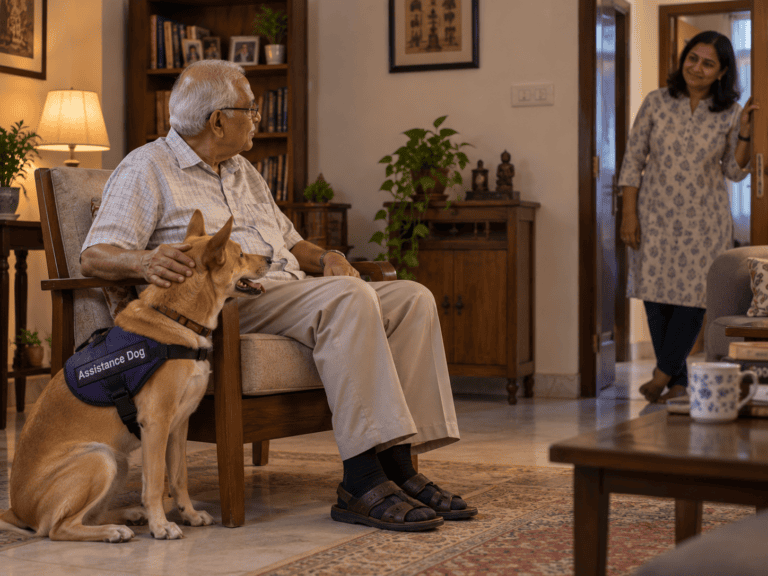
But a few things remain specific to a hearing dog. A dog is mobile - it is present wherever the person is in the home, or outside it, rather than fixed to a device or dependent on connectivity. A dog may respond to some relevant sounds that have not been integrated into a particular smart-home system, though this ability is not guaranteed and depends on training and generalisation. A trained dog can often generalise selected alert behaviours to new environments, subject to training and the handler's safety plan, where technology may not be set up or available. And a dog provides companionship that recipients and earlier research have identified as an important part of the experience - though companionship is not unique to hearing dogs and is not the same as the task-specific sound-alerting evidence.
The 2019 review in the International Tinnitus Journal notes that the role of hearing dogs "may appear controversial considering technological advances" but concludes that for people who cannot access or do not benefit adequately from audiological rehabilitation, hearing dogs "may play a role to reduce the negative effects of hearing impairment." Dog and technology are not mutually exclusive; many hearing dog recipients use both.
Why this matters in India - and what the barriers are
India's hearing loss burden is significant. Cochlear implants, which can cost ₹8 to 15 lakh or more, are accessible to a small proportion of those who might benefit. Hearing aids are more widely available, but quality varies substantially and ongoing costs create access barriers. For people with severe or profound hearing loss who are not well-served by audiological technology, a hearing dog represents a form of practical support that currently barely exists in India.
The Indian household context makes specific hearing dog tasks particularly relevant. In many Indian households, called-out communication between rooms, door knocks and sounds from commonly used cooking appliances may be among the most practically significant sounds to consider in a hearing-dog task assessment. Pressure cooker alerts, door knocks and cooking sounds carry household significance that may not translate directly from Western task lists but can be trained to Indian household specifics. Multi-generational households mean that independence within the home - rather than absolute independence - is often the meaningful goal: a dog that enables a person with hearing loss to function without constant dependence on a family member in the same household changes daily dynamics in important ways.
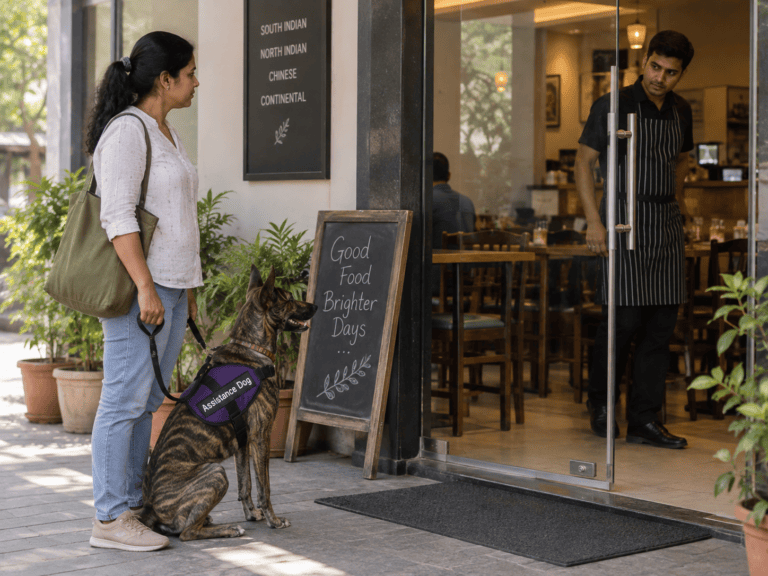
The barriers to establishing hearing dog programmes in India are similar to those for other assistance dog roles: very limited public awareness that this is something that exists at all, and no widely established infrastructure or certification system for hearing-dog programmes. India does not currently appear to have a widely established, dedicated national accreditation or certification system for hearing-dog providers. These barriers are the same ones that existed in the UK decades before its current infrastructure developed.
What we are working towards
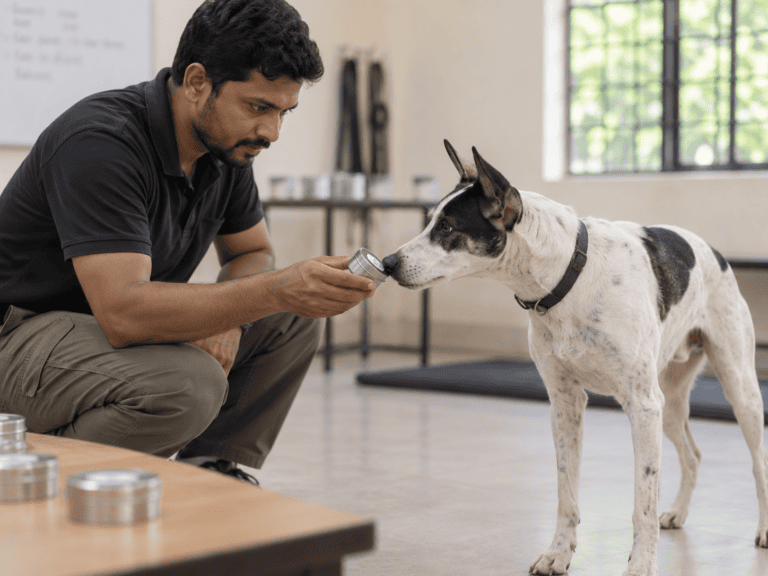
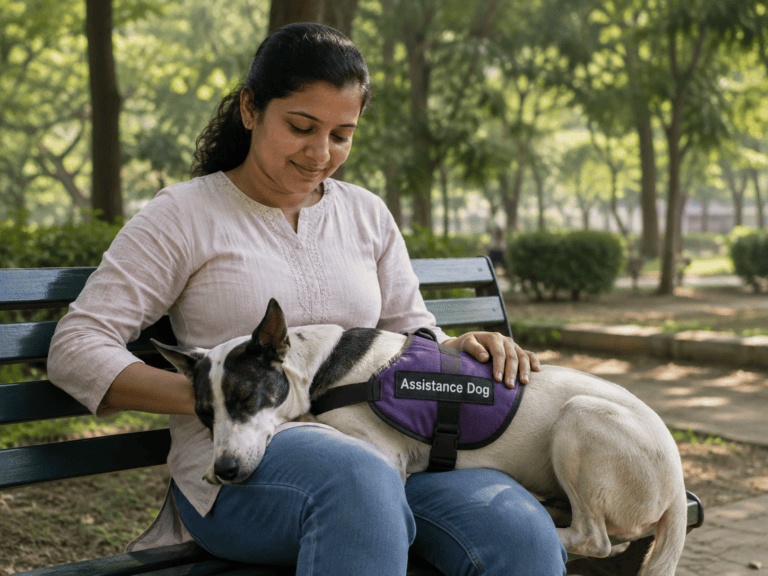
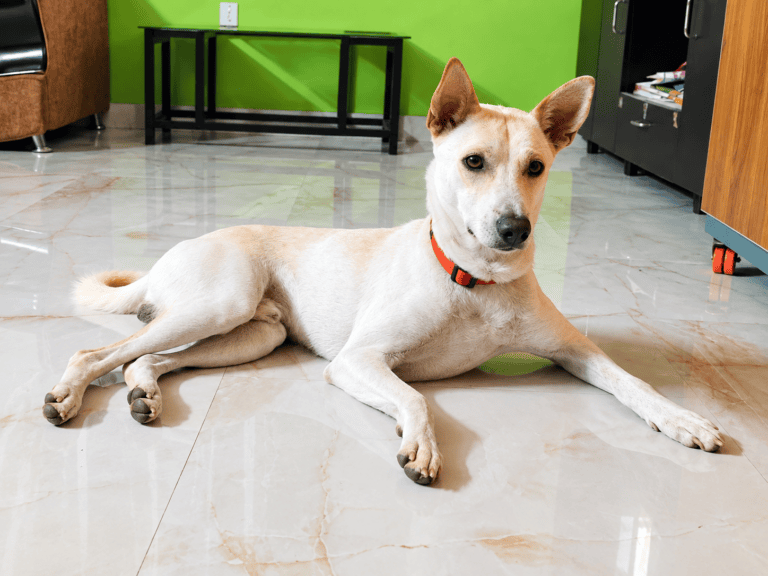
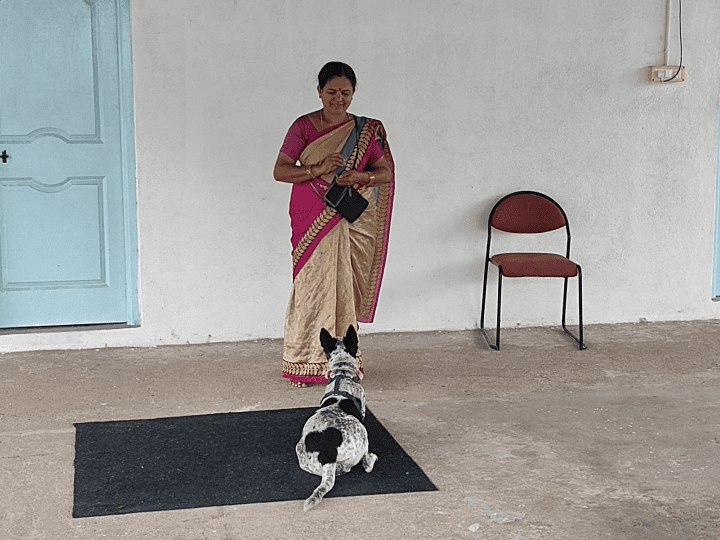
HeartDogs is developing assistance roles that may include hearing support tasks for people with severe or profound hearing loss. The alert-and-lead mechanism that hearing dogs use - touch, then lead to source - is a well-defined, trainable task sequence that a suitable, calm and socially engaged Indie may be trained to perform these tasks reliably after individual assessment, sound generalisation and placement-specific training.
Hearing dog placements require careful task mapping to the individual's home and daily routine - the sounds that matter in their specific household, the layout of the space, the people they live with. That individualisation is part of what we build into all our assistance placements. We are working towards it, not claiming it as current operational reality.