Why most dogs don't make it - and why that's not a failure
Research by Bray and colleagues (2019), published in Frontiers in Veterinary Science, analysed assistance-dog training data from Canine Companions for Independence - one of the largest assistance dog organisations in the US. The study included 5,967 dogs assessed with an In-For-Training temperament test, with separate C-BARQ samples of 3,569 dogs, and a combined sample of 2,990 dogs with both measures. All dogs were purpose-bred Labrador Retrievers, Golden Retrievers and their crosses. The study reports that Canine Companions' average success rate over 13 years was 43%, excluding breeder and medical releases. Across the broader field, published success rates typically range from 30 to 50%.
This is not a failure of the dogs, the trainers or the programmes. It is a reflection of how specific and demanding the requirements of assistance dog work are. The behavioural profile required - calm under pressure, focused under distraction, able to generalise reliably across environments, socially appropriate with a wide range of people, responsive to its handler and physically capable of sustained work - is a rare combination. Assessment exists to identify whether a given dog has that combination before a placement is made, not after.
The dimensions of a pre-placement assessment
In established programmes, assessment is generally built from multiple sources of evidence rather than a single test on a single day. The pre-placement process typically considers:
- Temperament and behavioural traits. The most studied aspect of assistance dog assessment. Key traits include fearfulness (or its absence), excitability, trainability, attachment to people, social behaviour, impulse control and recovery from novelty or stress. These are assessed through structured behavioural tests, handler questionnaires and ongoing observation across training. The Canine Behavioral Assessment and Research Questionnaire (C-BARQ) - one of the most validated tools in the field - captures these dimensions through standardised questions and has been used to build predictive models of training outcome.
- Response to novelty and stressors. An assistance dog will encounter unpredictable situations throughout its working life. How a dog responds when something unexpected happens - a loud noise, a sudden movement, an unfamiliar piece of equipment - can provide useful information about its readiness for the working world alongside how it performs under controlled training conditions. Recovery time from a stress response, and the degree to which that recovery is reliable, are key indicators.
- Distraction resistance. A dog that is well trained in a quiet room but loses focus in a crowded environment is not ready for placement. Assessment includes exposure to the range of distractions the dog will encounter in its specific working role - food on the ground, other animals, unfamiliar people, noise - and observation of whether the dog can maintain focus on its handler and its tasks across those distractions.
- Task reliability. The tasks the dog has been trained for - whether retrieval, deep pressure, sound alerting or mobility support - must be performed reliably and consistently across different environments and contexts, not just in the training setting. A dog that performs well in training but inconsistently in novel settings has not been sufficiently generalised.
- Physical health and soundness. A working dog must be physically capable of performing its role safely and comfortably over many years, though working life varies considerably by dog, role and health. Pre-placement health assessment considers musculoskeletal soundness and any conditions relevant to the dog's specific working role and its welfare during work. For roles involving physical assistance, the dog's size, strength and joint health are particularly relevant.
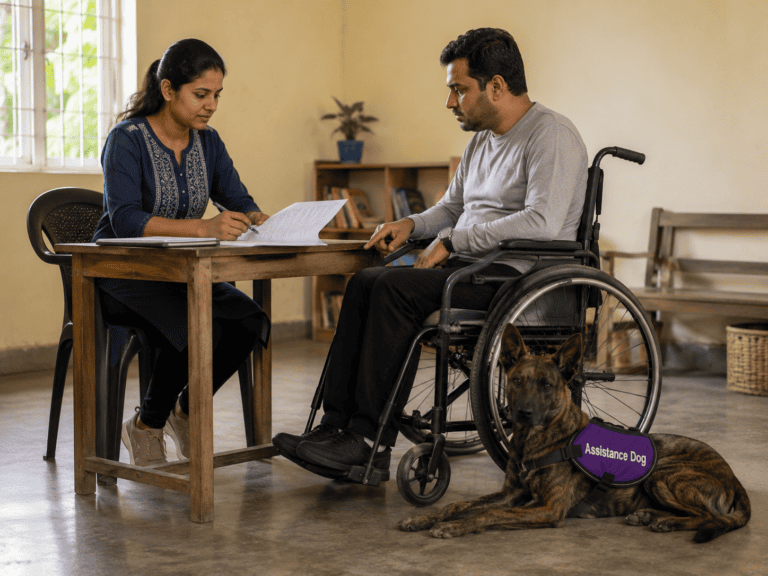
- Handler compatibility. Assessment is not only of the dog. The handler's lifestyle, home environment, physical capability, daily routine and specific support needs must be assessed alongside the dog's capabilities to ensure the match makes practical sense. A calm, task-trained dog placed with a handler whose home and daily life don't suit the dog's needs - or whose support needs don't match the dog's trained tasks - is not a successful placement regardless of the dog's quality.
Marcato et al., Applied Animal Behaviour Science, 2022 (comprehensive assessment review)
The limits of prediction - and why that's honest
The research on assistance dog assessment reveals an important honest truth: even well-designed assessment tools predict training outcome imperfectly. In the Bray et al. (2019) study, predictive models based on C-BARQ and the In-For-Training test achieved 64-68% accuracy on held-out data - useful evidence that these measures contain predictive information, but well short of certainty. Notably, the models were considerably better at identifying dogs likely to struggle than at confidently identifying future graduates: for the lowest-probability group, accuracy reached 85-92%, while predictions for the highest-probability group were only 62-72% accurate. Better than chance - but a long way from certainty.
As a comprehensive 2022 review by Marcato and colleagues on assistance dog selection methods notes, there is currently no universally accepted assessment standard across assistance dog programmes. Methods, terminology and criteria vary between organisations, and there is evidence that assessments developed for one programme's dog population may not generalise well to another's. The variation in assessments may not be a weakness in the field - an organisation's assessment criteria reasonably reflect the specific demands of their programme, their population of dogs and the handlers they serve.
Assessment is the programme's best available tool for managing uncertainty - not for eliminating it. The goal is to make a placement that is right for both the dog and the handler, with as much evidence as possible and as much honesty about what remains unknown.
This also means that no programme can guarantee a placement will work indefinitely. It is also worth noting that the Bray study measured graduation or release from a training programme - not whether a placement remained successful across the dog's entire working life. Those are different outcomes, and post-placement monitoring and support are part of a responsible programme because life changes - handler needs evolve, the dog ages, circumstances shift. Ongoing assessment after placement is as important as the assessment before it.
Bray et al., Frontiers in Veterinary Science, 2019 · Marcato et al., Applied Animal Behaviour Science, 2022
What assessment looks like for rescued Indies
A substantial proportion of the published research on assistance-dog assessment has involved purpose-bred dogs from established programmes, particularly Labradors, Golden Retrievers and their crosses - whose genetic background, early rearing conditions and developmental history are known. The picture for rescued dogs entering training from unknown or street backgrounds is different, and requires some adaptation in approach.
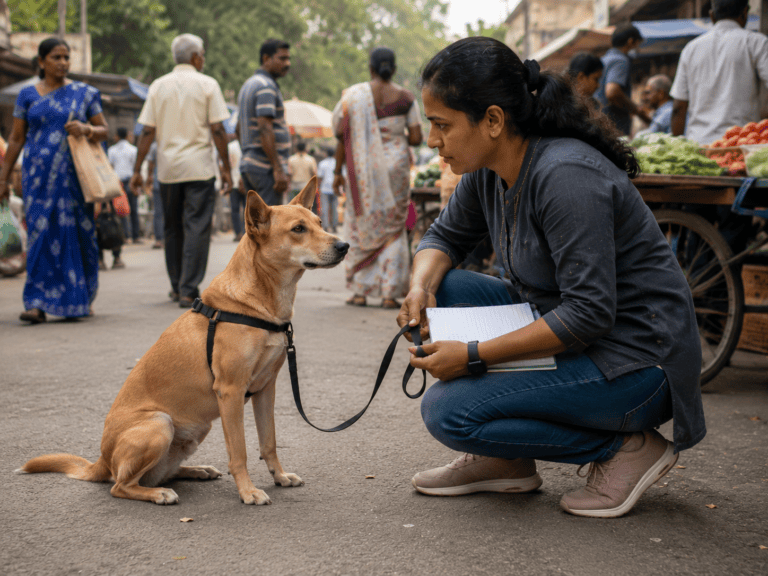
Without a known developmental history, initial assessment of a rescued Indie is more about identifying where the dog currently is than predicting where it came from. Key questions include: How does this dog respond to novelty? How does it recover from mild stress? Is it engaged with people and responsive to training? Is there any history of fearfulness, reactivity or behavioural problems that is visible under assessment conditions?
Because rescued dogs may have varied and incompletely known histories and exposures, some relatively confident and some having acquired specific fear responses - assessment of rescued dogs requires more extended observation across more situations before conclusions can be drawn. A dog that appears confident in the assessment environment may show different behaviour in a hospital corridor or a school common room for the first time. This is why assessment is ongoing throughout the HeartDogs training period, not a one-time gateway at the beginning.
The positive side of this is that each rescued dog can be assessed as an individual rather than accepted or rejected solely because of a breed label or assumed history. That does not mean size, structure, health or observed behavioural tendencies are irrelevant - they remain important when considering the demands of a particular role. The central question is whether this individual dog has the behavioural, physical and emotional characteristics needed for the work, and whether those characteristics remain stable across the environments where the dog is expected to work.
Assessment is as much about the handler as the dog
Matching a dog to a handler is not simply placing the most capable dog with the most eligible person. It requires that both sides of the partnership are assessed and that the fit between them is considered carefully.
The handler's specific support needs determine what tasks the dog must perform. A person with epilepsy needs different tasks from a person with autism, who needs different tasks from a person with mobility impairment. The handler's home environment - its size, its other occupants, its proximity to suitable spaces - affects how the dog will live and work. The handler's capacity to maintain a dog's training - to practise cues, to maintain the dog's skills, to recognise when the dog needs support - affects how the placement will function over time.
A good match makes the dog's strengths directly useful to the handler's real needs. A poor match - even between an excellent dog and a deserving handler - creates friction that can undermine both parties. Getting the matching right is where the programme's understanding of both the dog and the handler comes together.
How HeartDogs approaches assessment
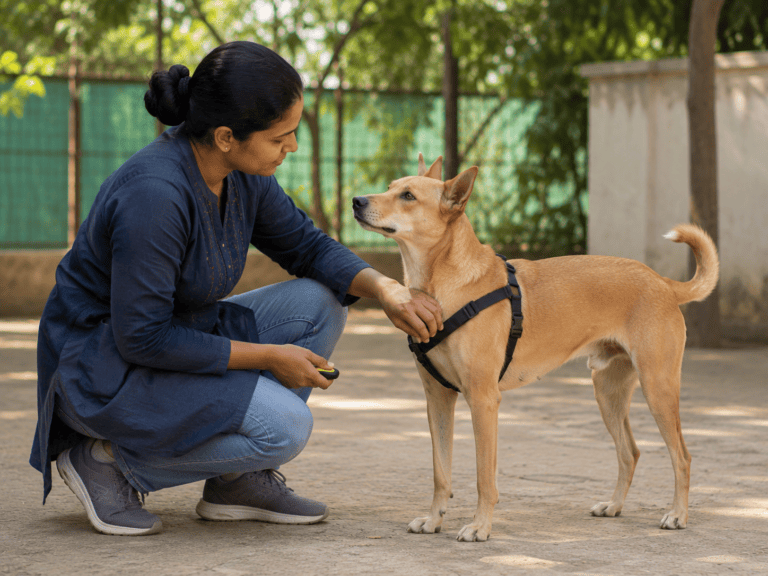
In the HeartDogs programme, assessment is continuous rather than event-based. From the moment a dog enters its foster-trainer's home, observations are recorded and reviewed. Progress through training benchmarks is tracked. Response to new environments is documented. Health is monitored. The picture built over months of training is what informs placement decisions - not a single test.
Assessment for matching also includes understanding the handler and their family thoroughly - the specific challenges they face, the home environment the dog will enter, and what tasks will make the most meaningful difference to daily life. The placement is the beginning of an ongoing relationship between the dog, the handler and HeartDogs - not the conclusion of the assessment process.