What Parkinson's actually does to the body
Parkinson's disease is a progressive neurological condition primarily caused by the degeneration of dopamine-producing neurons in the substantia nigra, a region in the midbrain involved in movement control. As these neurons are progressively lost, the brain's ability to regulate and coordinate movement becomes increasingly impaired. No two people with Parkinson's are quite the same - the mix of symptoms, the speed of progression, and how well medication manages those symptoms varies considerably from person to person.
The physical symptoms most relevant to assistance dog work include:
- Freezing of gait - where the feet suddenly feel stuck to the floor mid-step. The person is upright and trying to move but cannot initiate the next step. Freezing often happens in doorways, when turning, or in crowded spaces. Falls are common in Parkinson's and can lead to injury and hospitalisation; freezing is one of the factors that contributes to fall risk.
- Balance problems - postural instability makes falls more likely, particularly when getting up from a chair, turning quickly, or navigating uneven ground.
- Tremor and rigidity - the characteristic resting tremor and muscle stiffness that affect fine motor tasks like picking things up, getting dressed, or opening containers.
- Fatigue - many people with Parkinson's experience significant fatigue that limits what they can physically do in a day, separate from the motor symptoms.
- Cognitive changes - particularly in later stages, some people with Parkinson's experience memory difficulties, slowed thinking, or other cognitive changes, though this varies widely.
Many people also develop significant anxiety around falling - which can lead to reduced activity and social withdrawal, creating a cycle that becomes harder to break over time.
Examples of tasks that can be trained
Examples of tasks that can be trained for Parkinson's assistance dogs include:
- Responding to a freezing episode - a dog can be trained to respond when the person freezes or gives a cue, using a foot tap, gentle forward movement through a harness, or another trained tactile prompt. Some handlers find that the dog's forward momentum or physical contact helps them initiate stepping again. External cueing can help some people with freezing, though the response varies from person to person; the evidence for dog-assisted cueing specifically is still limited.
- Brace support after a fall - the dog stands firm on a verbal cue, allowing the person to use it as a stable point to push up from the floor. This requires the dog to be physically capable of bearing the person's weight safely; breed, build, and specialist assessment all matter here.
- Support during transfers and walking - a larger dog fitted with a mobility harness can provide a brace point during a stumble and help steady transitions in and out of chairs. The evidence for this is largely based on practitioner experience and individual accounts, and the tasks require specialist assessment to be done safely.
- Tug tasks for transfers - pulling a rope or tug attached to a chair, bed, or stable point to help the person rise.
- Retrieving dropped items - medication containers, a phone, glasses, or anything else that falls and is difficult to retrieve from the floor due to tremor, rigidity, or difficulty bending.
- Fetching medication - retrieving a pre-designated medication container on cue. Consistent medication timing matters significantly in Parkinson's management, and making the medication physically easier to reach is one practical way a dog can help. The dog cannot determine whether medication is due or administer it.
- Alerting others after a fall - the dog can be trained to find a family member or press a purpose-built emergency alert device, if one is accessible and if another person is available to respond.
- Opening doors and operating light switches - reducing the number of moments where the person has to stop, reach, or manage a handle or switch.
"She pulls forward... just enough to get me going, but not so much as to pull me over." Paraphrased from an account published by the Parkinson's Foundation, describing one person's trained dog and how it helps with freezing episodes. Individual experiences with assistance dogs vary.
Research specifically on assistance dogs for Parkinson's remains limited. Much of what is known comes from programme descriptions, practitioner experience, and individual accounts. These suggest that a well-trained dog may support mobility, confidence, daily routines, and social participation for some people, but they cannot yet establish how often these benefits occur or which tasks produce them.
What an assistance dog can't do
An assistance dog is a practical tool, not a treatment. It cannot:
- Replace medication management - the dog works alongside whatever medical treatment the person is on, not instead of it.
- Help with dyskinesia - an assistance dog cannot stop or make predictable the involuntary movements that can develop in people treated with levodopa, particularly after longer-term treatment. Disease duration and progression also contribute to dyskinesia alongside medication. Unpredictable involuntary movements can make some physical assistance tasks unsuitable or unsafe.
- Compensate for significant cognitive decline without support - if Parkinson's has progressed to a stage where the person can no longer reliably remember cues or maintain the working relationship safely, an assistance-dog placement may not be appropriate without substantial support from family members, carers, or a programme.
- Carry the full care burden - assistance dogs work best as part of a broader care plan that includes physiotherapy, occupational therapy, and appropriate medical management. They add to that plan; they don't replace any part of it.
There is also a physical reality to keep in mind. Because some Parkinson's assistance tasks involve the dog providing physical resistance or support, providing resistance, or working against the handler's instability, breed and build matter. A dog that is too small or not structurally suited to this work cannot safely perform brace or transfer tasks. Programmes that specialise in this area will assess the person's needs carefully before matching a dog.
Questions to work through honestly before applying
Getting an assistance dog is a significant undertaking - emotionally, practically, and financially. A few honest questions worth thinking through first:
- Are your primary challenges ones a dog can genuinely help with? If your most limiting symptoms are fatigue, dyskinesia, or cognitive changes rather than freezing and falls, an assistance dog may offer less practical benefit. A conversation with your neurologist or occupational therapist is a useful starting point.
- Does everyone in your household agree? An assistance dog lives in the home, travels with the person, and needs consistent handling. If other family members are resistant, that creates real friction for the dog's training and the working relationship.
- Can you manage a dog's daily needs? Assistance dogs still need feeding, toileting, grooming, and exercise. On days when symptoms are poorly controlled, who does that? This needs a clear answer before applying.
- Can you sustain the financial commitment? Some established nonprofit programmes provide dogs at little or no direct cost; others charge a fee; privately trained dogs usually involve significant direct training costs. All dogs have ongoing care costs - food, veterinary care, and retirement planning - that rest with the family throughout the dog's working life.
- Are you prepared for the training commitment? An established programme will train the handler and dog together, typically over several weeks. Owner-training with a professional trainer requires sustained daily work over many months. Either way, this is not a passive process.
How to find a programme - and what to look for
Where available, a useful starting point is an organisation accredited by Assistance Dogs International (ADI). ADI accredits assistance-dog organisations against defined standards; it does not certify individual dogs or teams. The International Guide Dog Federation (IGDF) is a separate body that accredits guide-dog organisations specifically. Both are worth understanding, but for Parkinson's assistance-dog work, ADI-accredited assistance-dog programmes are the more relevant accreditation to look for.
When assessing a programme, ask:
- Do they have experience with Parkinson's specifically? Mobility assistance for Parkinson's requires a different skill set from guide dog work or psychiatric assistance dog training. Ask how many Parkinson's placements they have made and whether they can put you in touch with past clients.
- What does their assessment process look like? A responsible programme will want to meet the person, assess their specific needs, consider their home environment, and involve their care team before accepting an application.
- What follow-up support do they provide after placement? Parkinson's is progressive, which means the dog's tasks may need to be updated as the person's needs change. Long-term support from the programme matters more here than in many other conditions.
- What are the waiting times? Waiting times at established programmes can be long - often a year or more, and sometimes considerably longer - though they vary substantially by organisation and country. It is worth applying earlier than you think you need to, particularly given how Parkinson's can progress.
Your neurologist, occupational therapist, or a Parkinson's disease nurse specialist can often point you towards suitable programmes and may be willing to support your application with a clinical letter.
What's available - and what isn't
India's large population means it carries a significant Parkinson's burden in absolute numbers. A Global Burden of Disease analysis estimated that around 771,000 people in India were living with Parkinson's disease in 2019, though India-specific epidemiological data remains limited and varies across studies.
The gap between that need and what's available in terms of assistance dog support is significant. There does not appear to be an ADI-accredited organisation in India currently offering a dedicated Parkinson's assistance-dog programme. We have not identified an established programme in India currently offering this specialist combination of mobility tasks for Parkinson's.
People in India who have explored importing a trained dog from the UK, US, or Australia have typically found it prohibitively expensive. For many families, the combined cost of a trained dog, international travel, veterinary documentation, import requirements, and ongoing support can be prohibitive - which can place it out of reach for many families.
India does not currently have a clear, comprehensive national framework guaranteeing assistance-dog public access comparable to the ADA in the US. Access to hospitals, clinics, and public transport may therefore depend on institutional policies and local practice.
Global Burden of Disease - Parkinson's disease in India (PMC)
What we are working towards
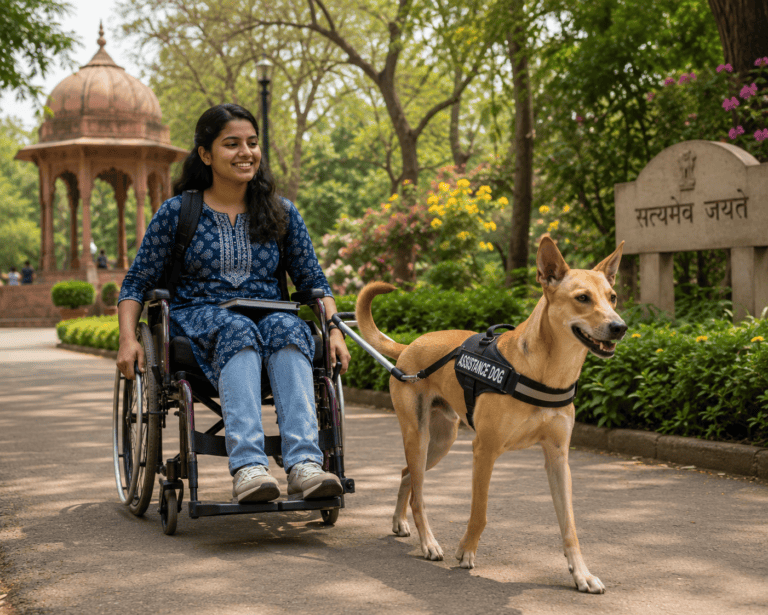
HeartDogs is building India's first systematic programme to train rescued Indie dogs as assistance animals. Our Cohort 1 dogs are currently in training. Mobility assistance work - including the tasks most relevant to conditions like Parkinson's - is part of the capability we are developing.
We are not yet at the stage of accepting applications from people with Parkinson's disease specifically. But if you are a person with Parkinson's, a family carer, or a neurologist or physiotherapist who works with Parkinson's patients and would like to understand what might be possible in India, we would like to hear from you. Understanding the demand, the clinical context, and what families actually need helps us build something genuinely useful.