A condition that varies by person, by type, and by day
MS presents differently depending on the type and progression. Relapsing-remitting MS, the most common course at onset, involves episodes of new or worsening neurological symptoms, often followed by partial or complete recovery. Progressive forms involve gradual accumulation of disability, with or without prior relapses. The symptoms that matter most for assistance dog planning include:
Mobility and balance problems are among the most common effects of MS. These include weakness in the legs, balance difficulties, spasticity - muscle stiffness and involuntary spasms - and an increased risk of falls. Fatigue can compound mobility difficulties significantly.
Hand and arm function can be affected by tremor, weakness, or reduced coordination, making everyday tasks such as picking up objects, gripping, or operating switches more difficult.
Fatigue is one of the most common and disabling symptoms of MS. It can be disproportionate to physical activity, arrive unpredictably, and significantly limit what a person can do on any given day. It is different from ordinary tiredness after exertion, and is one of the symptoms that people with MS most commonly identify as affecting their quality of life.
Bladder and bowel problems are common in MS and can affect independence and daily planning in significant ways. Some people also experience cognitive difficulties - problems with memory, attention, word-finding and processing speed - that are separate from any physical effects.
Emotional effects including depression and anxiety are common in MS. These are partly a response to living with a progressive and unpredictable condition, and partly a direct neurological effect of the disease itself.
This range of symptoms explains why MS service dog task lists vary so much between individuals. A person with significant mobility difficulties and relatively preserved upper limb function needs different tasks from someone whose main challenges are fatigue, cognitive symptoms, and low mood.
Tasks matched to MS symptoms - not a standard package
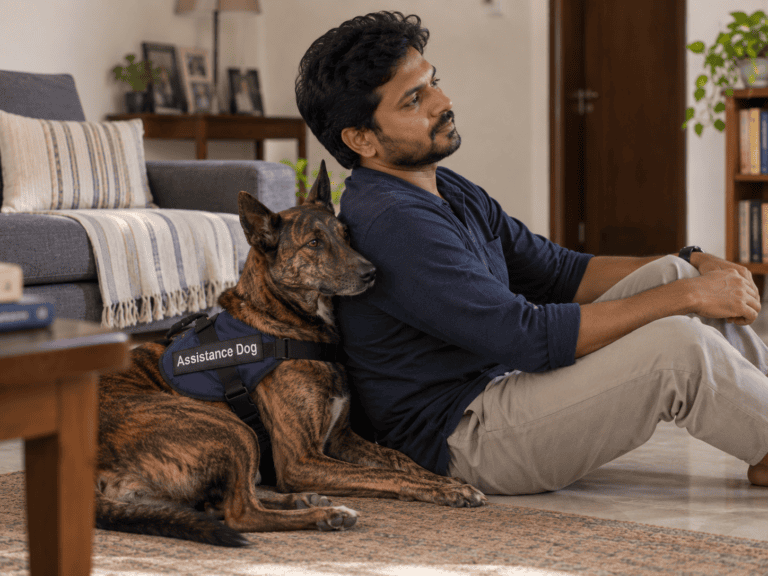
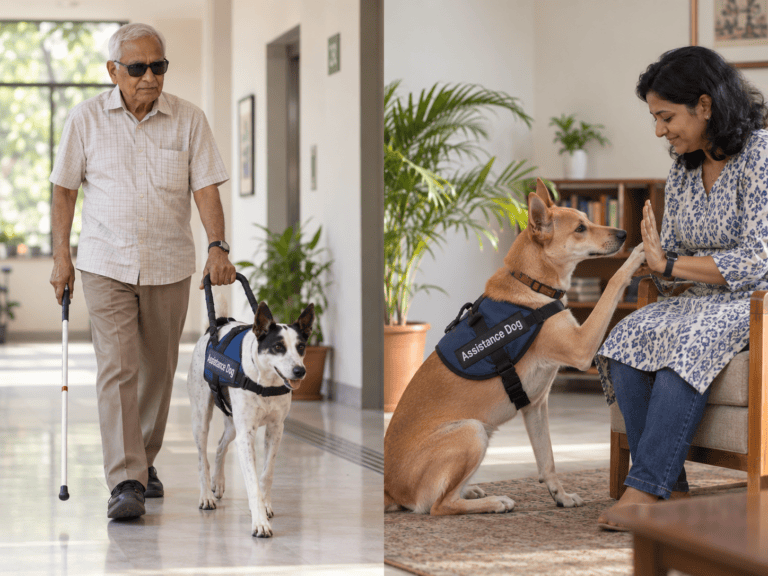
Assistance dogs and service dogs for MS draw heavily on mobility assistance dog tasks, with additional tasks addressing fatigue management and emotional wellbeing where relevant. A dog is trained around the individual's current symptom profile, which means the task set needs to be revisited as the condition changes. Tasks commonly trained for MS include:
- Counterbalance and stability support. For people with balance difficulties or leg weakness, a suitably sized and physically assessed dog can provide a stable surface to lean on when rising from a chair or managing stairs. This task requires careful individual assessment - of the person's needs, the dog's size and build, and the specific demands of the home environment. Bracing and counterbalance tasks should only be considered after assessment by a qualified assistance dog trainer and, where relevant, a veterinarian or rehabilitation professional, and must not be treated as a substitute for appropriate mobility equipment. We cover mobility tasks in detail in our piece on mobility assistance dogs.
- Retrieving dropped items. Picking up objects from the floor can be difficult or impossible for someone with significant spasticity, weakness or balance problems. A trained dog can retrieve named items from the floor and bring them to the handler, reducing the need to bend, squat or risk a fall. This is one of the most consistently documented and trainable tasks in mobility assistance dog work.
- Fall response. If a person with MS falls and cannot get up independently, a trained dog can retrieve a phone, activate an accessible alert device connected to a monitoring system, or seek another person in the home. This is a response task - the dog acts after the fall occurs, not before it.
- Opening and closing doors and drawers. For people with hand weakness or fatigue, a dog trained to tug on a rope attached to a door handle, pull open a drawer, or push a door closed can reduce the physical demand of navigating a home independently.
- Switching lights on and off. Using a paw to operate accessible light switches reduces reliance on hand function and helps someone with fatigue or mobility difficulties manage their home environment more safely, particularly at night.
- Undressing assistance. A dog can be trained to pull off socks, gloves or shoes by gripping and tugging - a small but practically significant task for someone whose hands or arms are affected. This task should only be trained where the person wants it, where it is physically safe for both dog and handler, and where the dog is not placed in a position where it could be injured or cause injury.
- Fatigue and rest prompts. Some programmes train dogs to prompt rest at set intervals or respond to a cue associated with a rest routine. There is no established evidence that dogs can independently detect neurological fatigue, and this task should be treated as individually designed rather than a standard one.
- Grounding and emotional support tasks. For MS-related depression, anxiety, or emotional dysregulation, tasks such as deep pressure on cue, nudging to interrupt observable anxious or repetitive behaviour, and providing a physical presence during difficult periods can be individually trained. These are response tasks built around observable cues, not internal state detection.
MS is a condition where a person's needs in year three may be significantly different from year one. A task set that works now should be reviewed as the person's symptoms or function change, including after a relapse.
A dog can be trained to perform these tasks in controlled settings, but real-world reliability still depends on the individual dog, the specific task, the home environment, and ongoing maintenance training. No task should be assumed to transfer automatically to new environments or after a significant relapse has changed the handler's function.
More evidence here than for many conditions - and some important limits
MS has been included in some of the earlier and more frequently cited assistance dog research, particularly studies of mobility disabilities. However, high-quality MS-specific randomised evidence remains limited, and much of the available research is observational, self-reported, or based on mixed-diagnosis samples.
A 1996 randomised trial by Allen and Blascovich, published in JAMA, is one of the most widely cited in this area. It included 48 people with severe mobility impairments from a range of causes - not MS specifically - and randomised them to receive a trained service dog immediately or remain on a waiting list. Those who received a service dog showed improvements in self-esteem, psychological wellbeing and community integration, and used fewer paid and unpaid human assistance hours. Depression did not significantly change. Because the sample included people with different underlying conditions, these findings cannot be treated as MS-specific.
A 2011 systematic review by Millan and Reynolds examined service dogs for people with mobility-related physical disabilities across multiple diagnoses, including MS. It found promising but inconclusive evidence, with reported benefits in functional ability, social participation and psychological outcomes. The authors also highlighted substantial weaknesses in the available studies.
The honest summary: there is somewhat more evidence for the functional and mobility benefits of assistance dogs - including for people with MS - than for tasks aimed specifically at fatigue management or emotional support. Even so, much of the evidence is self-reported, observational, or based on mixed-diagnosis samples, and high-quality randomised trial evidence specific to MS is still limited.
Allen & Blascovich, JAMA, 1996 | Millan & Reynolds, Systematic Review, 2011
A condition that is less common here - but unevenly diagnosed and under-resourced
MS is generally less common in India than in many high-income Western countries, although prevalence estimates remain uncertain and may be rising. India lacks large nationwide epidemiological studies, and published estimates vary substantially by region, population and study period. Older regional studies commonly reported around 7 to 10 per 100,000, while more recent national estimates have been higher. Despite the lower reported prevalence, India's true burden is likely underestimated because access to diagnosis remains uneven, particularly outside major centres.
Many people living with MS in India do not have access to specialist neurology care or disease-modifying therapies - medicines that aim to reduce relapses and slow disability progression - with access varying substantially by income, location and health system. MS can also be confused with other neurological conditions common in India, adding to the diagnostic challenge.
MS often begins during the working-age years. Indian clinical reports frequently describe onset in the third or fourth decade of life, which means its impact often falls on people during education, employment and family-building years - making the independence that an assistance dog can support particularly significant.
As with most assistance dog applications in India, public access for a service dog trained for MS is not clearly guaranteed under Indian law. We covered this landscape in detail in our piece on assistance dog certification and law in India.
Why MS requires a different approach to placement than stable conditions
Most assistance dog placements are built around a person's current needs, with the expectation that those needs will be reasonably stable. MS disrupts that assumption. A person in an early relapsing-remitting phase may have relatively mild mobility difficulties; the same person five years later may have very different functional needs, depending on how their disease has evolved.
This means several things practically. A placement made early in someone's MS journey should be accompanied by a clear plan for reassessment - both of the dog's tasks and of whether the handler-dog partnership remains appropriate as the person's symptoms, function or disease course changes. Tasks that were sufficient in year one may need to be expanded or changed in year three. A placement made when someone is primarily ambulatory but fatiguing quickly may require a different task set from one made when someone uses a wheelchair. A well-trained dog can often be retrained for new tasks - but the placement needs to be made with the person's possible trajectory in mind, not assumed to be permanent.
This is also why the relationship between an MS assistance dog programme and a clinical team matters more than average. A neurologist who understands the person's disease type and likely progression, an occupational therapist who can advise on home environment and task prioritisation, and a physiotherapist who understands the physical demands being placed on both the handler and the dog should all be part of the planning conversation - not consulted after a placement has already been made.
Where MS sits in our programme
MS assistance dog work sits primarily within our mobility and physical disability track, with elements from our psychiatric and emotional support track where relevant. The physical tasks - counterbalance, retrieval, fall response, door and light work - are generally the most trainable and have somewhat more supporting evidence than fatigue or emotional-support tasks, and they are the tasks we would build a placement around first.
What MS specifically requires from a programme is a commitment to reviewing the placement over time rather than treating it as a one-time event. HeartDogs is working towards building that kind of ongoing support into our model from the start - because for a condition like MS, a placement that is not reviewed may eventually stop fitting the person it was made for.
If someone in your family has MS and you want to understand what assistance dog support might look like in an Indian context, we would like to hear from you.