C-PTSD shares PTSD's core symptoms - and adds three more clusters
PTSD can follow a single traumatic event or a bounded period of trauma. C-PTSD is associated with prolonged or repeated trauma - often in situations where escape or safety was difficult: childhood abuse or neglect, domestic violence over years, captivity, trafficking, or sustained institutional mistreatment. What distinguishes C-PTSD in the ICD-11, however, is its symptom profile rather than the duration of trauma alone.
C-PTSD includes the core PTSD cluster - re-experiencing, avoidance, and persistent sense of current threat - but also involves what the ICD-11 calls "disturbances in self-organisation": three additional symptom groups.
- Affect dysregulation - difficulty managing emotional responses; feelings that arrive suddenly and overwhelmingly. This can present as explosive anger, persistent emotional numbness, or both at different times.
- Negative self-concept - a deep and persistent sense of shame, worthlessness, or guilt; the feeling that something is fundamentally broken or wrong about oneself. This goes well beyond low mood or ordinary self-doubt.
- Disturbances in relationships - difficulty trusting others, extreme sensitivity to perceived rejection, oscillation between closeness and distance, difficulty feeling safe with people who are genuinely safe.
The combination of hypervigilance, emotional dysregulation, and relational difficulty makes everyday environments - crowded spaces, unexpected physical contact, unfamiliar situations, interactions with strangers - significantly harder to navigate. The additional relational and self-concept difficulties associated with C-PTSD can also make treatment and therapeutic relationships more complex, and care may need to be adapted accordingly.
It is also worth noting that the ICD-11, which took effect in 2022, recognises C-PTSD as a distinct diagnosis. The US DSM-5 does not list it as a separate diagnosis - which affects how it is identified and treated in different clinical contexts.
ICD-11, World Health Organisation · Complex PTSD Assessment, VA National Center for PTSD · Herman JL, Complex PTSD: A syndrome in survivors of prolonged and repeated trauma, PMC
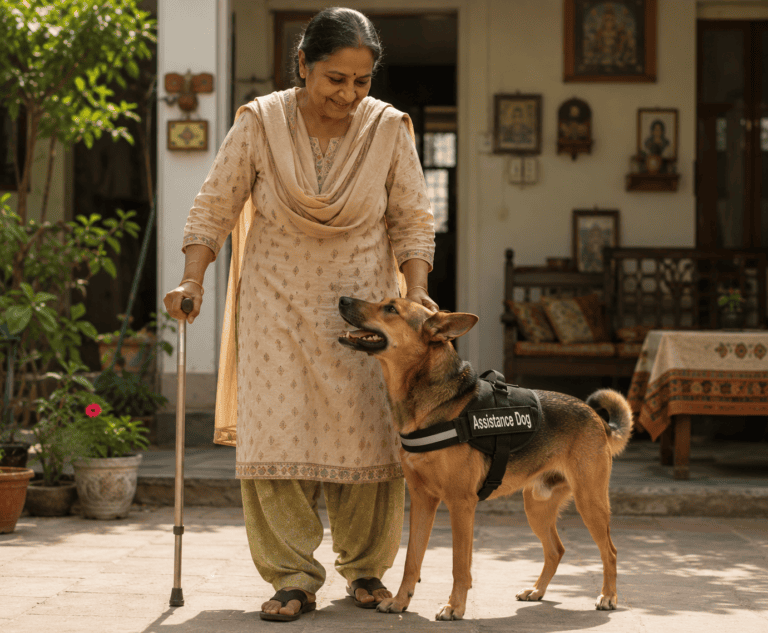
A psychiatric assistance dog is trained to specific tasks - not just to be present
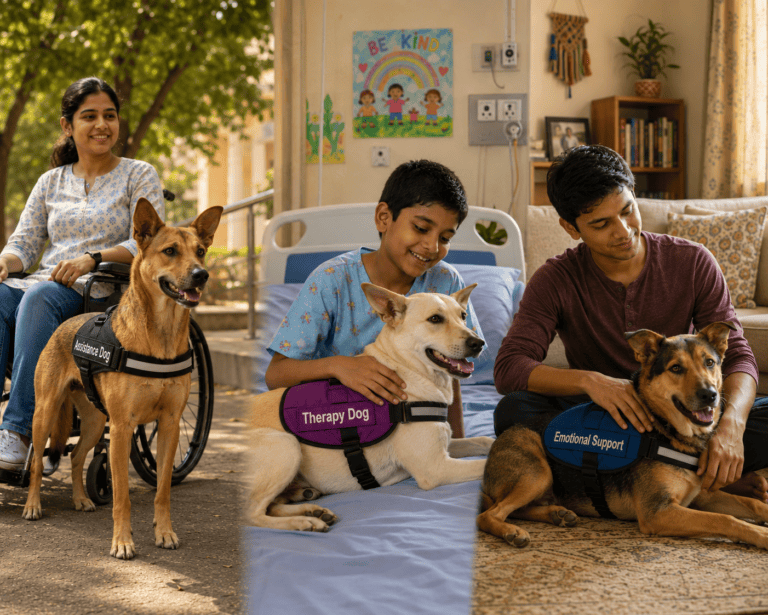
There is an important distinction between an assistance dog and an emotional support animal. An emotional support animal provides comfort by its presence - it is not trained to perform specific disability-related tasks. A psychiatric assistance dog is trained to respond to specific observable cues or handler signals, and those trained behaviours are what qualify it as an assistance dog under many established assistance-dog frameworks.
For someone with C-PTSD, the tasks a psychiatric assistance dog may be trained to perform fall into a few categories. These are possible trained behaviours - they are not guaranteed effects, and what works varies by individual, by dog, and by how the partnership is developed.
- Anxiety interruption - the dog can be trained to respond to observable signs of distress or to a handler cue - for example, by nudging, leaning, or making deliberate contact. This may help interrupt an escalating episode or provide grounding at a moment the handler has learned to recognise. It is not established that dogs can reliably detect internal anxiety before it has any outward expression.
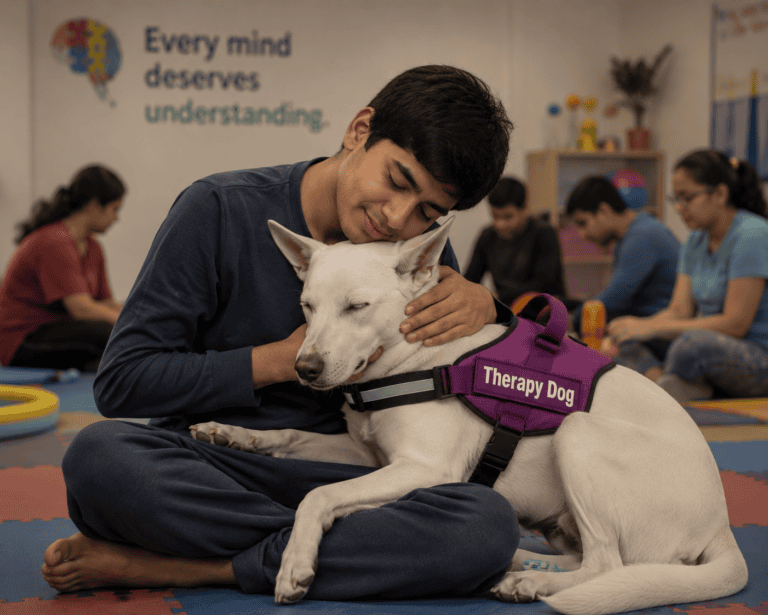
- Grounding during distress - deliberate physical contact from the dog - weight on the lap, a paw placed on the arm - may provide a sensory anchor for some people during periods of dissociation or overwhelm. Effects vary and should be individually assessed rather than assumed.
- Perimeter work in public spaces - the dog can be trained to position itself to create physical space around the handler: covering their back in queues or open spaces, or standing in front to reduce the volume of direct approach. This may reduce the load of constant environmental monitoring for some people, though it cannot guarantee that the handler will not be approached.
- Night-waking support - a dog can be trained to respond to a handler cue associated with nightmares or night waking, and to make contact to help the handler reorient. It cannot be assumed to reliably detect a nightmare before the handler is aware of it, and this is not an established outcome across all dogs or all partnerships.
- Environmental check routines - some programmes train dogs to perform a check of a new room before the handler enters. This may provide a familiar routine and a moment of reassurance as part of a structured entry protocol. It does not establish whether a room is objectively safe - a dog cannot do that - but the routine itself can be part of how the handler manages the moment of entering an unfamiliar space.
- Support during crisis or flashback - during a flashback or panic episode, the dog may maintain contact and perform trained behaviours that help the handler reorient. A well-trained dog may be able to remain relatively settled during its handler's distress, but dogs are not immune to stress, and their responses vary. Handlers must also monitor the dog's comfort and stress signals, and allow it to disengage when needed.
The dog does not ask what happened. It does not need the story. For some people, that consistency - non-judgemental, not dependent on performance - can be experienced as deeply supportive, in a way that complements rather than replaces therapeutic work.
A Purdue University study of psychiatric service dogs for veterans found that calming and comfort tasks, along with anxiety interruption tasks, were reported as among the most important and most frequently used by the veterans in the study. These were self-reported perceptions of veterans with PTSD - not evidence that dogs can reliably detect distress before a handler is aware of it, and not a study of C-PTSD specifically.
Defining the PTSD Service Dog Intervention, Frontiers in Psychology (Purdue/VA)
Promising but preliminary - and mostly about PTSD in veterans, not C-PTSD
The research base is growing but still limited, and it is important to be clear about what it does and does not show. Almost all published studies on psychiatric assistance dogs and trauma have been conducted with military veterans diagnosed with PTSD. Very little research specifically addresses C-PTSD and assistance dogs as a distinct combination.
A 2022 systematic review by Leighton, Nieforth and O'Haire examined 41 articles - 29 peer-reviewed publications and 12 unpublished dissertations. Its meta-analysis of nine articles found a significant reduction in PTSD symptom scores, but the authors noted substantial variation between studies and that only one study used a randomised controlled trial. The review found promising but limited evidence that assistance-dog partnerships may be associated with improved wellbeing and reduced PTSD-related symptoms for some veterans. The evidence was largely observational or self-reported, and the review could not establish that assistance dogs cause these improvements. Studies in this field have methodological limitations, including the difficulty of blinding participants to whether they have an assistance dog. Larger, more rigorous studies are needed to clarify the benefits, limitations, and longer-term outcomes of these partnerships.
One small study included in that body of research examined attentional bias and proximity to a dog. Its findings are preliminary and correlational - they do not establish that a service dog changes hypervigilance or attentional threat processing in any sustained way.
The honest position is this: psychiatric assistance dogs may provide individually tailored support for some people with C-PTSD, and the broader PTSD literature is cautiously encouraging. But the evidence does not establish that dogs can detect internal states, prevent trauma responses, or substitute for trauma treatment. An assistance dog is most appropriately considered as part of an integrated care plan, in conversation with mental health professionals who understand the person's specific needs.
Leighton, Nieforth & O'Haire (2022), Assistance dogs for posttraumatic stress disorder, PLOS ONE · ADI summary, Research Shows Assistance Dogs Reduce Symptoms and Boost Wellbeing
The additional symptoms of C-PTSD have implications for how a dog is trained and placed
The three disturbances in self-organisation that distinguish C-PTSD from standard PTSD - affect dysregulation, negative self-concept, and relational difficulties - have direct implications for how a psychiatric assistance dog partnership needs to be designed, as programme recommendations rather than established clinical protocols.
Affect dysregulation means some handlers may experience heightened arousal, emotional intensity, or numbness at different times - and across a wider range of triggers than combat-related PTSD typically involves. The dog needs to be genuinely stable under emotional intensity, which requires careful selection and assessment for this specific profile.
Negative self-concept creates a particular dimension to the handler-dog relationship. Many people with C-PTSD describe relational experiences in which they feel fundamentally flawed or unworthy. For some, the dog's consistent, non-judgemental presence may feel supportive and may complement treatment. It is not a substitute for trauma therapy or a mental health professional - but it may be a form of safe relational experience that supports the person's engagement with everything else, including treatment.
Relational difficulties mean the handler may find the handler-trainer relationship during placement difficult to sustain, and the early period of building a working partnership with the dog genuinely challenging. Good placement programmes for C-PTSD would need to account for this: slower initial work, more graduated expectations, and a training approach that does not require the handler to perform or demonstrate competence in ways that could trigger shame. These are programme-design recommendations - this specific approach has not been formally studied.
High-demand partnerships require close attention to the dog's wellbeing
Psychiatric assistance dogs working with C-PTSD are in high-demand partnerships. Some handlers may experience heightened arousal, emotional intensity, or numbness at different times - and the dog is trained to respond to these states repeatedly over the course of a day. This is meaningful work for a suitable dog, but it requires careful monitoring.
Signs that a working dog is under sustained stress include changes in appetite, sleep, or play behaviour; increased vigilance and difficulty settling; reduced responsiveness to familiar cues; or changes in how the dog seeks interaction. These are not signs of a bad dog or a failing partnership - they are signals that the dog needs rest, variety, and decompression time, and that the handler may benefit from additional human support so the dog is not carrying the full weight of the regulation work.
Responsible programmes build in regular welfare assessments for the dog alongside support for the handler. The partnership is not a one-way intervention - it is a relationship, and like all relationships, it needs maintenance from both sides.
C-PTSD in India: a condition that needs greater recognition
Research on C-PTSD in India remains limited. Its recognition in routine mental healthcare and access to trauma-informed assessment and care are areas that need further study. What can be said is that C-PTSD may be under-recognised in many settings internationally, and that trauma-related difficulties can sometimes be attributed to other conditions - but how this plays out specifically across Indian clinical practice is not well documented.
In that context, psychiatric assistance dogs for C-PTSD are some way downstream of where the conversation currently sits in India. The more immediate need is awareness: that C-PTSD exists as a distinct diagnosis, that chronic trauma produces a different and more pervasive profile than single-event trauma, and that people living with these experiences deserve recognition and evidence-based support.
As psychiatric assistance dog programmes develop in India, C-PTSD is a population that will require careful thought - about how dogs are selected and assessed for this specific profile, how handlers are supported through the placement process, and how welfare monitoring is built into long-term partnership. These are questions the field is still developing answers to internationally.
Working towards psychiatric assistance dog partnerships in India
HeartDogs is working towards building a systematic programme for training and placing assistance dogs in India, including psychiatric assistance dogs for conditions like C-PTSD. This is an area that requires careful groundwork: the selection criteria for dogs suitable for psychiatric work are distinct from those for physical disability assistance; the training is more complex; and the handler support required through the placement process and beyond is more intensive.
Getting the psychiatric assistance dog model right in India also requires engagement with the mental health sector - psychiatrists, trauma therapists, and clinical psychologists who understand the C-PTSD profile and can work with handlers as part of an integrated approach. An assistance dog is most effective as part of a care plan, not as a substitute for one. The handler support required through the placement process and beyond may be more intensive for some psychiatric assistance-dog partnerships than for others.
If you work in mental health in India and are curious about what an assistance dog partnership might mean for your patients or clients, we would welcome the conversation.