A stigma with colonial roots
The preference for imported pedigree breeds in Indian urban households is relatively recent, and it has specific roots. As the INDog Project notes, European breeds were actively marketed in India partly by positioning indigenous dogs as inferior - the term "pariah dog" carries the stigma of that framing, and that stigma has lingered long after the colonial context that created it.
What gets lost in that history is a simple fact: Indies were living successfully alongside Indian families long before any of those imported breeds existed. They are not a consolation choice. They are the original family dog of this subcontinent - shaped over thousands of years by exactly the conditions Indian families still live in today. The question isn't whether they can make good family dogs. The question is whether families understand what they're actually getting.
Yes - with the right understanding
The INDog Project's breed standard puts it plainly: the Indie "has no inherited traits that make it unsuited to being an urban family pet, provided it gets sufficient outdoor exercise." That's a significant statement - not marketing, but a description of a dog that evolved alongside human families in India for millennia.
Indies can make excellent family dogs. They are loyal, alert, highly intelligent and built for Indian conditions in a way no imported breed is. But they are not the right dog for every family or every living situation, and anyone who tells you otherwise isn't being straight with you. The honest picture is that an Indie thrives in a home that gives it exercise, engagement, patient socialisation and the time it needs to form trust. In that environment, families consistently report deep loyalty, low veterinary costs, easy training and a dog that genuinely becomes part of the household.
It's also worth saying clearly: this isn't an argument that pedigree breeds are automatically better behaved or more suited to family life. Every dog, regardless of breed , starts life without knowing what's expected of it. Undesirable behaviour isn't a street dog problem or an Indie problem - it's simply behaviour that hasn't been shaped yet. The same way we teach young ones what's acceptable and what isn't, dogs need consistent guidance, socialisation and engagement from early on, regardless of breed. An Indie that receives this is a different dog from one that doesn't - and the same is true of any Labrador, Golden Retriever or German Shepherd. The Indie simply deserves to be assessed on the same terms as any other dog - not dismissed before that assessment begins.
With that context established, here's what the research and real family experience actually shows.
What makes Indies well-suited to Indian family life
- Built for India's climate. The breed standard notes that Indies "thrive with minimal maintenance, especially in tropical weather" and are "relatively clean" with "almost no body odour." A short double coat requires little grooming. This is a dog shaped by Indian conditions - not one that needs air conditioning to function.
- Robust health and low veterinary bills. The breed standard describes Indies as having "very few health concerns" with genetic conditions like hip dysplasia being "extremely rare, since in a naturally evolved breed only the fittest breed and the flaws are bred out." Average lifespan under good care is over 15 years. Families consistently report significantly lower veterinary expenses than pedigree breed guardians.
- Highly intelligent and trainable. The breed standard describes them as "highly intelligent and easily trainable." Families in the INDog Club community report dogs that pick up household routines quickly and respond well to positive reinforcement. The caveat is that their intelligence means they bore easily - repetitive training methods or repetitive games don't hold their attention.
- Loyal and family-oriented. Indies are "very territorial and defensive of their pack/family," according to the breed standard. Once bonded with a family, this loyalty is consistent and enduring. They make excellent watchdogs as a result.
- Modest appetite. The breed standard specifically notes that Indies are "very modest eaters and will rarely overeat" - a practical consideration for any family managing a household budget.
These strengths are real and well-documented. But a balanced picture also means being honest about what an Indie needs from its family - and where things can go wrong without the right preparation.
What to be realistic about
- They are cautious with strangers - this is not a flaw. The breed standard is clear: "they are not comfortable around strangers and can get defensive." This wariness evolved in dogs that had to read unfamiliar humans accurately for thousands of years - a survival skill, not a temperament defect. The breed standard specifically notes this caution "is not to be mistaken for a lack of courage." With good socialisation from an early age, an Indie becomes confident and manageable around visitors. Without it, the caution can become a challenge.
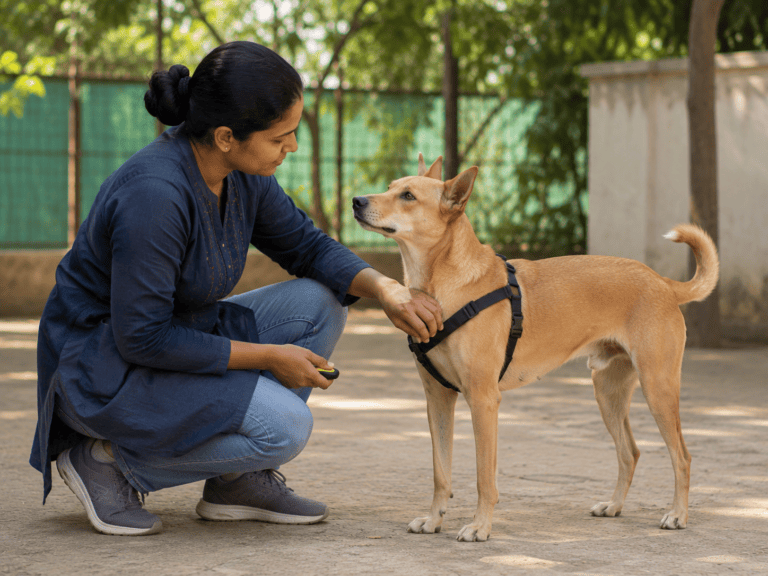
- Early socialisation is non-negotiable. The breed standard notes Indies "need good socialising as pups." This is the single most important thing a family can do with a young Indie. A well-socialised Indie is a genuinely different dog from one that was not.
- They need real exercise. The breed standard describes Indies as "a very active breed" that "thrives with regular exercise and very long walks, several times a day." A small flat with no outdoor access and an inactive household is not an ideal environment. Families with access to open areas are significantly better placed.
- They are vocal - and this can be shaped. The breed standard notes they "bark at the slightest doubt or provocation." This is part of what makes them excellent watchdogs. With training that begins early, barking can be channelled and managed - the dog learns what warrants alerting and what doesn't. An untrained Indie in a flat with thin walls is a different proposition from a trained Indie that understands when its voice is needed.
- They settle slowly. An Indie rehomed as an adult needs time to decompress and adjust. Families that push for affection too early or expect immediate bonding often find the dog more reserved than expected. Patience in the first weeks pays off significantly over the years that follow.
The INDog has no inherited traits that make it unsuited to being an urban family pet, provided it gets sufficient outdoor exercise. - INDog Project Breed Standard
Taken together, these are not dealbreakers - they are the profile of an intelligent, sensitive, active dog that repays the effort put in. The families who understand this going in consistently report that the Indie more than lives up to its potential. Those who don't can find it difficult.
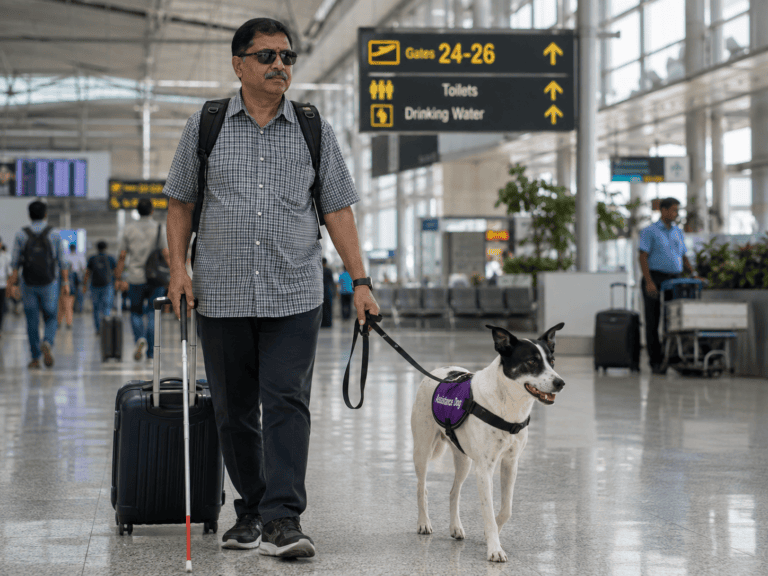
How these same traits translate to trained assistance dogs
Some of what's described above might seem to complicate the case for Indies as assistance and therapy dogs - wariness around strangers, vocal tendencies, high exercise needs. It's worth addressing this directly, because what looks like a concern in a family pet context looks quite different in a trained working dog.
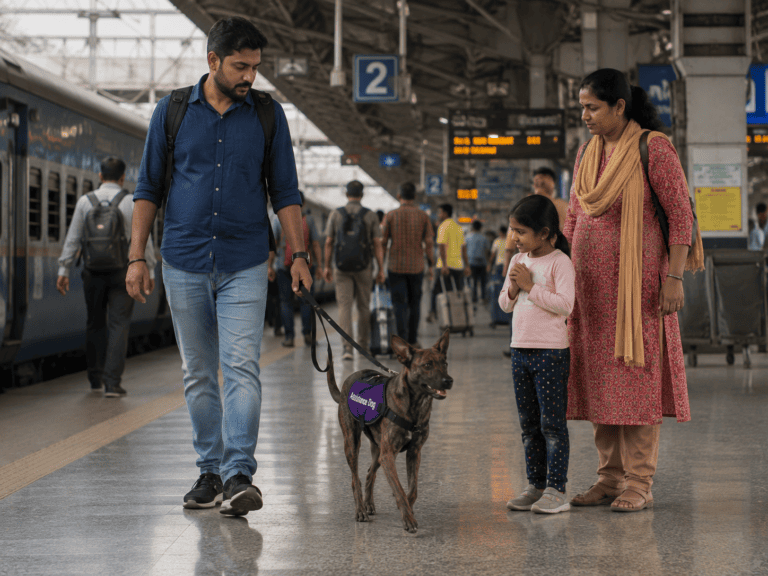
- Wariness around strangers. In an untrained, poorly socialised Indie, this is a genuine challenge. In a carefully selected and thoroughly socialised assistance dog, it becomes heightened alertness - the ability to read environments and people accurately, which is exactly what assistance work requires. Training builds confident exposure to strangers, settings and crowds from the earliest stages. Dogs that don't pass this consistently don't proceed. Those that do carry their alertness as an asset.
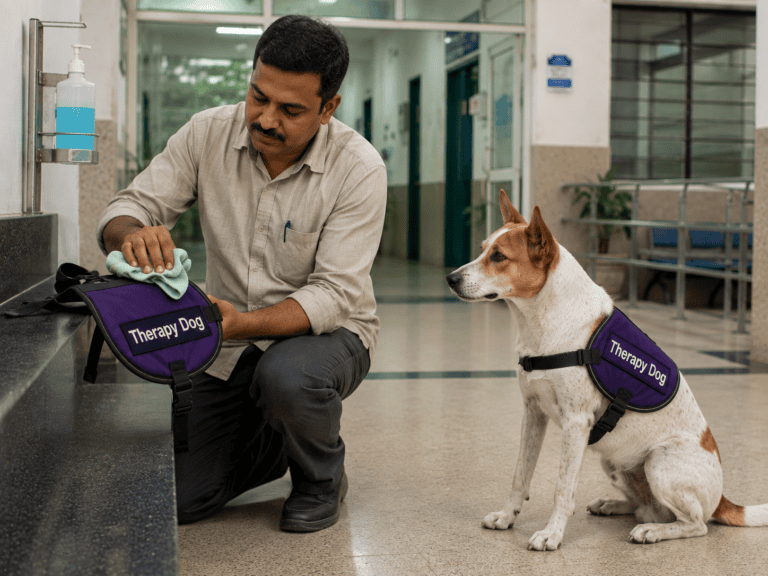
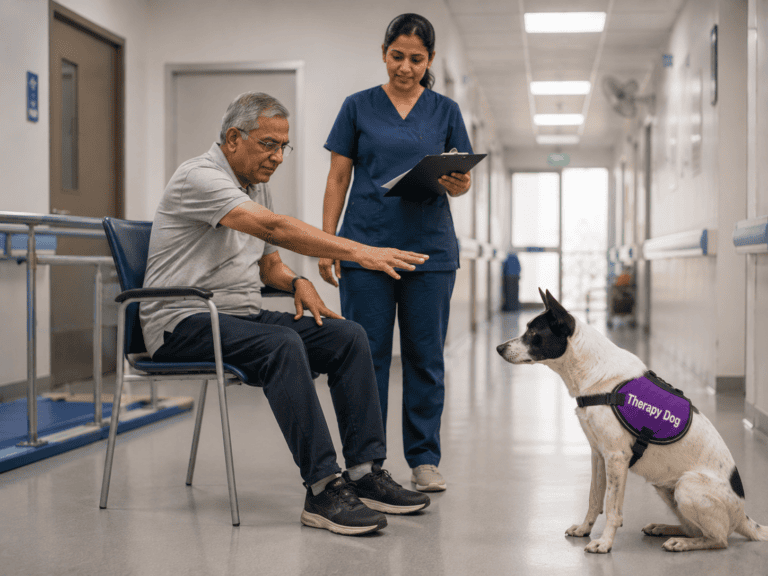
- Vocal tendencies. From the earliest stage of training, it pays to work with dogs to help them understand when their voice is needed and when it isn't - channelling the Indie's natural alertness rather than suppressing it. A working assistance or therapy dog that constantly barks in a hospital corridor hasn't completed the programme. Calm, quiet behaviour in institutional settings is a core requirement, assessed throughout training and before any placement.
- High exercise needs. This is actually well-suited to working dog life. An assistance dog that works daily - walking with its handler/care taker, responding to cues, staying engaged and attentive - gets the mental and physical stimulation it needs as part of its job. A working Indie in a structured placement is doing exactly what keeps this breed settled and focused.
The underlying point is this: the traits that make an Indie an excellent family watchdog - alertness, loyalty, sensitivity to its environment - are the same traits that, properly selected for and trained, make it a capable working dog. HeartDogs assesses every dog individually, choosing those that carry these traits in the form the work requires.
What this means for our work
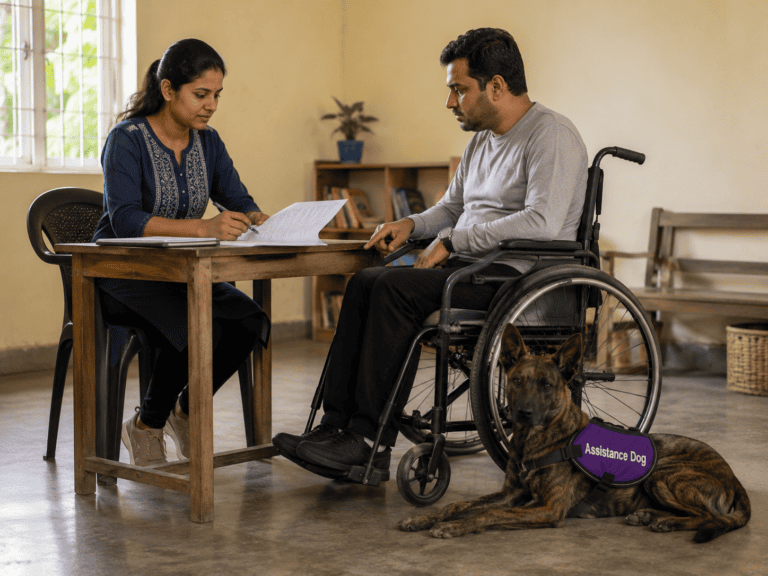
HeartDogs trains Indies - India's native landrace dogs - as assistance and therapy dogs. The same qualities that make a well-socialised Indie a good family dog - loyalty, intelligence, adaptability, alertness - are the foundations of the work we're building. Our foster-trainers live with these dogs daily in real homes in rural Karnataka, and those homes are exactly the kind of family environments that bring out the best in them.
If you're considering adopting an Indie as a family dog, we'd encourage it - with realistic expectations and the commitment that any intelligent, active dog deserves.