What a dog actually does in a session
In animal-assisted speech therapy, the therapist delivers the therapy, not the dog. Sharon Antonucci, a speech-language pathologist writing for SpeechPathology.com, describes it as a clinician-provided service within the clinician's scope of practice. The animal acts as a communication partner and facilitator, and the therapy goals stay the same as they would be without a dog. The activities may be playful, but they should serve defined therapy goals.
- A reason to communicate. For example, a child might practise a target word or phrase by giving the dog a cue, or take turns in a short game with the dog.
- Language tasks built around the dog. For adults with aphasia, Antonucci's examples include naming things linked to the animal, lengthening utterances, and starting or keeping up a topic of conversation.
- Rapport and participation. Speech pathologists in a 2025 Australian study reported that the dog helped them build rapport quickly and supported turn-taking and natural language.
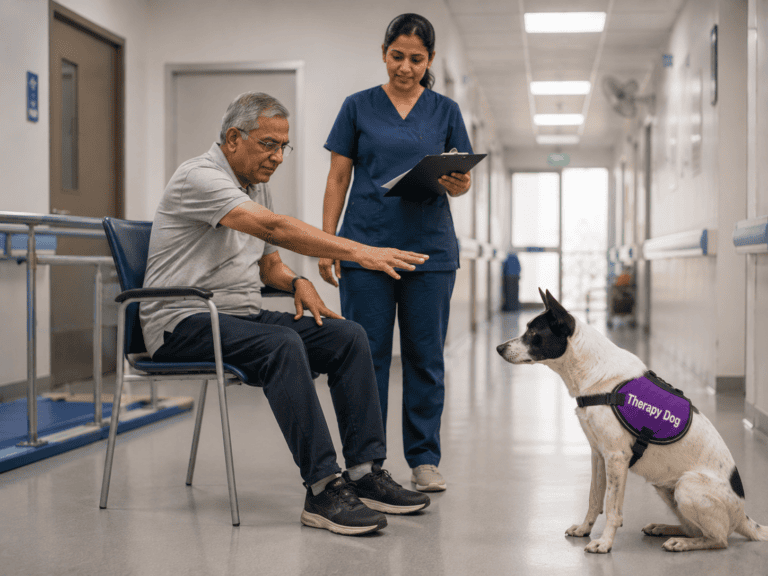
The dog may be a visiting therapy dog with its handler, or a dog worked by the clinician. Our posts on facility dogs and therapy dogs and animal-assisted intervention explain the difference. Reading dogs in schools are a related but separate idea, covered in our post on reading-assistance dog therapy. This post is about speech and language therapy itself.
Sources: Antonucci, SpeechPathology.com (2020) | Zhang et al., Healthcare (2025)
What the research shows so far
- One of the few randomised trials. A 2018 randomised controlled trial in the Czech Republic (Machova and colleagues) followed 69 nursery-school children with developmental dysphasia for 10 months. One group had conventional speech therapy and the other had sessions that included a dog. The study measured facial motricity and motor proficiency, not standardised speech or language outcomes. Improvements were reported in both groups, with some measures improving significantly more in the dog-assisted group. The authors called for further research with larger samples.
- Perceptions, not outcome measures. In a 2025 Australian interpretive descriptive study, five speech pathologists and 42 caregivers described therapy dogs as helping children build rapport, regulate emotions and behaviour, engage with tasks, attend sessions, use natural language and develop social skills. Most caregivers perceived a positive influence on mood, stress and anxiety. These were perceptions from one clinic, and the study did not use standardised outcome measures.
- Evidence involving adults. A 2024 scoping review looked at animal-assisted services for adults with acquired neurogenic communication disorders, including aphasia. As summarised by its abstract, it identified 17 studies, with mostly positive findings for mood, motivation and satisfaction but mixed findings for communication and participation. Inconsistent reporting makes it hard to draw firm conclusions about effectiveness.
- A young field. An overview in the communication sciences literature says interest in animal-assisted interventions is growing, and that building an evidence base for clinical practice is still a challenge.
The available evidence does not yet establish that adding a dog improves speech, language or communication outcomes beyond conventional therapy. Early studies suggest that a dog may help some children engage and participate, but this needs confirming through larger, well-designed studies with clear clinical outcome measures.
Sources: Machova et al., Anthrozoos (2018) | MedicalXpress summary of the trial (2018) | McSween et al., scoping review, International Journal of Language & Communication Disorders (2024) | Zhang et al., Healthcare (2025) | Interest in animal-assisted interventions within communication sciences (Thieme)
What needs to be in place
- Consent and clearance. This means consent from the client or guardian, plus any clinical clearance the setting or professional guidance requires. Antonucci lists physician permission among those that may be needed, and says the session should not go ahead if the person or guardian declines.
- Screening for risk. This covers allergies, fear of dogs, open wounds that cannot be covered, and infection risk for people with weakened immunity. One caregiver in the Australian study reported an allergic skin reaction. Our post on hygiene and working dogs covers the basics.
- The right dog and handler. Antonucci says a dog should be reliable, controllable and predictable, seek interaction, and stay calm among distractions. She says suitability depends on the animal's behaviour, not its breed.
- Dog welfare. One Australian clinic described a limited weekly schedule, rest days and a crate or time-out space for the dog. That is one clinic's practice, not an established safe workload. A therapist there also said it "can be really hard to manage a dysregulated dog and a dysregulated child in the same room". Only one of the five therapists had formal animal-assisted therapy training, which shows how much of this field is still being worked out.
- Structure. A casual visit is not therapy. Our post on why a pet visit is not a therapy dog programme explains why goals, screening and training matter.
Sources: Antonucci, SpeechPathology.com (2020) | Zhang et al., Healthcare (2025)
Speech therapy in India, and where a dog might fit
Access to speech-language therapy remains limited in many parts of India, and reported workforce shortages mean that a dog must never substitute for a qualified therapist. A June 2025 Careers360 report, citing Rehabilitation Council of India figures, says around 2,500 students graduate each year with a Bachelor of Audiology and Speech Language Pathology (BASLP) degree. It quotes an academic describing a substantial shortage of audiology and speech-language pathology specialists. That figure covers the combined qualification, not speech-language therapists alone, and is not a workforce census.
We have not identified a nationally standardised framework for animal-assisted therapy in speech-language settings in India, and programmes of this kind may not yet be widely available. Anything that develops will need to sit inside qualified therapy, with consent, hygiene and animal welfare standards written down in advance. Schools and rehabilitation centres are natural places where it could be considered; see our posts on school facility dogs and therapy dogs in rehabilitation centres.
Source: Careers360 (June 2025)
What HeartDogs is doing
HeartDogs is working towards trained therapy and facility dogs that can support clinicians and institutions in settings such as schools, hospitals and rehabilitation centres. In speech therapy, that would mean a dog working towards a qualified therapist's goals, never in place of one, with the welfare of the dog considered at every step.