A therapy dog visit in a hospice setting is structured, not casual
A well-run therapy dog programme in a hospice or palliative care setting is not a casual "bring your nice dog to cheer people up" arrangement. It involves a handler-dog team that has been assessed for this kind of work, coordination with clinical staff, careful patient consent and screening, and structured visits with clear boundaries around what is appropriate in each setting.
The dog and handler are typically registered or assessed through an animal-assisted intervention organisation - in the UK this includes Pets as Therapy (PAT); in the US, Pet Partners and similar organisations. Requirements vary by organisation and country, but typically involve temperament testing, health checks, and assessment of the handler's ability to manage the dog appropriately in a clinical environment. Many organisations require periodic re-evaluation or renewal, although requirements differ.
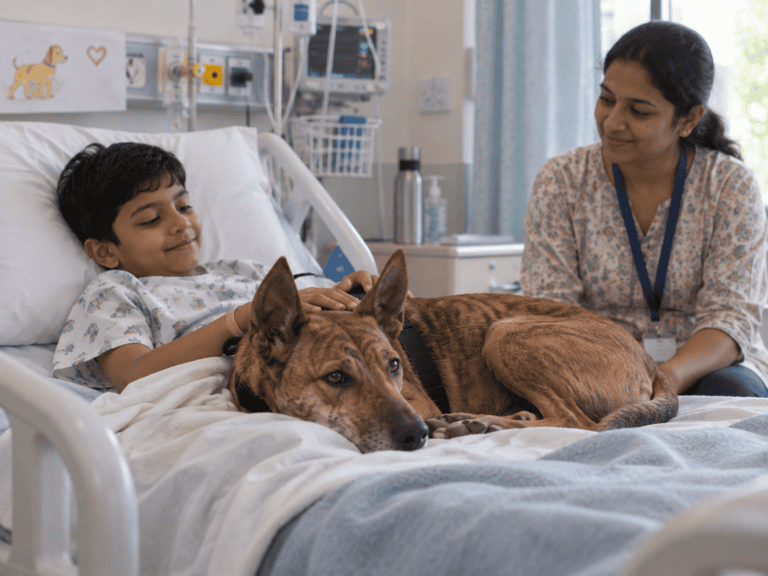
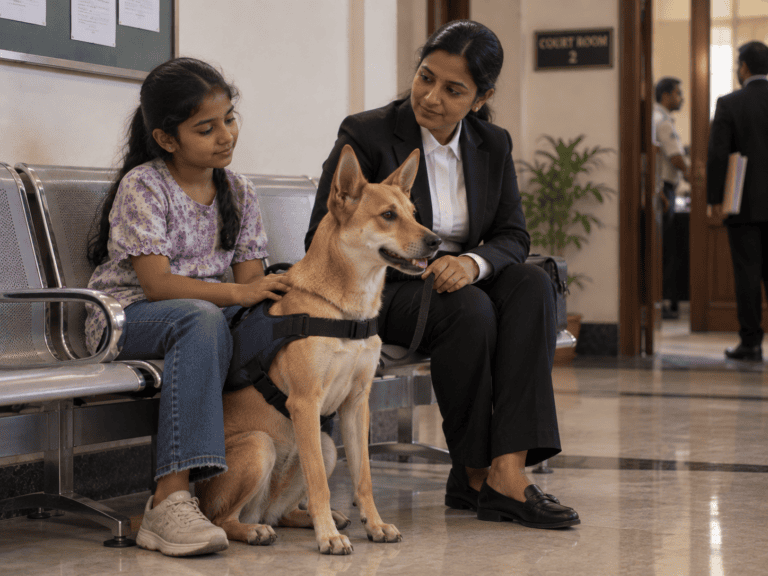
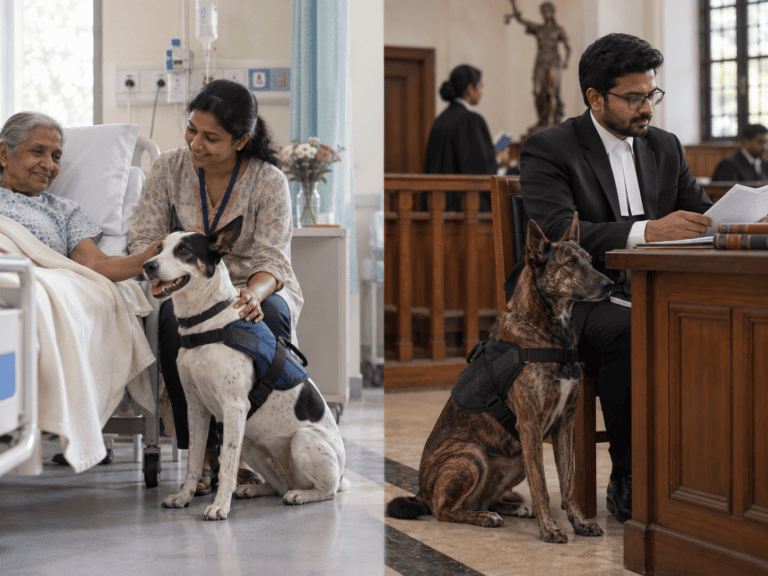
During a visit, the handler brings the dog to a patient's room or a common area, introduces themselves and the dog, and spends a defined period with the patient - with the length adapted to the patient's condition, the setting, and the dog's welfare. The interaction is patient-led: some people want to stroke the dog, talk to it, or simply have it sit near them. Some want to talk about their own pets or memories of dogs. Some simply enjoy the warmth of an animal presence in a space that can feel clinical and isolating. The handler manages the dog throughout, reads both the patient's and the dog's cues, and ends the visit if either seems uncomfortable or fatigued.
The handler's role is as important as the dog's. A therapy dog visit is not the dog working independently - it is a team visit, where the handler facilitates the interaction, manages safety, and is attentive to the emotional and physical state of both the patient and the animal throughout.
Family members present during a visit often benefit as much as the patient. The presence of a calm, friendly animal can shift the emotional atmosphere of a room and open up conversation in ways that feel less pressured than talking directly about what the family is going through.
Pet Partners, About Animal-Assisted Interventions · Pet Partners, Volunteer Requirements · Pets as Therapy, About PAT
Evidence is promising but still preliminary - particularly in palliative-specific settings
Research on animal-assisted interventions across healthcare and residential settings has reported possible improvements in outcomes such as anxiety, mood, perceived pain, and social engagement, although findings vary and study quality is uneven. The animal-assisted intervention field is described in published literature, and the International Association of Human-Animal Interaction Organizations (IAHAIO) maintains published guidelines for practice.
Research specifically focused on hospice and palliative care is smaller in volume and more variable in quality. Reviews of animal-assisted interventions in palliative and hospice care have generally described positive but preliminary findings, with small samples, varied outcome measures, and limited follow-up. A 2021 review published in Complementary Therapies in Clinical Practice examined 10 studies and reported promising findings related to mood, perceived pain, and quality of life, while noting inconsistent methods and small sample sizes. A 2024 scoping review similarly found encouraging early results alongside a clear need for better-designed research.
What is broadly accepted is that patient-reported experience matters in palliative care, and that many patients and families report these visits as meaningful. The absence of large randomised controlled trials does not mean the work lacks value - it means the evidence base is still developing, and the field is honest about that.
One area where there is growing clinical interest is pain perception. Several studies have found that patients report lower pain scores during or shortly after therapy dog visits. The precise mechanism is not established, and these studies are not saying that a dog visit reduces pain the way a medication does. What appears to be happening is more likely related to distraction, reduced anxiety, and the physiological effects of positive social contact - but this requires further investigation to understand properly.
IAHAIO White Paper on Animal-Assisted Interventions · Engelman et al., 2021, Complementary Therapies in Clinical Practice · 2024 scoping review, PMC
The benefits are emotional and relational as much as they are clinical
Patients living with serious illness often describe feelings of isolation, loss of identity, and disconnection from the ordinary texture of life. Many have spent weeks or months in clinical settings where interactions are structured around treatment and monitoring. A dog - attentive, non-judgemental, entirely present - can disrupt that pattern in a small but meaningful way.
For people who have had dogs throughout their lives, a visit can bring up memories and stories that feel very much like themselves, in a setting where there can be few opportunities for that. It can prompt conversation that has nothing to do with illness - about childhood pets, about dogs they remember, about places they used to walk. That kind of conversation has its own value in a palliative context.
For patients who are less verbal or who have limited capacity for sustained conversation - due to fatigue, medication, or cognitive changes - a therapy dog can offer a form of contact and sensory engagement that does not require words. Stroking a dog, feeling its warmth, having it rest a head on the bedside - these are forms of connection that do not depend on language.
Children visiting ill family members in hospice are a particular case. The presence of a dog can reduce the fear and unfamiliarity of a clinical setting for a child and give them something to focus on and interact with that feels safe and normal. Palliative care teams sometimes use therapy dog visits specifically when children are present, as a way of reducing distress.
In palliative care, "quality of life" includes moments of ordinary joy. A therapy dog visit does not need to be a clinical intervention with measurable outcomes to be worthwhile. Sometimes the point is simply that someone had a nice half-hour with a dog they liked.
The distinction to hold onto here is between patients and families finding visits meaningful - which is well reported - and studies demonstrating measurable clinical outcomes, which the research describes as promising but not yet conclusive. Both matter, but they are different kinds of evidence and should not be conflated.
Family members and caregivers - who are often under sustained emotional strain - also report finding therapy dog visits comforting. The presence of a calm, warm animal can briefly shift the emotional weight of a room, and give family members permission to be present in a slightly different way.
The dog's temperament and the handler's preparation are both non-negotiable
Not every dog is suited to this work, and not every dog-owner pair is suited to it either. The specific demands of a hospice or palliative care setting are different from other therapy dog environments. The dog will encounter people in significant physical distress, may be near medical equipment, will sometimes be present during difficult emotional conversations, and needs to remain calm and settled throughout. It will also need to be completely comfortable with being handled by strangers in ways that vary considerably - some patients are very gentle, some grab suddenly, some are unpredictable in their movements.
Dogs assessed for this kind of work are typically evaluated specifically for their response to unpredictable handling, sudden noises, unfamiliar smells (including medical smells), and varied environments. A dog that is otherwise excellent in a school or library setting may not be well suited to a hospice ward. The assessment needs to reflect the actual environment.
Handler preparation is equally important. Hospice and palliative care staff often receive specific training in how to support volunteers in these environments, including how to brief handlers before a visit and debrief them afterwards. Handlers need to understand patient confidentiality, how to read clinical cues, and how to exit a visit sensitively if a patient becomes distressed or fatigued. They also need to be prepared for the emotional demands of the setting themselves - regular visits to a hospice affect handlers too, and good programmes build in supervision and support for volunteers.
Infection control is a practical concern that any programme in a clinical setting must address. Programmes should set clear hygiene requirements, which may include bathing or cleaning the dog before visits, handler hand hygiene, regular veterinary health screening, and rules about which patients can receive visits - including restrictions related to isolation precautions, transmissible infection, open wounds, or other clinical risks identified by the care team. These are not obstacles to the work - they are part of doing it properly.
Pet Partners, Infection Control During Therapy Animal Visits · CDC, Animals in Healthcare Facilities
Palliative care in India is growing, but therapy animal programmes remain rare
India's palliative care sector has developed considerably over the past two decades, led by organisations such as Pallium India, which has worked extensively on expanding access to palliative care particularly in Kerala, and by a growing network of palliative care units within larger hospitals. The Indian Association of Palliative Care represents practitioners across the country and has been central to the development of national policy on palliative care access.
Against that backdrop, animal-assisted intervention in palliative care settings appears to remain uncommon in India. Pallium India wrote about animal companionship in a palliative care context in 2022, noting that it remained a rare sight in Indian settings. We have not identified a nationally standardised framework for the certification and deployment of therapy-animal teams in India comparable to the systems used by established organisations in the UK and US. A 2021 review of animal-assisted therapy in India described the field as nascent overall, including in healthcare and palliative contexts.
This is partly an infrastructure question - structured training, assessment, and the organisational frameworks needed to run these programmes safely in clinical settings take time to develop. It is also partly a cultural and institutional one: integrating animal-assisted approaches into formal healthcare requires institutional buy-in, clear infection-control protocols, and staff training - capacity that may not yet be widely available across Indian healthcare settings.
India has many Indie dogs, and some individual dogs may have the temperament and adaptability needed for therapy work. Proper behavioural assessment, health screening, and training would be essential - suitability cannot be assumed from breed or background alone. The gap is in building the frameworks that can identify those dogs, train them to a consistent standard, and deploy them safely in clinical settings.
Pallium India, Pets, People and Palliative Care (2022) · Animal-Assisted Therapy in India: A Review, PMC (2021) · Indian Association of Palliative Care
What a therapy dog visit is not, and where the limits are
A therapy dog visit is not a treatment. It does not cure illness, extend life, or replace any clinical intervention. In palliative care, that needs to be said clearly - not to diminish the value of what therapy dogs offer, but because the emotional stakes of the setting mean that the work needs to be introduced and described honestly.
Not every patient wants an animal visit. Some people do not like dogs, are frightened of them, or find the idea intrusive at a time when they want quiet and minimal stimulation. Patient choice is fundamental. A therapy dog programme in a palliative care setting should always be clearly opt-in, with staff explaining what a visit involves and ensuring the patient has genuine freedom to decline without any pressure.
There are also patients for whom a visit may not be clinically appropriate - those with severe allergies, compromised immune systems, or certain infection risks. The clinical team, not the volunteer handler, makes those decisions.
And there is the welfare of the dog itself. A hospice environment can be demanding for dogs because of unfamiliar smells, medical equipment, unpredictable handling, physical contact, and the emotional intensity of the setting. Dogs need regular breaks, careful monitoring for stress signals, and handlers who will end an interaction when the animal is uncomfortable. A dog that is showing signs of stress should not be pushed to continue. That is not a failure of the programme - it is the programme working as it should.