A condition that looks different in every person
FND is not one thing. It is a group of conditions in which neurological symptoms occur without a structural explanation. The most common forms include:
Functional seizures - episodes that may look like epileptic seizures but are not caused by the abnormal electrical brain activity that defines epilepsy. They are real, involuntary events. They can cause falls, injury, and severe exhaustion, and can have a major impact on daily life. They are sometimes also called non-epileptic attack disorder (NEAD) or dissociative seizures.
Functional movement disorders - tremors, muscle spasms, abnormal walking, or sudden temporary weakness or paralysis in a limb. These can come and go unpredictably. A person may find they cannot move their leg one morning; by the afternoon it may resolve.
Functional cognitive symptoms - memory difficulties, concentration problems, and word-finding difficulties that do not match what would be expected from structural brain damage.
FND also has a high rate of co-occurring conditions. Depression, anxiety, and PTSD are common. Chronic pain and fatigue are frequent. Some people have both FND and another neurological condition - such as epilepsy - alongside their functional symptoms, which is one reason diagnosis can be complex.
FND is more common in women, who make up roughly 60 to 80% of patients in many studies. It can affect any age group, including children and adolescents. Studies from Indian clinical settings have documented substantial numbers of FND cases, and one paediatric study from a North Indian tertiary centre reported a high proportion of FND diagnoses. However, India does not yet have systematic population-level prevalence data, so it is not possible to give a reliable national figure.
Functional Neurological Disorder, neurosymptoms.org (Prof Jon Stone, University of Edinburgh) | Management of Functional Neurological Disorder, PMC 2020
Functional seizures and epileptic seizures are different, and it matters for the dog's role
If you have read our earlier piece on seizure alert dogs, you may be wondering how that evidence applies to FND. The answer is: carefully, and not directly.
Seizure alert dogs have been studied in the context of epilepsy. The proposed mechanism involves the dog detecting physiological or behavioural changes before an epileptic seizure begins. Whether that same mechanism applies to functional seizures is not established. Functional seizures do not involve the same abnormal electrical brain activity that epileptic seizures do. There is no reliable research on dogs alerting to functional seizures specifically.
What is much clearer is the response role. A dog trained to respond after a functional seizure or episode - staying with the person, activating an alert device, fetching help, or retrieving a phone - addresses a real and practical safety need. This response work depends on the dog being trained to respond to the person's episode or to a trained cue associated with it. That is a trainable, verifiable task that does not depend on the dog predicting anything in advance.
The seizure alert dog literature is about epilepsy. It does not transfer directly to functional seizures. What can transfer is seizure response work - trained tasks that help after an episode occurs. That distinction matters and should be understood clearly before anyone pursues a dog for FND seizure support.
Can Dogs Detect a Seizure Before It Happens? HeartDogs FootNotes
The tasks that address what FND actually takes away
There is no FND-specific assistance dog research. People living with FND are already using assistance dogs for practical support, but the evidence specific to FND remains very limited. The tasks below come from the broader assistance and psychiatric service dog literature, practitioner experience, and handler accounts. They are specific and trainable, and rationally connected to what FND does to daily functioning. Their effectiveness for FND specifically has not been established in controlled studies.
- Episode response. After a functional seizure or collapse, a dog can be trained to stay with the person, retrieve a phone or alert device, seek another person in the home, or activate a pre-set alarm. This can be an important safety task for some people with FND who live alone or are alone during episodes.
- Guiding to safety when warning signs appear. Some people with FND notice warning signs before an episode - a feeling of detachment from their surroundings (called dissociation), visual changes, or a familiar sense that something is coming. A dog cannot predict functional seizures. But if the person recognises their own warning signs, a dog can be trained to respond to a cue from the handler and guide them toward a chair, wall, or safer position before the episode arrives.
- Grounding during dissociation. Dissociation - feeling detached from your body or surroundings - is common in FND. A dog trained to make physical contact or provide firm pressure may provide a physical cue that helps the person orient to the present. This is reported across psychiatric assistance dog work generally, though FND-specific evidence is limited.
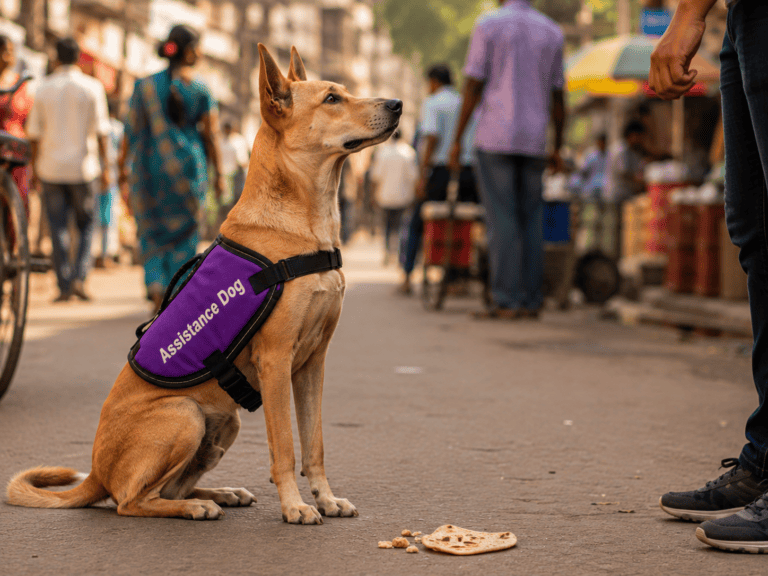
- Mobility support during movement episodes. Functional limb weakness or tremor can arrive unpredictably. During an episode affecting the legs, a dog can retrieve dropped items, open doors, or carry things the handler cannot manage at that moment. For an Indie - a lean, medium-built dog - retrieval, carrying, and door work are well within their capability. Full weight-bearing support while walking is not in our programme; if that is the primary need, a larger specifically assessed dog through a specialist programme would be more appropriate.
- Reducing isolation between episodes. The unpredictability of FND is one of its most disabling features. Not knowing when the next episode will come creates real anxiety and leads many people to restrict their lives - avoiding being alone, avoiding public spaces. A trained response dog provides a safety net that allows some people to live more freely. This is not a clinical research outcome, but it is a real effect described consistently by handlers.
- Medication retrieval and reminders. A dog can be trained to respond to a medication reminder cue, retrieve a pre-identified medication container, or bring a phone or alert device. This supports daily management routines, particularly during periods when cognitive symptoms make self-management harder.
- Psychiatric support tasks. For someone with FND who also experiences significant anxiety, dissociation, or trauma-related symptoms, psychiatric assistance tasks may also be relevant - grounding, interrupting distress cycles, providing pressure during acute anxiety. We covered the broader landscape of psychiatric assistance dogs in an earlier piece.
Service Animals for Neurologic Disorders, MedLink Neurology 2026
The condition people are still told they are imagining
FND sits at the intersection of neurology and psychiatry, and that intersection has historically been a place where patients get lost. Told their symptoms are psychosomatic. Told they are attention-seeking. Told there is nothing wrong at all. The older language - conversion disorder, hysteria, psychogenic - carried implications that the symptoms were not real, which they are. The modern term "functional neurological disorder" reflects a better understanding: something is genuinely wrong with how brain networks are functioning, even if conventional scans look normal.
A 2025 survey of Indian neurologists found persistent challenges in FND care, including widespread myths about the condition, limited access to multidisciplinary teams, and low engagement in FND-specific research and professional societies. This matters because FND requires a particular kind of care - physiotherapy adapted for functional symptoms, psychological treatment, careful medication review - that is not the same as standard neurology management and is not widely available.
An assistance dog does something concrete for a person with an invisible, stigmatised condition: it signals that this person has a disability-related support need. For some people with FND, that signal matters as much as the practical tasks the dog performs.
Current Opinions and Practices in FND: A Survey of Indian Neurologists, PubMed 2025
Common here, rarely named correctly
FND is seen commonly in Indian clinical settings - in neurology clinics, psychiatry services, and paediatric departments. The older terms used in Indian practice - conversion disorder, dissociative disorder, hysteria - refer largely to what is now understood as FND. The shift to the modern FND framework, with its positive diagnostic approach and neurobiological understanding, is happening slowly in India and is still not widely adopted outside specialist centres.
One practical consequence is that some people with functional seizures are initially treated as though they have epilepsy. Antiseizure medicines do not treat functional seizures when epilepsy is not also present, and current clinical guidance specifically recommends against using them for functional seizures alone. When the correct diagnosis eventually comes, access to the specialist multidisciplinary care that FND requires can be difficult, particularly where specialist services are not available.
We have not found a documented FND-specific assistance dog programme in India. At HeartDogs, we are actively thinking about the range of neurological and psychiatric conditions that our programme will eventually support. FND is part of that thinking.
Real tasks, limited evidence, part of a larger plan
Assistance dogs for FND are a plausible and developing application of service dog work. The tasks - episode response, grounding, mobility support during symptomatic periods, medication retrieval, psychiatric support - are specific and trainable. People living with FND are already using dogs for practical support. The evidence base specific to FND is limited, and that should be said clearly.
A dog does not treat FND, alter brain network function, or prevent episodes from occurring. Medical and psychological treatment - which may include specialist physiotherapy, psychological therapy, and careful medication review - remains the foundation of FND care. A well-trained assistance dog is an addition to that foundation, not a substitute for it.
For people with severe FND who are often misdiagnosed, undertreated, and managing a disabling condition without adequate support - knowing that an assistance dog is an option worth exploring may itself be useful information. The dog is not a cure. But for the right person, with the right tasks designed around their specific FND presentation, it can meaningfully change what daily life looks like.
This article is for information only and is not medical advice. Anyone who thinks they might have FND should seek assessment from a neurologist or neuropsychiatrist familiar with the condition. Assistance dog tasks should be designed with qualified professional trainers and, where relevant, the person's clinical team.