The daily reality, not just the clinical definition
POTS is a form of dysautonomia. A commonly used diagnostic criterion is a sustained heart rate increase of 30 or more beats per minute within ten minutes of standing in adults, or 40 bpm in adolescents aged 12 to 19, without significant orthostatic hypotension. Diagnosis also takes symptoms, their duration, and other possible causes of tachycardia into account - it is not made from a single heart-rate reading alone.
POTS symptoms include severe fatigue, light-headedness, brain fog, nausea, and fainting or near-fainting episodes. For many people, symptoms are worst in the morning and after meals. Bending down to pick something up can trigger an episode. Standing in a queue, taking a shower, cooking - all of these may require management strategies that people without POTS often do not have to plan around. Many people with moderate to severe POTS also experience significant anxiety and depression, partly as a consequence of the condition's unpredictability and its impact on employment, relationships, and independence.
Treatment may include individually tailored fluid and salt intake, compression garments, recumbent or graded exercise, medication, and symptom monitoring. Salt and fluid changes should be guided by a clinician because they are not appropriate for everyone. There is no single curative treatment for POTS, although symptoms may improve, fluctuate, or remit for some people over time.
Postural Orthostatic Tachycardia Syndrome, Dysautonomia International
Two categories of work - and why the distinction matters
It helps to separate what a POTS assistance dog does into two categories, because the evidence behind each is different.
Physical assistance tasks are the better-established category. These are tasks that reduce the physical demands or risks of daily life for someone with POTS.
- Stability and counterbalance assistance. For suitably selected and trained dogs, carefully limited counterbalance or stability work may help some handlers manage balance during position changes. This is physically demanding for a dog and requires appropriate dog selection, physical assessment, equipment, and veterinary oversight. Not every dog is suitable, and this should not be confused with full weight-bearing bracing.
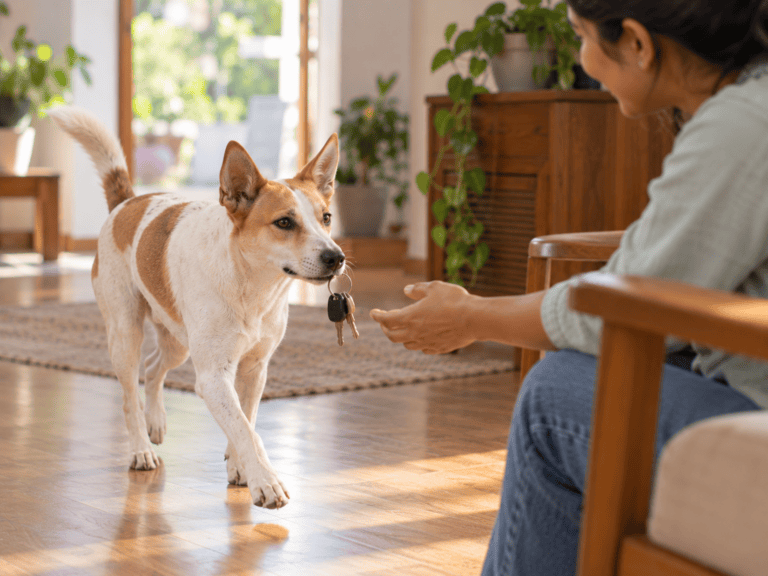
- Retrieval tasks. Bending down to pick up a dropped item is a common trigger for a POTS episode. A trained dog can retrieve dropped objects, carry items, and fetch water, medication, or a phone - removing the need for the handler to bend or move unnecessarily throughout the day.
- Response after a faint. A dog can be trained to remain with the handler, retrieve a phone or emergency item, activate an alert system, or seek another person for help after a collapse.
- Deep pressure and tactile support. Some assistance dogs are trained to provide deep pressure or close physical contact during periods of distress or recovery. This may be comforting for some people, though evidence that it specifically treats POTS symptoms such as tachycardia is limited.
- Cued reminders. The dog can be trained to provide scheduled reminders or respond to a handler's cue to retrieve a pre-identified water bottle or medication container. It cannot determine what treatment the person requires - that remains a medical decision.
- Retrieval and task assistance more broadly. A dog may retrieve items or assist with daily tasks where unnecessary movement would otherwise accumulate and increase symptom burden across the day.
Alerting before an episode is the second category - and the one where the evidence requires more careful handling.
Service Dogs for POTS, Cooperative Paws | POTS Assistance Dogs, Assistance Dogs International
Can a dog detect a POTS episode before it happens?
Some handlers and trainers report that POTS assistance dogs alert before episodes - nudging, pawing, or otherwise signalling the handler to sit or lie down before they consciously notice symptoms. If accurate, this is a meaningful capability: the window between alert and episode gives the handler time to reach a safe position.
A 2021 PLOS ONE online survey of 61 medical alert dog owners recorded reports of dogs alerting to 33 different conditions. Eleven owners reported alerts associated with POTS - making it one of the more frequently reported conditions in that particular survey, though not one of the most clinically validated. The study did not independently verify the alerts, measure sensitivity or specificity, or establish the biological mechanism behind them.
Subsequent research has begun testing POTS alert dogs more objectively. One detailed study, conducted as part of a University of Bristol research programme, observed a single dog across 18 POTS episodes and found trained alert behaviours associated with changes in the handler's heart rate. That is an encouraging early finding, but a sample of one dog is far too small to establish how reliably dogs can detect POTS episodes across different people and conditions. The evidence is still developing.
It is also worth naming an important distinction: there is a difference between a dog detecting an impending episode and a dog responding once an episode has begun. Retrieval, help-seeking, and staying with a person after a collapse are trained response tasks with a straightforward rationale. Pre-episode alerting is a separate capability, and its reliability is still being studied.
The proposed mechanism for alerting involves volatile organic compounds - odour molecules released through sweat or breath as the body's physiology changes. Dogs may also respond to visible changes in posture, breathing, or behaviour that precede an episode. None of these mechanisms has yet been established as the universal explanation for POTS alerts.
POTS is one of the conditions for which canine alerting has been reported and is beginning to be studied objectively. The evidence is still limited and not yet sufficient to establish how reliably dogs detect episodes across different people. Pre-episode alerting should be treated as supplementary to medical monitoring - not as a substitute for prescribed treatment or emergency planning.
Dog Owners' Survey Reveals Medical Alert Dogs Can Alert to Multiple Conditions and Multiple People, PLOS ONE 2021 | Medical Alert Assistance Dogs for POTS Research Programme, Health Research Authority
Looking well while being seriously limited
POTS is an invisible disability. Most people with POTS look fine. They are often young, often women, and their symptoms - dizziness, fatigue, brain fog, difficulty standing - are not visible from the outside. This creates real problems: being disbelieved by doctors, dismissed by employers, and questioned when they use accessibility accommodations or travel with an assistance dog.
For some handlers, the presence of an assistance dog also provides a visible indication that they have a disability-related support need. That can make navigating public spaces, workplaces, and social situations easier, though the dog's primary role remains the trained assistance it provides.
We covered invisible disabilities more broadly in an earlier FootNotes piece. POTS is a particularly clear example of the category: a condition that is serious, physiologically real, and largely invisible to observers.
A condition that exists here - largely unrecognised
POTS clearly exists in India, but reliable national prevalence data are not available. A case series published in 2021, based on patients seen between 2014 and 2017, described itself as the only Indian POTS series available at that time and noted that incidence in the Indian subcontinent had not been systematically studied. Reporting from 2022 found that POTS was appearing in long Covid patients but that awareness among general physicians remained very low - one specialist noted that autonomic dysfunction receives minimal coverage in the MBBS curriculum, meaning most primary care doctors are unlikely to recognise the condition promptly.
Limited awareness and access to autonomic testing - tilt table tests are not widely available outside major centres - may contribute to delayed or missed diagnosis. Symptoms can be attributed to anxiety, anaemia, dehydration, or general weakness rather than to an underlying autonomic disorder, making proper clinical evaluation important for anyone who suspects POTS.
We have not identified a publicly documented POTS assistance dog programme in India. Awareness of assistance dogs as a potential form of support for POTS appears to be very limited. The broader assistance dog infrastructure that would be required - trained dogs, trained handlers, public awareness, legal access frameworks - is itself still being built. At HeartDogs, POTS is one of the conditions we are actively thinking about as we consider what kinds of assistance dogs the programme should eventually train for. Our current focus is Cohort 1, establishing the foundational training model with rescued Indies. Specialised medical alert and assistance work for conditions like POTS is a longer-term direction we are exploring.
POTS and Long Covid in India: Lack of Awareness Delays Diagnosis, Down To Earth 2022
The practical difference, honestly stated
A POTS assistance dog does not treat the underlying condition or replace medical care. Its role is to reduce specific risks and physical demands, and in some cases to provide an earlier warning of an episode.
Retrieving dropped items can reduce the need to bend or squat, which may remove one potential trigger for a particular person. Appropriately trained stability assistance may reduce fall risk for some handlers, though it is not suitable for every dog or every person. Some dogs appear to alert before episodes - where this occurs, it gives time to respond before symptoms escalate, though alert timing and reliability vary and a dog cannot be assumed to detect every episode.
For some handlers, the most important thing may not be any single task but what the presence of a well-trained dog makes possible: going out alone, holding a job, having a life that extends beyond constant supervision or constant fear. A POTS assistance dog does not give the handler a normal autonomic nervous system. But it can return a meaningful amount of the independence that POTS takes away.
This article is educational and is not a diagnosis or treatment plan. Anyone with recurrent fainting, severe palpitations, chest pain, breathlessness, or suspected POTS should seek medical assessment. Assistance-dog tasks for medical conditions should be designed in consultation with qualified clinicians and professional trainers.